


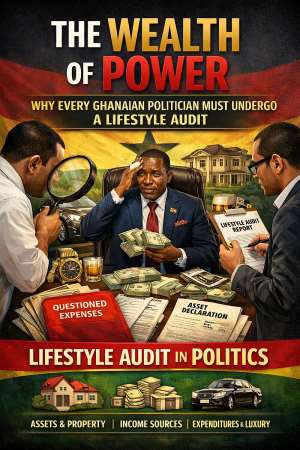
The Unspoken Truth: How Politics Became a Wealth-Building Machine in Ghana
In the quiet corners of Ghanaian homes, the backseats of trotro vehicles, and the late-night debates on social media, a question lingers unspoken but undeniable: Why do politicians emerge from public office richer than the institutions they were elected to serve? The paradox is glaring—while ordinary Ghanaians grapple with rising costs of living, inadequate healthcare, and crumbling infrastructure, a select few political leaders seem to thrive financially, often with little to no explanation for their sudden affluence.
This is not merely about envy or suspicion. It is about accountability—a fundamental pillar of democracy that Ghana has struggled to uphold. For decades, anti-corruption efforts in the country have focused on reactive measures: investigating embezzled funds after they vanish, prosecuting officials after scandals erupt, and exposing mismanagement post-facto. But what if the solution lies not in chasing stolen money, but in preventing the accumulation of unexplained wealth in the first place?
Enter the lifestyle audit—a proactive, transparent tool designed to bridge the gap between a politician’s declared income and the lavish lifestyle they lead. Unlike traditional asset declarations, which often remain confidential or poorly enforced, lifestyle audits publicly scrutinize how public servants live, invest, and accumulate wealth while in office. This approach forces a simple but critical question: Can a politician’s financial growth be justified by their salary, or are they benefiting from something far more sinister?
What Is a Lifestyle Audit, and Why Does Ghana Need It?
A lifestyle audit is a comprehensive, independent assessment that cross-references a politician’s legitimate income, declared assets, and public expenditures against their actual living standards. It goes beyond mere asset declarations by examining:
- Income and Salary Verification: Does the politician’s declared income align with their financial transactions?
- Property and Landed Assets: How many properties do they own, and how were they acquired? Are they all legally obtained?
- Luxury Vehicles and Transportation: Do their cars, boats, or private jets match their official allowances?
- Investments and Business Interests: Do they have stakes in companies, farms, or real estate beyond what their salary could support?
- Domestic and International Travel: Are their frequent flights, hotel stays, and private jet charters justified by their official duties?
- Bank Accounts and Financial Transactions: Are there unexplained deposits, offshore accounts, or sudden wealth transfers?
- Family-Owned Businesses: Do their spouses or relatives operate businesses that benefit from their political connections?
- Gifts and Donations: Are there unexplained cash gifts, “loans,” or “business partnerships” from private entities?
At its core, a lifestyle audit asks: Is this politician’s wealth a product of hard work, transparency, and legal business ventures—or is it built on the backs of public funds?
The Dark Truth: Why Politicians Are Becoming Wealthier Than the Institutions They Lead
Ghana’s political class has long been accused of financial transformation—a dramatic shift from modest beginnings to opulence within years of taking office. Yet, the public rarely receives satisfactory explanations for this phenomenon. Some of the most pressing (and uncomfortable) questions include:
- From Struggle to Sudden Affluence: How does a politician who entered politics with limited resources suddenly own multiple mansions, luxury cars, and offshore investments?
- The Luxury Paradox: Why do politicians campaign in modest vehicles but return to office in convoys of Mercedes, Range Rovers, and private jets?
- The Education Enigma: How do their children secure expensive foreign educations (Oxford, Harvard, or Ivy League schools) when the politician’s declared salary could barely cover basic living expenses?
- The Business Boom: Why do some politicians own multimillion-dollar businesses while their constituents struggle with unemployment and underemployment?
- The Post-Office Fortune: Why do politicians leave office wealthier than when they entered, despite their primary duty being public service?
- The Infrastructure Disconnect: How can a politician build a mansion in Accra while their home constituency’s schools lack desks, hospitals lack medicine, and roads remain impassable?
These are not questions of personal ambition—they are questions of systemic corruption, lack of transparency, and a culture that rewards self-enrichment over service.
How Lifestyle Audits Could Transform Ghana’s Fight Against Corruption
If implemented effectively and transparently, lifestyle audits could radically alter the landscape of political accountability in Ghana. Here’s how:
1. Restoring Public Trust
Ghanaians are disillusioned. They no longer believe that politicians are serving the nation—they suspect many are serving themselves. A publicly accessible lifestyle audit system would:
– Deter corruption by making illicit enrichment visible and punishable.
– Reinforce transparency, proving that public office is not a license to steal.
– Empower citizens with the knowledge to hold leaders accountable.
2. Ensuring Better Use of Public Funds
Every Ghana Cedi spent on roads, schools, hospitals, and jobs should directly benefit the people. Currently, a significant portion of public funds disappears into private pockets through:
– Procurement fraud (overinflated contracts, kickbacks).
– Embezzlement (diversion of funds for personal use).
– Abuse of office (using public resources for private gain).
– Money laundering (hiding illicit gains through shell companies).
Lifestyle audits would expose these gaps, ensuring that taxpayers’ money goes where it is needed most.
3. Boosting Investor Confidence
Ghana’s economic growth depends on foreign and local investment. When corruption is rampant and unchecked, investors hesitate—they fear that their money could be misused or stolen. A strong lifestyle audit framework would:
– Signal to investors that Ghana is serious about transparency.
– Reduce corruption risks, making the country a more attractive destination for business.
– Attract ethical entrepreneurs who want to build, not exploit.
4. Reducing Opportunities for Illicit Enrichment
Corruption thrives in secrecy. When politicians know their financial dealings are under scrutiny, they are less likely to engage in:
– Bribery (paying off officials for contracts).
– Kickbacks (taking a cut from public tenders).
– Conflict of interest (using office for personal gain).
– Money laundering (hiding wealth through offshore accounts).
Countries like Singapore, Norway, and Botswana have successfully implemented asset declaration and lifestyle audit systems, leading to lower corruption rates and higher public trust.
Can Lifestyle Audits Stop Corruption Completely?
No system is perfect, and corruption is highly adaptive. However, lifestyle audits significantly reduce opportunities for abuse by:
– Making corruption visible (when wealth cannot be explained, investigations follow).
– Creating a culture of accountability (politicians think twice before misusing public funds).
– Providing real-time monitoring (instead of reactive investigations).
The biggest weakness of current anti-corruption efforts is delayed action—by the time a scandal breaks, millions (or billions) have already been lost. Lifestyle audits close this gap by preventing corruption before it happens.
Should Lifestyle Audits Be Public? The Case for Transparency
Public office is funded by taxpayers. If citizens pay politicians’ salaries, they have the right to know:
– What assets politicians declared before taking office.
– What they acquired while in office (and how).
– What they own after leaving office.
Secrecy fuels corruption. When asset declarations remain hidden documents, politicians have no incentive to be honest. But when every Ghanaian can see whether a leader’s wealth matches their salary, accountability becomes inevitable.
Countries like South Africa, Kenya, and Rwanda have publicly disclosed asset declarations, leading to greater trust and lower corruption. Ghana must follow suit.
How Could Ghana Implement Effective Lifestyle Audits?
For lifestyle audits to work, they must be:
✅ Independent (conducted by neutral institutions, not political appointees).
✅ Transparent (results publicly available for citizens to verify).
✅ Regular (conducted annually or biennially, not just at the start/end of office).
✅ Technology-driven (using digital platforms for real-time tracking).
A Step-by-Step Framework for Ghana:
- Pre-Office Declaration
-
Politicians must publicly declare:
- Bank accounts (local and offshore).
- Properties (owned or leased).
- Vehicles and luxury assets.
- Business interests and investments.
- Liabilities and debts.
-
During Office Monitoring
-
Independent agencies (like the Election Commission, Anti-Corruption Bureau, or a new Lifestyle Audit Authority) should:
- Track major financial transactions (sudden deposits, large purchases).
- Verify procurement deals (are contracts awarded to related parties?).
- Check tax compliance (are they paying their fair share?).
- Monitor international travel (are frequent flights justified by official duties?).
-
Post-Office Exit Audits
- When a politician leaves office, they must submit a final asset declaration.
-
If unexplained wealth is found, investigations must follow, leading to legal consequences (fines, asset forfeiture, or imprisonment).
-
Digital Public Portal
- Ghana should launch a secure, user-friendly website where citizens can:
- View politicians’ asset declarations (before, during, and after office).
- Compare wealth growth (e.g., “This MP declared GH₵50,000 in 2016 and now owns GH₵50 million in assets”).
- Report suspicious activities (whistleblower protections for citizens).
The Role of Technology in Combating Corruption
Ghana is tech-savvy, and digital solutions can revolutionize transparency. Possible innovations include:
– Blockchain for Asset Tracking: Ensuring immutable records of asset declarations.
– AI-Powered Fraud Detection: Flagging suspicious financial patterns (e.g., sudden offshore transfers).
– Real-Time Spending Alerts: Notifying authorities if a politician’s lifestyle exceeds their declared income.
– Citizen Reporting Tools: Allowing anonymous tips on corruption via a secure app.
Imagine a future where:
✔ Every Ghanaian can see whether their MP’s wealth growth matches their salary.
✔ Public projects are funded without kickbacks or embezzlement.
✔ Politicians enter office knowing that unexplained wealth will trigger investigations.
This is not just possible—it is necessary.
What Are Ghanaians Saying? The Growing Demand for Accountability
Across town halls, radio shows, and social media, the sentiment is clear:
– “Why do politicians live like kings while we struggle?”
– “Where is the money meant for our schools and hospitals?”
– “If you want to serve, prove it—don’t just talk about it.”
– “We don’t need empty promises; we need action.”
The public is tired of broken promises. They want leadership that prioritizes service over self-interest. The growing movement for transparency is not just about punishing the guilty—it is about building a Ghana where honesty is rewarded, and corruption is punished.
What Are Politicians Saying? The Pushback and Counterarguments
Not all politicians support lifestyle audits. Some arguments against them include:
1. “It’s Politically Motivated” – Critics claim audits could be used to target opponents.
– Response: Independent, professional audits (like those in Singapore or Norway) are not political tools—they are legal requirements.
- “It Violates Privacy” – Some argue that personal finances should not be public.
-
Response: Public office is not private—it is funded by public money. Privacy ends where public interest begins.
-
“Asset Declarations Already Exist” – Why do we need lifestyle audits if politicians declare assets?
-
Response: Current declarations are weak—they are not verified, not public, and not enforced. Lifestyle audits close these gaps.
-
“Anti-Corruption Agencies Should Be Strengthened Instead” – Some believe better laws and enforcement are the solution.
- Response: Stronger laws alone are not enough—transparency and real-time monitoring are critical.
The real question is not whether lifestyle audits are necessary, but whether Ghana is willing to implement them fairly and effectively.
What Is the Government Doing? A Mixed Record of Progress
Successive Ghanaian governments have taken steps toward accountability:
– Asset Declaration Laws (since 2003, with weak enforcement).
– Anti-Corruption Agencies (Election Commission, Anti-Corruption Bureau, Public Procurement Authority).
– Financial Auditing Mechanisms (Audit Service, Internal Revenue Service).
– Public Financial Management Reforms (efforts to reduce leakage).
However, the problem remains: implementation is inconsistent, investigations take years, and many cases go unresolved. Without real-time transparency, corruption continues unchecked.
A Vision for a New Ghana: Where Honesty Is Rewarded
Imagine a Ghana where:
✅ Every minister, MP, and local chief executive undergoes mandatory lifestyle audits.
✅ Citizens can track how their tax money is spent—no more mysteries.
✅ Politicians who enter office poor leave office with honest wealth (or less).
✅ Corruption becomes harder than honesty—because every move is monitored.
✅ Public projects are completed—no more abandoned roads, schools, or hospitals.
✅ Ghana’s youth have jobs—because public funds are used for development, not personal gain.
This is not a distant dream—it is a realistic possibility if Ghana commits to lifestyle audits.
Final Thoughts: The Choice Before Ghana
Ghana is not lacking in resources. It is not lacking in talent. It is not lacking in opportunities.
What Ghana often lacks is accountability.
The greatest tragedy of corruption is not the money stolen—it is the dreams stolen from millions of Ghanaians who deserve better. Every unexplained mansion, luxury car, or offshore account built on public funds is a stolen future for a child who cannot afford school fees, a farmer who lacks irrigation, or a worker who struggles to find a job.
Lifestyle audits are not about embarrassing politicians. They are about:
✔ Protecting democracy from self-serving leaders.
✔ Preserving public trust in institutions.
✔ Ensuring that leadership remains a sacred responsibility, not a lucrative business.
If a politician’s wealth is honestly earned, then a lifestyle audit becomes a badge of honor—proof that they served well.
But if public office has become a pathway to unexplained riches, then every Ghanaian deserves to know.
The real question is no longer whether Ghana needs lifestyle audits.
The question is: If politicians have nothing to hide, why should they fear transparency?
By: Patrick Belebang Yagsori
+233240292413
[email protected]
