


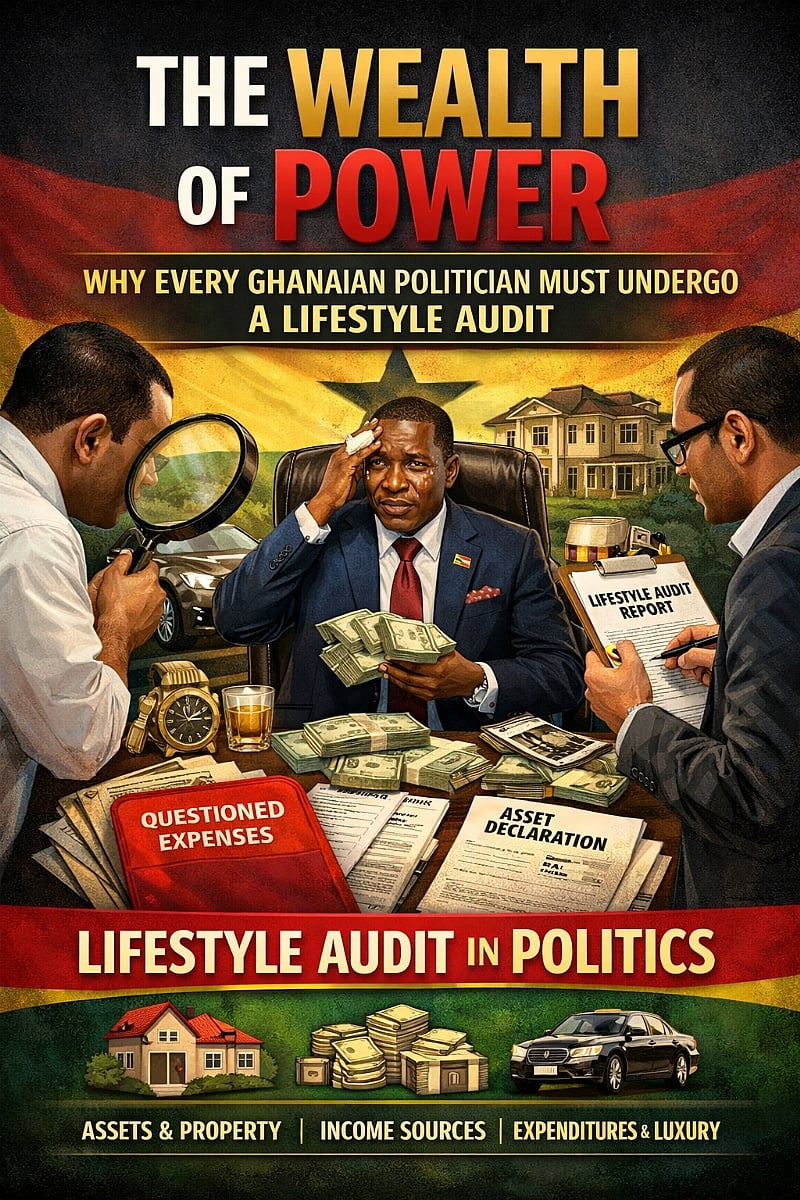
In the heart of every Ghanaian home, taxi ride, and social media debate, a question lingers unspoken but undeniable: “If politics is meant to serve the people, why do so many politicians emerge from office wealthier than the institutions they were elected to lead?” This is not merely a matter of curiosity—it is a cry for justice, a demand for transparency, and a call to dismantle the systemic corruption that has plagued Ghana’s democratic progress.
For decades, Ghana has grappled with corruption scandals, embezzlement, and the mysterious accumulation of wealth by public officials. Yet, the nation’s anti-corruption efforts have largely focused on reactive investigations—uncovering missing funds after the fact rather than preventing the wealth-building machinery that fuels corruption in the first place. The time has come to shift the paradigm. Instead of asking, “Where did the money go?” we must ask: “Where did the money come from—and how did it get there?”
The answer lies in lifestyle audits—a rigorous, independent assessment of a politician’s financial dealings that compares their declared assets, income, and public salary against the extravagant lifestyles they lead. This is not about suspicion; it is about democratic accountability.
What Is a Lifestyle Audit?
A lifestyle audit is a comprehensive financial forensic examination that scrutinizes every aspect of a politician’s economic activity. Unlike traditional asset declarations, which are often incomplete or manipulated, lifestyle audits go deeper by cross-referencing:
- Income and Salary: Verifying whether declared earnings align with actual financial inflows.
- Properties and Landed Assets: Investigating the ownership of multiple homes, commercial properties, and undeclared landholdings.
- Luxury Vehicles and Transportation: Examining the acquisition of high-end cars, private jets, and armored convoys—often funded by public funds.
- Investments and Business Interests: Uncovering hidden directorships, shell companies, and offshore accounts.
- Domestic and International Travel: Auditing first-class flights, private residences abroad, and lavish vacations.
- Bank Accounts and Financial Transactions: Tracking suspicious deposits, untraceable transfers, and sudden wealth spikes.
- Family-Owned Assets: Investigating whether spouses, children, or relatives have benefited from public office through undeclared wealth transfers.
- Gifts and Donations: Ensuring that “generous” contributions from businesses or foreign entities do not mask kickbacks or bribes.
At its core, a lifestyle audit asks one critical question: “Can this politician’s wealth be reasonably explained by their legitimate income?” If the answer is no, then the public has the right to demand answers.
Why Are Lifestyle Audits Necessary for Ghana?
Ghana’s political landscape is riddled with contradictions:
- Politicians who entered office with modest means suddenly own multi-million-dollar mansions, private schools, and offshore accounts.
- Public servants who campaigned on promises of development return to their constituencies with luxury vehicles and foreign passports, while basic infrastructure remains neglected.
- Children of politicians attend expensive international schools—far beyond what their parents’ declared salaries could afford.
- Public funds meant for roads, hospitals, and schools vanish into private bank accounts, while politicians live in fortified estates with 24/7 security.
These are not isolated incidents. They are systemic patterns that suggest a culture of impunity—where public office is treated as a personal ATM rather than a sacred trust.
Lifestyle audits are not about personal attacks or political vendettas. They are about restoring faith in democracy. If implemented effectively, they could:
- Deter Corruption – Politicians would think twice before misusing public funds if they know their every financial move is under scrutiny.
- Improve Public Service Delivery – Funds allocated for healthcare, education, and infrastructure would be less likely to be diverted into private pockets.
- Boost Investor Confidence – Foreign and local investors would be more willing to commit capital to Ghana if they see transparency in leadership.
- Reclaim Public Trust – Ghanaians would no longer feel betrayed by leaders who promise development but deliver luxury.
Without such audits, corruption thrives in secrecy. Lifestyle audits expose the truth—and truth is the first step toward justice.
Can Lifestyle Audits Really Stop Corruption?
Corruption is adaptive—it evolves to avoid detection. However, lifestyle audits disrupt its cycle by:
- Exposing Bribery Schemes – If a politician’s wealth cannot be explained, investigators can legally demand answers.
- Unmasking Procurement Fraud – Sudden wealth spikes often correlate with suspicious government contracts.
- Preventing Embezzlement – Public officials would hesitate to steal if they know their assets are continuously monitored.
- Stopping Money Laundering – Offshore accounts, shell companies, and untraceable transactions become harder to conceal.
- Reducing Conflict of Interest – Politicians would avoid self-dealing if their financial dealings are publicly scrutinized.
Countries like South Africa, Kenya, and Nigeria have already implemented asset declaration and lifestyle audit systems, leading to greater transparency and reduced corruption. Ghana must follow suit.
Should Lifestyle Audits Be Public?
Absolutely.
Public office is funded by taxpayers. If citizens pay politicians’ salaries, they have the right to know:
- What assets politicians declared before taking office.
- What they acquired while in power.
- What they own after leaving office.
Transparency is the cornerstone of democracy. If asset declarations remain hidden documents, they become tools of corruption rather than mechanisms of accountability.
Ghanaians deserve real-time access to financial disclosures. A digital public portal—where citizens can track politicians’ wealth changes—would be a game-changer in the fight against corruption.
How Can Lifestyle Audits Be Conducted Effectively?
A well-structured lifestyle audit system should operate in three phases:
1. Before Assuming Office
Politicians must declare:
– All bank accounts (local and offshore).
– Properties, vehicles, and businesses owned.
– Investments, debts, and liabilities.
– Family assets (to prevent wealth transfers).
2. During Office
Independent institutions (such as the Anti-Corruption Bureau and the Auditor-General’s Office) must monitor:
– Major financial transactions (sudden deposits, large purchases).
– Procurement deals (conflicts of interest, over-invoicing).
– Tax compliance (unpaid taxes, hidden income).
– Business interests (directorships in companies receiving public contracts).
3. After Leaving Office
An exit audit should verify:
– Final asset declarations (comparing pre- and post-office wealth).
– Financial investigations (if unexplained wealth is detected).
– Consequences for discrepancies (legal action, asset forfeiture).
Regular audits (every two years) would make corruption far harder to conceal.
Can Technology Strengthen Lifestyle Audits?
Yes—and it must.
Ghana should establish a digital transparency platform where citizens can:
– View declared assets in real time.
– Track wealth changes over time.
– Monitor public contracts for suspicious dealings.
– Access financial disclosures of all political office holders.
Imagine a system where:
– A citizen could compare a minister’s declared salary with their accumulated wealth in four years.
– Every purchase of a luxury vehicle is publicly logged.
– Offshore accounts are automatically flagged if they exceed declared income.
Technology is not just a tool—it is a weapon in the fight against corruption.
What Are Ghanaians Saying?
The frustration among ordinary Ghanaians is palpable. In town halls, radio debates, and social media, citizens repeatedly ask:
- “Why do politicians live in luxury while our roads are potholed?”
- “Why do public funds vanish while politicians buy private jets?”
- “Why do corruption scandals keep emerging despite laws?”
- “Is politics really the fastest way to get rich?”
The demand is clear: “If you want to serve the people, prove you are serving—not stealing.”
Ghanaians are tired of broken promises. They want stronger anti-corruption measures, real transparency, and meaningful consequences for illicit enrichment.
What Are Politicians Saying?
Opinions are divided:
- Some support lifestyle audits, arguing they strengthen accountability.
- Others resist, claiming:
- “Lifestyle audits are politically motivated.”
- “They violate privacy rights.”
- “Asset declarations already exist—why complicate things?”
These concerns are valid but misplaced. Lifestyle audits must be:
– Independent (not politically biased).
– Professional (conducted by experts, not partisan investigators).
– Focused on accountability, not persecution.
The goal is not to punish politicians—it is to ensure they serve the public, not themselves.
What Is the Government Doing?
Successive governments have introduced:
– Asset declaration laws (though enforcement is weak).
– Anti-corruption agencies (but investigations are slow).
– Financial auditing mechanisms (but many cases go unresolved).
The problem is implementation. Laws on paper are useless without enforcement.
If Ghana wants to seriously fight corruption, it must:
– Strengthen the Anti-Corruption Bureau with real investigative power.
– Mandate lifestyle audits for all public officials.
– Make asset declarations public—not just for show.
– Introduce digital transparency to prevent corruption before it happens.
Imagine a New Ghana
What if:
– Every minister, MP, and public official underwent mandatory lifestyle audits?
– Citizens could track how much wealth a politician gained or lost in office?
– Unexplained wealth automatically triggered investigations?
– Politicians knew that corruption would be their downfall?
In this Ghana:
– Public projects would finally be completed.
– Hospitals and schools would receive proper funding.
– Youth would have jobs instead of begging for opportunities.
– Development would happen at the speed we all desire.
Corruption is not just about money—it is about stolen dreams. Every Ghanaian deserves:
– Clean water.
– Safe roads.
– Quality education.
– A future where their children do not have to leave the country for opportunities.
Lifestyle audits are not about shaming politicians. They are about protecting democracy, restoring trust, and ensuring that leadership remains a sacred responsibility—not a lucrative business.
If a politician’s wealth is honestly earned, then a lifestyle audit becomes a badge of integrity.
But if public office has become a pathway to unexplained riches, then every Ghanaian deserves to know.
The question is no longer whether Ghana needs lifestyle audits.
The real question is:
“If politicians have nothing to hide, why should they fear transparency?”
