


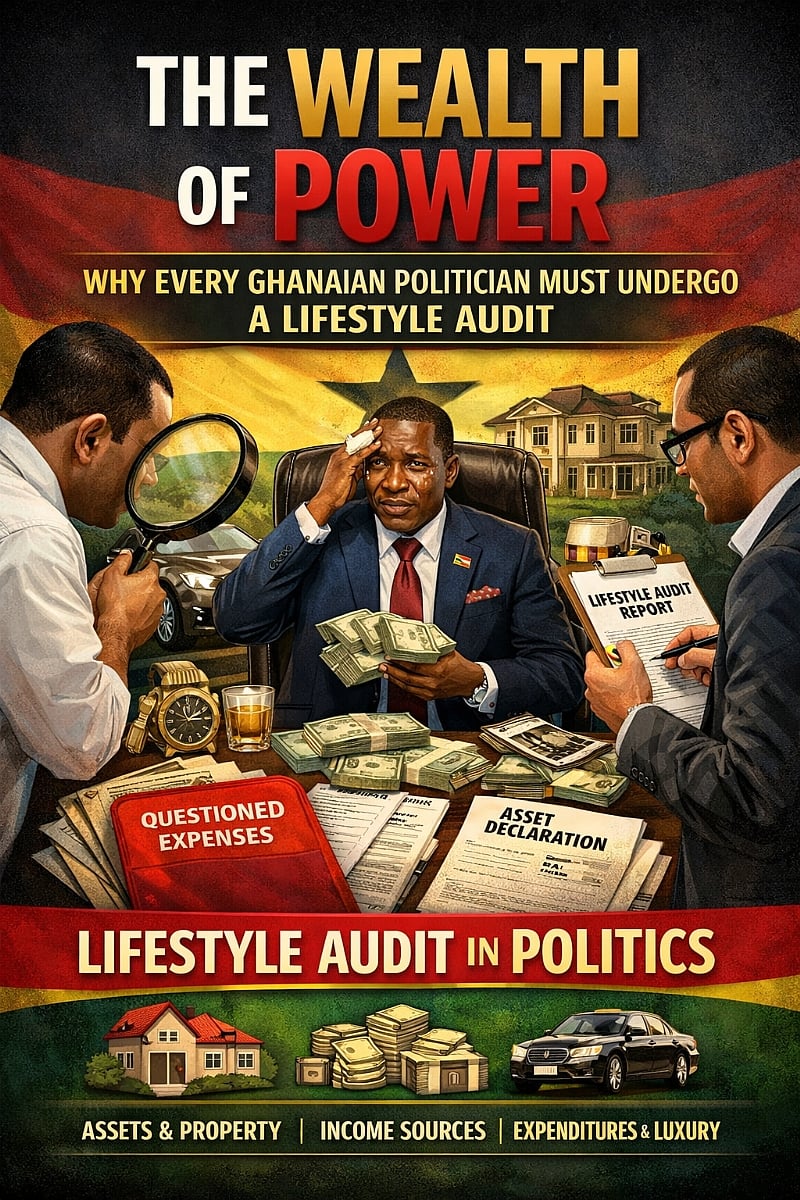
In the heart of every Ghanaian community, there is an unspoken yet pervasive question that lingers like a shadow over the nation’s political landscape: “How does a politician who once struggled to make ends meet suddenly own mansions, luxury cars, and international assets within a few years of taking office?” This question is not one of envy or malice, but of accountability—a fundamental pillar of democracy that has been systematically eroded by unchecked wealth accumulation among public officials.
Ghana’s fight against corruption has historically been reactive, focusing on investigations after funds disappear rather than preventing the accumulation of wealth in the first place. Yet, the real question remains: Where does the wealth come from before it becomes untraceable? The answer lies in lifestyle audits—a proactive, transparent mechanism that could reshape Ghana’s political and economic future.
What Is a Lifestyle Audit?
A lifestyle audit is a rigorous, independent assessment that cross-references a politician’s declared income, assets, and financial transactions against the lifestyle they publicly exhibit. Unlike traditional financial audits, which focus on accounting discrepancies, lifestyle audits examine the gap between declared wealth and observable affluence.
Key areas of scrutiny include:
– Income and Salary: Verification of declared salaries, bonuses, and allowances against actual spending patterns.
– Properties and Landed Assets: Comparison of registered property ownership with visible residential and commercial holdings.
– Luxury Vehicles and Transportation: Analysis of declared vehicles against high-end car registrations, private jets, or yachts.
– Investments and Business Interests: Examination of declared business ventures against unexplained wealth in private enterprises.
– Domestic and International Travel: Scrutiny of declared travel expenses against first-class flights, private residences abroad, or elite educational institutions for children.
– Bank Accounts and Financial Transactions: Cross-checking of declared accounts with high-value deposits, offshore assets, or suspicious financial flows.
– Family-Owned Assets: Assessment of spouses’ or relatives’ wealth accumulation during the politician’s tenure.
– Gifts and Donations: Investigation of unexplained transfers, “donations,” or assets received while in office.
At its core, a lifestyle audit asks a simple yet profound question: “Can this individual’s wealth be reasonably explained by their legitimate income?” If the answer is no, then the public has a right to demand answers.
Why Should Politicians Undergo Lifestyle Audits?
The core principle of public service is sacrifice—the idea that those who lead should prioritize the collective good over personal gain. Yet, in Ghana, politics has become synonymous with rapid wealth accumulation, raising critical questions:
- How does a politician who entered office with modest means suddenly own multiple properties, private schools, and offshore accounts?
- Why do some politicians’ children attend elite international universities while their constituents struggle with underfunded public schools?
- How do public officials justify owning luxury vehicles and mansions while basic infrastructure—like roads, healthcare, and education—remains neglected?
- Why do politicians’ fortunes grow exponentially after leaving office, often through unexplained business ventures?
These are not questions of paranoia or suspicion—they are questions of governance. If politics is truly about service, then politicians must prove that their wealth is earned through legitimate means, not siphoned from public resources.
The Cost of Unchecked Wealth: Why Ghana Cannot Afford Silence
The consequences of allowing politicians to accumulate wealth without scrutiny are devastating for national development:
- Erosion of Public Trust
-
When citizens see their leaders living in opulence while public services collapse, distrust deepens. Surveys consistently show that Ghanaians rank corruption as one of their top concerns, yet little is done to hold leaders accountable in real time.
-
Misallocation of Public Funds
-
Billions of cedis meant for healthcare, education, and infrastructure are diverted into private bank accounts, shell companies, and offshore havens. Lifestyle audits would expose mismanagement and redirect resources where they are needed most.
-
Deterrence of Foreign and Local Investment
-
Investors—both domestic and international—hesitate when corruption is rampant. A country where politicians’ wealth grows disproportionately while institutions fail sends a clear signal of instability. Transparency through lifestyle audits would restore investor confidence.
-
Normalization of Corruption
-
When unexplained wealth is not questioned, it becomes acceptable. Politicians who see others getting away with embezzlement are less likely to hesitate. Lifestyle audits would send a message: Corruption will not be tolerated.
-
Undermining Democratic Values
- Democracy thrives on transparency and accountability. When leaders hide their financial dealings, they erode the very foundation of trust that sustains a functioning society.
Can Lifestyle Audits Really Stop Corruption?
While no single measure can eliminate corruption entirely, lifestyle audits would significantly reduce opportunities for illicit enrichment by:
– Exposing bribery and kickbacks through inconsistent wealth patterns.
– Detecting embezzlement by comparing declared salaries to lavish lifestyles.
– Preventing money laundering by tracking unexplained asset transfers.
– Reducing conflict of interest by monitoring business dealings during and after office.
– Deterring abuse of office when politicians know their financial activities are publicly scrutinized.
Countries like South Africa, India, and the Philippines have implemented asset declaration and lifestyle audits with varying degrees of success. While challenges remain—such as political resistance and enforcement gaps—the psychological impact on potential corruptors is undeniable. If a politician knows their every purchase, property, and investment will be examined, they are far less likely to steal.
Should Lifestyle Audits Be Public?
Absolutely. Public office is funded by taxpayers, and citizens have a right to know how their money is being used—or misused.
Key reasons for public disclosure:
– Accountability: If politicians’ assets are publicly declared and audited, they cannot hide behind private bank accounts or shell companies.
– Deterrence: The fear of public scrutiny acts as a strong deterrent against corruption.
– Participatory Governance: When citizens can track their leaders’ wealth, they become active participants in governance, not passive observers.
– Legitimacy: Transparency restores faith in institutions and proves that leaders are serving the people, not themselves.
Currently, Ghana’s asset declaration system exists on paper but lacks real-time monitoring and public access. A digital portal where citizens can track politicians’ wealth over time would be a game-changer in the fight against corruption.
How Can Lifestyle Audits Be Effectively Conducted?
For lifestyle audits to be effective, they must be structured, independent, and technologically supported. A three-phase approach would work best:
1. Pre-Office Declaration (Before Taking Office)
Before assuming office, politicians should mandatorily declare:
– All bank accounts, properties, vehicles, and investments.
– Business interests (including family-owned enterprises).
– Liabilities and debts.
– Tax compliance records.
This baseline data would later be compared against their post-office wealth to detect unexplained increases.
2. In-Office Monitoring (During Tenure)
Independent anti-corruption agencies (such as the Election Commission, Accountant-General’s Department, and the National Security) should:
– Audit major financial transactions (e.g., sudden property purchases, luxury vehicle registrations).
– Monitor procurement deals for conflicts of interest.
– Verify tax filings to ensure no underground income is being hidden.
– Track international assets (e.g., offshore accounts, foreign properties).
Regular audits (every 1-2 years) would prevent last-minute wealth transfers before elections.
3. Post-Office Investigation (After Leaving Office)
Even after leaving office, politicians should be required to:
– Submit exit asset declarations within 30 days of resignation.
– Face financial investigations if unexplained wealth is detected.
– Return ill-gotten gains if proven corrupt.
Independent verification by international auditors (e.g., KPMG, PwC) would add credibility to the process.
The Role of Technology in Combating Corruption
Ghana is well-positioned to leverage digital innovation to strengthen financial transparency. A unified digital platform could:
– Aggregate and verify asset declarations in real time.
– Allow citizens to track politicians’ wealth changes via a public dashboard.
– Flag suspicious transactions using AI and machine learning.
– Publish annual reports on wealth accumulation trends.
Countries like Estonia and Denmark have successfully implemented digital governance tools that enhance transparency. Ghana could adopt a similar model, ensuring that no politician can hide behind “privacy” or “lack of records.”
What Are Ghanaians Saying? A Cry for Accountability
Across town halls, social media, and public debates, Ghanaians are united in their frustration:
- “Why do politicians live like kings while our roads are potholes?”
- “How can someone who earned GH¢50,000 a year suddenly own a GH¢1 million mansion?”
- “Why do corruption scandals keep emerging, yet no one is held accountable?”
- “If you want to serve, prove it—don’t steal from the people who elected you.”
The public demand is clear: Stronger anti-corruption measures, real-time transparency, and consequences for illicit enrichment.
Yet, politicians remain divided on the issue:
– Some support lifestyle audits, arguing they are necessary for accountability.
– Others resist, claiming:
– “It’s politically motivated.”
– “It violates privacy.”
– “Asset declarations already exist—why more?”
However, existing laws are not enough. Without mandatory, independent, and public audits, corruption will continue to thrive in secrecy.
What Is the Government Doing? A Patchwork of Policies, Not Solutions
Successive governments have introduced anti-corruption measures, including:
– Asset declaration requirements (though enforcement is weak).
– Strengthened anti-corruption agencies (e.g., Election Commission, Anti-Corruption Bureau).
– Procurement reforms to reduce kickbacks and nepotism.
– Financial auditing mechanisms (though delays and inconsistencies persist).
The problem? Implementation is inconsistent, and most cases take years to resolve. By then, corrupt officials have already fled with their ill-gotten gains.
A true commitment to transparency would require:
– Legislative amendments to mandate lifestyle audits.
– Budget allocation for independent auditing bodies.
– Public access to real-time financial data.
– Strict penalties for false declarations or concealment.
Imagine a New Ghana: Where Accountability Prevails
What if every minister, MP, and public official underwent mandatory lifestyle audits? What if every Ghanaian could track their leader’s wealth from day one in office?
In this new Ghana:
– Public projects would be completed because funds would not be diverted.
– Hospitals would be well-equipped because corruption would be minimized.
– Schools would improve because education budgets would not be embezzled.
– Youth would have jobs because economic resources would not be siphoned abroad.
– Politicians would think twice before stealing because their actions would be publicly exposed.
This is not utopian thinking—it is realistic governance. Countries like Singapore and Botswana have proven that transparency and accountability lead to sustainable development.
Final Thoughts: The Choice Before Ghana
Ghana is not lacking in resources. We have bright minds, untapped potential, and abundant opportunities. But what we lack is accountability—the glue that holds democracy together.
The real tragedy of corruption is not just the money stolen—it is the dreams stolen from millions of Ghanaians who watch their leaders grow rich while they struggle. Lifestyle audits are not about shaming politicians—they are about protecting democracy, restoring trust, and ensuring leadership is a sacred responsibility, not a lucrative business**.
If a politician’s wealth is honestly earned, then a lifestyle audit becomes a badge of integrity. But if public office has become a path to unexplained riches, then every Ghanaian deserves to know.
The question is no longer “Can Ghana afford lifestyle audits?”—it is:
“If politicians have nothing to hide, why should they fear transparency?”
The answer lies in one simple truth: A nation that does not hold its leaders accountable will never achieve the development it deserves. The time for lifestyle audits is now.
