


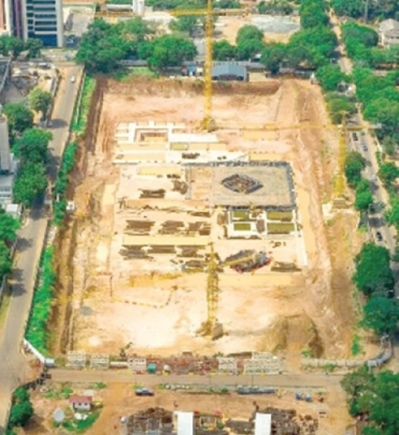
Ghana’s stalled national cathedral is an issue of immense public concern and controversy, for two reasons: first, it is unclear if anyone will be prosecuted for what the Commission on Human Rights and Administrative Justice (CHRAJ) has identified as severe procurement breaches in the construction process, recommending that the Board of Trustees be investigated.
Second, what has been called President Akufo-Addo’s ‘vanity project’ – with the state inappropriately contributing tens of millions of dollars – is widely regarded as entirely unfitting at a time of soaring price inflation, rising unemployment and public utilities’ decline.
Critics contend that the national cathedral project led to an unacceptable financial ‘hit’ for the country, as the government struggled with international indebtedness and was compelled to seek a multibillion-dollar IMF bailout.
CHRAJ findings on national cathedral project
The National Democratic Congress (NDC), in opposition during the first nine years of the national cathedral project (2016-2024), labelled the national cathedral project a ‘misuse of taxpayer funds’.
The NDC questioned the Akufo-Addo government’s priorities amid serious economic challenges.
Prior to the December 2024 elections, the NDC vowed to halt the national cathedral and to expose what it claimed was serious corruption in its preparation and construction.
Following a petition by the current Foreign Minister and MP for North Tongu, Samuel Okudzeto Ablakwa, CHRAJ investigated the national cathedral project and reported back in November 2024.
CHRAJ uncovered serious procurement breaches, ruled the cathedral’s construction contract to be illegal, referred the Board of Trustees for further investigation, and recommended a full-scale forensic audit of all national cathedral funds by the Auditor-General.
CHRAJ concluded that the $312 million construction contract awarded to Ribade Company Limited was void ab initio because it was granted without securing the required approval from the Central Tender Review Committee.
Taking over from the NPP in government, the NDC administration ordered a complete halt and forensic audit of the national cathedral project, dissolved the overseeing secretariat, and tasked the Attorney General with legally terminating national cathedral contracts to prevent further financial losses to the state.
Deloitte audit
The Mahama government’s decisive actions followed an audit by Deloitte that uncovered significant financial irregularities and procurement breaches, with an estimated $97 million spent on the site before construction progressed beyond the initial foundation. Ongoing legal and financial investigations aim to ensure accountability for the previously disbursed funds.
The Deputy Attorney General and Minister for Justice, Dr Justice Srem-Sai, provided the most recent public update on the state’s investigation into the national cathedral project in December 2025. Interviewed on GHOne TV, Dr Srem-Sai indicated that wrongdoing in relation to the national cathedral project involved the use of state funds without the requisite approval.
Dr Srem-Sai added that continuing audit of the books of the cathedral was to find out the total amount of money that was committed without necessary approval.
Despite intense public speculation, investigations into the national cathedral project do not appear to have been delayed by the government’s anti-corruption drive.
The national cathedral investigation was absorbed as one of the primary targets of the ORAL (Operation Recover All Loot) initiative.
ORAL, it will be recalled, is a major anti-corruption initiative launched by President Mahama to investigate, track and reclaim misappropriated state assets and funds.
It primarily targets corruption and ‘state capture’ linked to politically exposed persons from the previous administration
National Cultural Convention Centre
President John Mahama announced in July 2025 that the abandoned national cathedral site will be converted into a National Cultural Convention Centre (NCCC). The new centre will feature a multipurpose arena, amphitheatre, exhibition pavilions, and a creative economy hub.
The project forms part of President Mahama’s 24-hour economy plan to promote Ghana’s culture, arts, sports, and tourism.
The NCCC, envisaged as the flagship hub for Ghana’s burgeoning creative economy and cultural diplomacy efforts, will be established in partnership with the African Union-instigated African Continental Free Trade Area Secretariat.
The government hopes that it will become Africa’s leading venue for international exhibitions, film festivals, trade shows and summits.
Feasibility studies are running during 2026, with the full commissioning of the centre expected between 2028 and 2030.
A decade after President Akufo-Addo announced the National Cathedral as his personal thanks to God for winning the 2016 presidential election, Ghanaians have nothing to show for the expenditure of $97 million beyond a massive hole in the ground in central Accra.
That sum could pay for five or six fully equipped district hospitals or 600 primary schools.
While the anticipated cost of the National Cultural Convention Centre has not (yet) been announced, judging by the artist’s impression of the completed project, it will be massive, and the associated cost necessarily substantial.
Without public debate, it is not known how Ghanaians feel about hundreds of millions of dollars being spent on NCCC when, despite Ghana’s ‘reset’, so much remains to be done in relation to education, health and other essential public services.
The writer is an Emeritus Professor of Politics, London Metropolitan University, UK
