


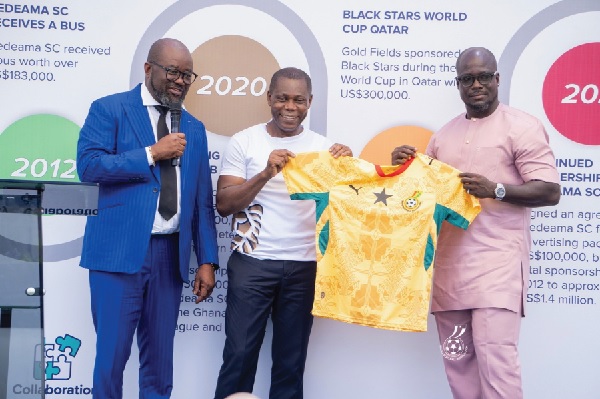
When Gold Fields Ghana Limited unveiled a $5million investment into Ghana football two weeks ago to cover the Black Stars, Black Queens, Black Challenge and the Women’s Premier League, the mining firm extended its foothold and influence in Ghana sports and in its areas of operations.
The new deal ranks among the most significant corporate investments in Ghana football in recent years and arrives at a pivotal moment, as the Black Stars build up towards the 2026 FIFA World Cup and the Black Queens intensify preparations for the Women’s Africa Cup of Nations.
Beyond the headline figure, the deal signals a deeper strategic alignment between one of Ghana’s biggest mining firms and the country’s football ecosystem, spanning elite national teams, women’s football and disability sports.
For the Senior Vice-President and Managing Director of Gold Fields Ghana, Elliot Twum, the newest deal is a further testament to the company’s commitment to sports development in Ghana over the last two decades, with investment spread into football, golf and infrastructure development.
From its backing of the Black Stars, Black Queens and Ghana’s national amputee football team, to its support for uncrowned 2025/26 Ghana Premier League champions Medeama SC, golf development initiatives, and the construction of a modern $16 million sports arena within its key operational enclave, the mining giant has consistently viewed sports investment through a far broader lens than short-term commercial returns.
Indeed, with an estimated $37.5 million channelled into sports development over the past two decades, the company’s strategy has increasingly reflected a long-term commitment to community impact, national development, youth empowerment and the creation of sustainable sporting ecosystems, rather than opportunistic brand visibility alone.
“We cannot simply come in when things are good and disappear when times are difficult,” Mr Twum said. “We have to remain consistent in supporting the teams, and over time that consistency will produce consistent results.”
Strategy, Not Charity
What distinguishes Gold Fields Ghana from the opportunistic wave of sponsors is the philosophical framework that sits behind its investments. For Mr Twum, sports investment is an extension of the firm’s core business rationale, not a philanthropy line item.
“Our participation in sports is strategic because we create value and believe in sharing the value we create through mining. Sports offers opportunities to people who otherwise may never have reached certain levels in society,” Mr Twum explained to the Graphic Business.
This framing of sports as a vehicle for social mobility and shared prosperity is fundamentally different from the transactional philosophy that drives most corporate sponsorships. Gold Fields Limited, according to its CEO, integrates its sports portfolio into its broader Environmental, Social, and Governance framework, treating each investment as a platform for value creation, diversity, inclusion, and community development.
Relationship built on substance
Gold Fields’ renewed investment in football and rekindled partnership with the Black Stars is rooted in a long-standing strategic commitment rather than corporate opportunism. The mining firm has been part of Ghana’s World Cup journey since the nation’s historic debut at Germany 2006.
That commitment was firmly established in 2005 when Gold Fields signed a landmark three-year sponsorship agreement with the Ghana Football Association as headline sponsor of the Black Stars, injecting $5 million annually into the national team in one of the biggest sports sponsorship deals Ghana had witnessed at the time.
For many industry observers, it represented strategic and transformational interventions in Ghana sports, as the partnership addressed some of the Black Stars’ most critical operational and performance needs.
Those interventions proved instrumental in stabilising the team’s high-performance environment and ultimately played a significant role in Ghana’s historic maiden qualification to the FIFA World Cup.
What began as a three-year agreement was subsequently renewed and extended through to 2012, shifting the model from symbolic brand association to long-term, performance-driven investment with measurable national impact.
