


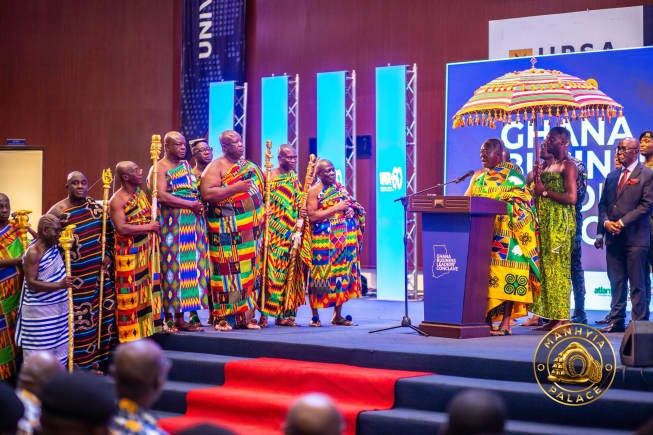
The Asantehene, Otumfuo Osei II, has said for almost 70 years the country has been talking but it is now time for it to become a nation of builders.
“We must move from slogans to production, from lamentations to enterprise, from dependency to value creation, from promises to hard road work with discipline, sacrifice and innovation,” he said.
The Asantehene was delivering a public lecture at the maiden “Ghana Business Leaders’ Conclave” in Accra last Friday.
The Otumfuo Centre for Traditional Leadership (OCTL) of the University of Professional Studies, Accra (UPSA) organised the thought leadership programme as its flagship programme.
Dubbed, A Time With HRM Otumfuo Osei Tutu II, Asantehene, it was on the theme: “Leading with integrity, negotiation, mediation and ethical governance for business sustainability.”
Next decade
Otumfuo Osei Tutu said the decade ahead of the country must be of serious business, “in which our energies must be directed towards building a strong ethical and sustainable economy.”
The Asantehene said political leaders must continue to create the right environment, the right policy framework and ensure stability.
Otumfuo Osei Tutu, an alumnus of the UPSA, then known as the Institute of Professional Studies (IPS), said the duty to create, innovate and build enterprises, create jobs and add value to the country’s natural resources rested also on citizens, entrepreneurs, professionals and institutions such as universities.
“In today’s world, businesses are the drivers of prosperity.
Across the world, prosperity is being driven by enterprise, innovation, technology, creativity and bold leadership.
“Since the beginning of time, leadership has been key to successful societies,” the Asantehene said before a packed auditorium chiefly made up of students, business leaders, politicians and traditional rulers.
The Asante Monarch posited that in peace and during war, nations were as great as their leaders who did not only fly the flag, but also created and sustained the building blocks on which the strength of the nations depended.
“Sadly, in Ghana, experience shows how deep and conflicted we have become about leadership. Every four or eight years, we welcome leaders with great hope yet, too often, loyalty is shot wide, trust is fragile and our heroes turn to be disappointed,” he stressed.
Otumfuo Osei Tutu stressed that the erosion of trust had left societies with a deficit whose effect went beyond politics, but reached to business, the banking sector, the boardrooms, the market place and even the classrooms.
He was of the view that while democracy required elections, nation building required trust.
“Democracy changes governance, but trust sustains societies.
We may change leaders through the ballot box but if we do not rebuild confidence in one another, we shall weaken the very foundation on which the republic rests,” the Asantehene said.
Touching on integrity, Otumfuo Osei Tutu said the concept went beyond textbook definition because it defined how a person behaved when no one was watching, how a leader acted when given power or how a manager decided when profit was at stake.
6 Business success pillars
He said honesty, trust, fairness, respect, responsibility and courage were the six indispensable pillars in business success.
“The first task of a business leader is, therefore, to build trust.
The person who has risen to the position of a chief executive must not assume that wisdom begins and ends with him.
Arrogance is not leadership,” Otumfuo Osei Tutu stressed.
The Asantehene said if such a leader was unable to relate appropriately with his colleagues, the board, staff and customers, then he did not have the skills to operate a sustainable business.
“Humility is a virtue. No matter how high you may be, you must agree that you’re only one in a long chain of actors who must combine forces to produce success,” he said.
Advice to students
Otumfuo charged students not to admire wealth without asking how it was made and not to admire power without asking how it was used.
“Do not admire success without asking who suffered for it.
Do not measure greatness only by cars, or by all sorts of titles.
“Measure greatness by honesty, service, discipline and ready to do the right thing when wrong is profitable,” he charged Ghanaians.
