
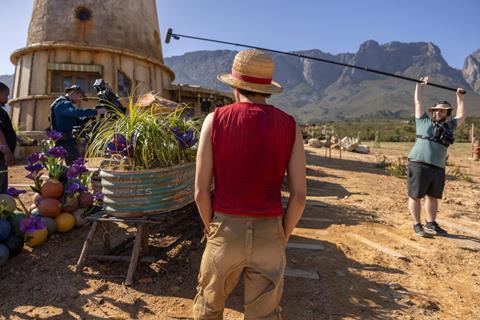
This is a transitional period for South Africa’s film industry. Major international projects are filming in the country, among them Netflix’s pirate adventure One Piece, which shoots its third season in Cape Town, and Studiocanal UK’s The Road Home.
The latter, about musicians Paul Simon, Hugh Masekela and Miriam Makeba and their fight against apartheid, is directed by Bill Condon and stars Cynthia Erivo, Guy Pearce and South Africa’s Thabo Rametsi. Videovison Entertainment is the local South African production partner, and shooting is due to begin soon.
However, there is acknowledgement across the industry that South Africa’s film and TV incentive programme needs reform and is not sustainable in its present position.
“[Reforming the incentives] would have the necessary effect of re-establishing trust in the systems and improving industry competitiveness in the short to medium term,” wrote industry analyst Olsberg SPI in a March 2026 report commissioned by South Africa’s Independent Producers’ Association.
Earlier this year, film workers protested outside the South African Parliament about Department of Trade and Industry (DTI) delays in processing film incentive payments. It was claimed this has cost jobs and puts productions at risk.
Leading local producer Tshepiso Chikapa-Phiri, CEO and founder of Known Associates Group of companies, acknowledges there has been a slowdown.
“Sadly, 2025 was difficult and the rebate was unofficially paused because the DTI’s application and adjudication committee has not actually had meetings.”
However, production companies are now being asked to submit Form B applications, which record when new projects have begun principal photography. These productions should then eventually be able to claim the rebate, which is set at 25% for the eligible local spend of international productions.
“[DTI] still has a shortage of funds but in our conversations with the DTI’s deputy minister Zuko Godlimpi, he indicated that they are doing everything in their power to raise additional funding,” says Chikapa‑Phiri of the government’s commitment to dealing with unpaid applications for the film and TV incentive.
The aim now is to move to a new blended model that would be more affordable for the public purse. As Chikapa-Phiri explains, the goal is “to keep an incentive alive in South Africa without it being purely cash.
“One of the things we are looking at is a potential tax credit as well, particularly for international productions. That business can come back because it’s important. It contributes to foreign direct investment in South Africa and it also ignites the local industry.”
Producers are meeting with the government in May and hope that a new policy strategy will be in place by late June.
International appeal
Despite uncertainty around rebates, South Africa remains an attractive filming destination for good reasons: its competitive currency, locations, skilled crew and filmmaking infrastructure.
In February, a delegation of South African industry figures visited Los Angeles to give Hollywood studios an update on what has been happening in the local industry. Now, Disney is reportedly bringing a major new project to the country later in the year, while Netflix’s One Piece has taken over Cape Town Film Studios — the family adventure series is produced by the US’s Tomorrow Studios, with South Africa’s Film Afrika Entertainment.
The hunt is now on for additional studio space. Known Associates Group is developing new studios near the paleoanthropological Cradle of Humankind world heritage site about 30 miles northwest of Johannesburg in anticipation of a future surge in production. Chikapa-Phiri is presenting a model of the studio plans in Cannes. “We are hoping to break ground in the first quarter of 2027,” she says.
Developer and producer Anant Singh is also pushing ahead with a long-planned Durban film studio based along the city’s beach front.
Various projects filmed in South Africa are also soon to be released, among them Paramount’s adventure fantasy Children Of Blood And Bone, directed by Gina Prince-Bythewood, with a cast led by Idris Elba, Cynthia Erivo, Chiwetel Ejiofor, Regina King, Viola Davis, Amandla Stenberg and Damson Idris. The film shot in and around Cape Town, and is due for release early next year. XYZ’s shark thriller Alphas, directed by Liam O’Donnell, also shot in Cape Town, starring Martin Henderson, Charlotte Vega and Teagan Croft.
“One of the things about South Africa that has always been exciting is our fabulous locations,” says Chikapa-Phiri. She lists some of the places where big international projects have shot in recent years and the talent attached is notable for the fact they have returned to South Africa for subsequent projects. They include Prince-Bythewood’s The Woman King in KwaZulu-Natal and Elba’s Beast in Northern Cape, as well as Christopher McQuarrie’s Mission: Impossible — The Final Reckoning for Paramount in Kruger national park.
Robust infrastructure
The film sector benefits from strong service companies and line producers, among them Moonlighting Films (of which Chikapa-Phiri is a part), Film Afrika (involved in Netflix’s One Piece) and Blue Ice Africa. The country also has robust post and VFX sectors led by outfits including The Refinery and Sound & Motion Studios.
“For the first time in a long time, it feels there is good intention from the government and industry side to work together to support the growth of the industry,” says Chikapa-Phiri of why she is anticipating better times ahead. “We believe that once our incentive is up and running and efficient again, then we will still be the flavour of the month in that international production location choice.”
