


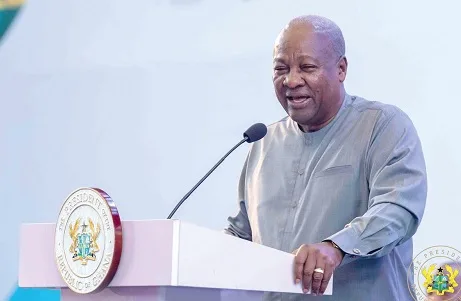
President John Dramani Mahama has cautioned governing boards and management of State-Owned Enterprises (SOEs) against using public funds to finance personal benefits at the expense of the Ghanaian taxpayer.
“You must not use profits that rightly belong to the Ghanaian people to finance the creature comforts of management and boards,” President Mahama said.
He made the remarks at the 2026 Governing Boards and CEOs Conference organised by the State Interests and Governance Authority (SIGA) on Thursday, September 10, 2026.
President Mahama said profitable state enterprises must meet their dividend obligations to the state, stressing that returns on public investments ultimately belonged to the people of Ghana.
“Profitable enterprises must also meet their dividend obligations. The returns on public investment ultimately belong to the people of Ghana,” he said.
He explained that while dividends contributed to the national budget, retained earnings must be backed by credible investment plans capable of strengthening the enterprises and creating long-term value.
The President said the recent improvement in the financial performance of SOEs was encouraging but warned that the gains must translate into sustained operational efficiency.
According to him, SOEs moved from an aggregate net loss of GH¢2.26 billion in 2024 to a net profit of GH¢19.8 billion in 2025.
Their combined revenue also increased from GH¢137.71 billion in 2024 to GH¢176.43 billion in 2025.
Mr Mahama noted, though, that some of the improvement was driven by factors which might not necessarily reflect stronger underlying operations.
“Approximately GH¢11.72 billion in net foreign exchange gains and a 42.5 per cent decline in aggregate finance costs contributed to the improvement,” he said.
“Our task is therefore to convert this favourable financial relief into sustained operational efficiency and stronger underlying performance.”
He stressed that a single year of improved results would not be enough to establish lasting success.
“A one-year turnaround is encouraging, but sustained performance is the real test,” he said.
Mr Mahama also warned that boards and management teams would be assessed against clearly defined financial, operational, governance and development targets.
“Persistence in underperformance will trigger corrective action, and where necessary, leadership changes,” he said.
He challenged boards and chief executives to move beyond merely keeping their institutions operational and demonstrate the value they created for the public.
“For far too long, some state entities have defined success as mere survival,” he said.
“Paying salaries, keeping the lights on, meeting routine obligations may be necessary, but they are not sufficient evidence of success.”
The President said every board chairperson and chief executive should be able to answer a fundamental question: “What additional value did our entity create this year?”
He said the answer must be reflected in profits, jobs, infrastructure, service delivery, national capability or improved experiences for Ghanaian citizens.
Mr Mahama reminded board members that their appointments were not ceremonial positions.
“A board is not a ceremonial position. A membership is not an entitlement,” he said.
“The Board is responsible for the strategic direction, policy, risk oversight, the integrity of financial reporting and the institutional performance.”
He also called for a clear distinction between the responsibilities of boards and management.
“Boards govern and management manages,” he said, warning that excessive board interference in routine operations weakened accountability.
He also cautioned chief executives against resisting legitimate board oversight.
“Political affiliation, personal relationships or proximity to the centre of power cannot substitute for competence, integrity, diligence and performance,” Mr Mahama said.
On remuneration, he said compensation, particularly for executives, must be linked to institutional performance.
“High-performing public enterprises and their leaders should be appropriately recognised, but poor performance cannot be continually rewarded without consequences,” he said.
“It is not fair to your shareholders to have salaries and allowances systematically increased even in chronically loss-making enterprises.”
The President cited several SOEs which recorded improvements in 2025.
Tema Oil Refinery moved from a net loss of approximately GH¢745 million to a net profit of GH¢1.09 billion, while the Ghana Water Company Limited moved from a loss of GH¢3.06 billion to a profit of approximately GH¢635 million.
The Ghana Cocoa Board also moved from a loss of GH¢5.73 billion to a profit of GH¢5.11 billion.
BOST increased its net profit from approximately GH¢398 million to GH¢684 million, while GoldBod recorded a net profit of approximately GH¢896.5 million, compared with GH¢178.5 million in 2024.
Despite the improvements, Mr Mahama said weaknesses remained within the SOE sector.
He noted that five SOEs recorded losses in every year between 2021 and 2025, while other state entities recorded an aggregate deficit of approximately GH¢10.48 billion in 2025.
He therefore directed boards to scrutinise major expenditures carefully and determine whether they were necessary, economical and aligned with their institutional mandates.
“Any board or chief executive who persistently places an entity beyond lawful oversight demonstrates an unwillingness to account for public assets,” he said.
Mr Mahama said state assets belonged to the Ghanaian people and boards and management were merely custodians.
“These assets do not belong to any government, a board or a chief executive. They belong to the people of Ghana. And you and I hold them only in trust for the people,” he said.
“That is the central proposition of this conference. Public ownership must produce public value.”
He urged the leadership of SOEs to return to their institutions and demonstrate measurable value from the assets entrusted to their care.
“Board chairpersons, board members, and chief executives, return to your institutions and ask, what value are we creating for the people of Ghana who own the assets that have been entrusted to our care?” he said.
