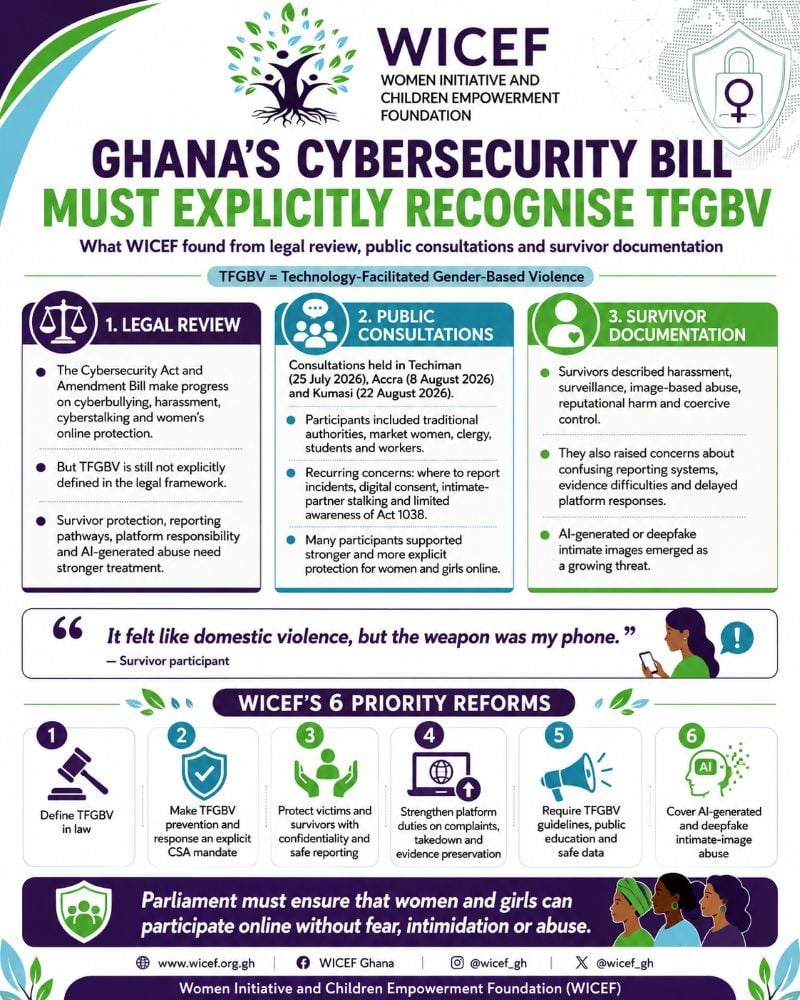
“It felt like domestic violence, but the weapon was my phone.” — Survivor participant, WICEF documentation
Those words, shared by a survivor during documentation undertaken by the Women Initiative and Children Empowerment Foundation (WICEF), capture a reality Ghana’s legal framework must increasingly confront.
Violence does not cease to be gender-based violence simply because the means of committing it is a smartphone, social-media platform, messaging application, location-sharing tool or artificial intelligence system.
For women and girls, digital technologies can open doors to education, enterprise, communication and participation in public life. But the same tools can also be used to stalk, intimidate, monitor, humiliate, threaten and control. The line between “online” and “offline” harm is increasingly artificial when technology is woven into intimate relationships, work, commerce and public life.
Ghana now has an important opportunity to respond. The Cybersecurity (Amendment) Bill, 2025 makes significant progress. The Cybersecurity Act, 2020 (Act 1038) already addresses conduct including sexual extortion, non-consensual sharing of intimate images and threats involving intimate images. The Amendment Bill goes further by proposing stronger provisions on cyberbullying, online harassment, cyberstalking, digital evidence and the online protection of women and other named groups.
WICEF welcomes those advances. The remaining gap is coherence: technology-facilitated gender-based violence, or TFGBV, is still not expressly defined or treated as a connected legal and policy category.
That matters because survivors rarely experience these harms as isolated technical offences. During WICEF’s public consultations in Techiman, Accra and Kumasi, participants repeatedly asked where incidents should be reported, what counts as technology-facilitated harm, how digital consent should be understood, and when intimate-partner monitoring or threats involving intimate images become legally actionable. Survivor documentation described persistent harassment, surveillance, coercive control, image-based abuse, reputational harm, digital-evidence difficulties, delayed platform responses and fear of secondary exposure.
A partner demanding passwords, secretly tracking a person’s location, monitoring communications or threatening to distribute intimate images may be using technology, but the underlying dynamics can still be those of coercion, control and gender-based violence. Ghana’s law should be able to recognise that reality clearly.
Six practical reforms
WICEF is not calling for Parliament to criminalise the same conduct twice. Rather, we are proposing targeted changes that connect existing and proposed protections into a coherent, survivor-centred and gender-responsive framework.
1. Define TFGBV in law. A statutory definition would give survivors, investigators, prosecutors, courts, regulators, employers and digital platforms a common vocabulary for gender-based harm committed, assisted, aggravated or amplified through technology.
2. Make prevention and response an explicit function of the Cyber Security Authority. The Bill’s recognition of women’s online protection is important, but a clearer mandate would help reduce uncertainty about institutional responsibility and coordination.
3. Protect victims and survivors expressly. Confidential, accessible and survivor-sensitive reporting and referral procedures should be built into the framework, including careful handling of intimate information and digital evidence.
4. Strengthen proportionate service-provider responsibilities. Platforms should maintain accessible complaint mechanisms, preserve evidence where lawfully required, provide transparent review processes and cooperate with competent authorities, while respecting privacy, due process and freedom of expression.
5. Require TFGBV guidelines, public education, referral pathways and safe data. People cannot use protections they do not understand, and Parliament cannot evaluate implementation without reliable, anonymised information on patterns of harm and institutional response.
6. Future-proof protections against AI and synthetic intimate-image abuse. Generative AI can now fabricate convincing sexual depictions of identifiable people even where no original intimate photograph exists. The law should make clear when such conduct falls within intimate-image protections, while preserving legitimate expression, satire, art and other protected activity.
A rights-respecting reform
Explicit recognition of TFGBV should not mean treating every unpleasant online interaction as gender-based violence. Nor should criminal prosecution be the only possible response. The legal framework should preserve survivor choice, due process, privacy, data protection and freedom of expression while providing firm accountability for serious, repeated or coercive abuse.
WICEF’s consultations and survivor evidence point to the need for a layered response: prevention and public education, competent investigation, confidential reporting, psychosocial and legal support, evidence preservation, appropriate platform cooperation and criminal accountability where the elements of an offence are met.
This is ultimately about participation. Women and girls cannot fully benefit from Ghana’s digital transformation if entering digital spaces exposes them to intimidation and abuse for which reporting routes are unclear, institutional responsibilities are fragmented, or emerging technologies have moved faster than legal protections.
Parliament does not need to start again. The Cybersecurity (Amendment) Bill already contains important foundations. What is required now is to connect those foundations deliberately and explicitly to the realities of technology-facilitated gender-based violence.
Ghana has an opportunity to build a cybersecurity framework that is not only technologically robust, but also practical, survivor-centred and gender-responsive — so that women and girls can participate in the country’s digital future without fear, intimidation or gender-based violence.
Women and girls should be able to participate in Ghana’s digital future without fear.
About this commentary
This op-ed is based on WICEF’s legal review of Ghana’s Cybersecurity Act, 2020 and Cybersecurity (Amendment) Bill, 2025, together with public consultations in Techiman, Accra and Kumasi and anonymised survivor documentation.
By Solomon Osei Poku | Women Initiative and Children Empowerment Foundation (WICEF LBG)