


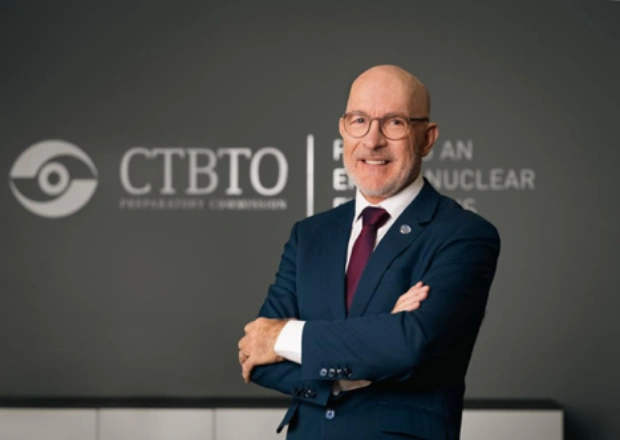
The writer
The risk of nuclear war does not rest on a single decision. It accumulates, test by test, each explosion edging the world closer to potential catastrophe. That escalation carries a cost of its own, too: every nuclear weapon test leaves a scar on land and on water, and some who lived near test sites have carried that cost for generations, long after the testing itself ended. The International Day against Nuclear Tests, IDANT, exists because those dangers remain part of our shared history, and because governments still face the same choice every year.
There was a time when the ground shook often. For four decades, the test site at Semipalatinsk was one of the places that felt it most, until its closure 35 years ago silenced a stretch of the Kazakh steppe. That decision reflected a broader shift away from nuclear testing. In the years before the Comprehensive Nuclear-Test-Ban Treaty, the CTBT, opened for signature in 1996, more than 2,000 such explosions were carried out. Since, fewer than a dozen. That the tremors grew rare is not an accident of history. It is a choice, made and remade by governments every year, and unlike a fact, a choice can be unmade. It must not be.
That choice is something built, maintained and verified, too. At the heart of it sits a global network of over 300 stations and laboratories, spread across more than 90 countries that listens to the earth with extraordinary precision. The International Monitoring System, established under the treaty’s verification regime, can detect an explosion equivalent to 500 tonnes of TNT, roughly three per cent of the Hiroshima yield. Every declared test by the Democratic People’s Republic of Korea was detected, including the smallest. The system does not ask the world to trust. It gives the world a way to check.
Science, in this sense, is the antidote to suspicion. It allows states to act with confidence that commitments are being upheld, and to see that others are doing the same.
None of this stands alone. The Treaty on the Non-Proliferation of Nuclear Weapons, the nuclear weapon-free zones, and the CTBT itself are not abstractions. Together, they form the architecture of global non-proliferation and disarmament, the quiet scaffolding beneath international peace and security, and each has shaped how governments act for decades. But no treaty sustains itself. It holds only because the states bound by it choose, year after year, to be held by it.
That is the part of the story that cannot be taken for granted right now. Nuclear weapons are not a problem any one country can solve alone. Their consequences would not stop at national borders, and no state can contain those risks by itself. A world free from nuclear testing cannot be built piecemeal. It depends on shared commitments and on the willingness of every state, including those that possess nuclear weapons, to sustain the systems that make trust between them possible.
I say this because some governments are speaking, more openly than they have in years, about the possibility of testing again. That is precisely the issue IDANT seeks to address: what are we doing, together, right now, to ensure the world does not slide back towards nuclear testing, this year or any year after it?
I believe the answer has three parts. First, a direct call to the nine remaining Annex 2 states whose ratification the treaty needs to enter into force: act without delay. The CTBT’s full strength, legal and moral, cannot be realised until you do. Second, sustained support, in word and in funding, for the verification regime and the organisation that keeps it running. An instrument this precise does not maintain itself. Third, and the foundation for both, a recognition that the multilateral system, the
Comprehensive Nuclear-Test-Ban Treaty Organization and states themselves have to work in concert, not in parallel, not in competition. The tools for this are already available: dialogue, transparency and practical steps that build confidence. What is required is the will to use them.
None of this is theoretical. The agreements exist. The infrastructure exists. What they have achieved so far is proof of what is possible when they are taken seriously.
The last 30 years were not inevitable. Neither are the next 30. That is not a warning. It is an invitation, to every government still weighing what kind of world it wants to leave behind.
Restraint was chosen, on purpose. It must be chosen again, and again.
One treaty. One goal. Zero tests.
By Robert Floyd is Executive Secretary of the Comprehensive Nuclear-Test-Ban Treaty Organization
