



Minister for Communication, Digital Technology and Innovations, Samuel Nartey George, believes Ghana cannot build an inclusive digital economy while leaving girls and young women behind.
He has therefore challenged young women to take their place in the country’s growing technology space and use digital skills to create solutions, businesses and opportunities for others.
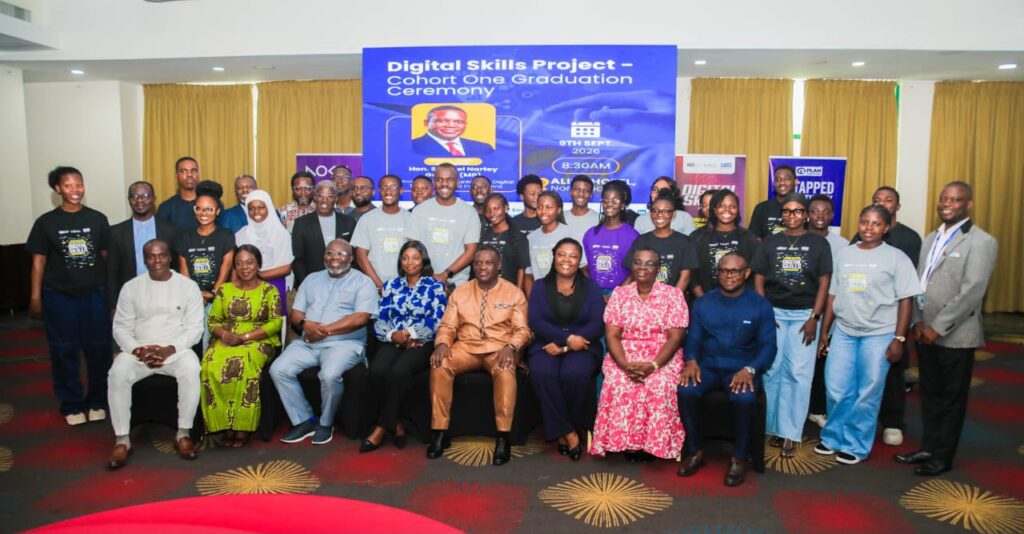
The minister made the call at the graduation ceremony of the first cohort of Plan International Ghana’s Digital Skills Project, where 26 young people completed an intensive digital skills training programme.
The cohort comprised 14 females and 12 males.
Speaking at the ceremony, he urged the female graduates not to allow the perception that technology is a male dominated field to limit their ambitions.
“To the 14 female graduates here today, you have a front-row seat in Ghana’s digital future. Do not allow anyone to say technology is not for you,” he said.
He encouraged them to pursue careers in areas including software engineering, cybersecurity, data science and artificial intelligence, while also urging them to reach back and support other girls seeking opportunities in technology.
Sam George noted that Ghana’s digital transformation is no longer an abstract policy discussion, with technology already shaping sectors including health, agriculture, finance, education and public service.
“Digital skills are not the future. They are the present,” he stressed.
He explained that the country’s digital economy cannot be built on infrastructure alone, but also requires skilled people who can use technology to solve real problems and create opportunities.
It was in this context that he commended Plan International Ghana for equipping young people with practical digital skills and giving them the opportunity to develop solutions to community challenges.
The Digital Skills Project, funded by Nokia, was implemented in partnership with Next Gen Infraco, Intellas, the University for Development Studies and Ho Technical University.
The initiative seeks to equip young people with relevant digital skills to improve their employability, entrepreneurial opportunities and participation in the digital economy, with a focus on emerging technologies and opportunities created by 5G infrastructure.
The first cohort underwent 12 weeks of intensive training, followed by a month of capstone project development. The 26 graduates produced five projects aimed at addressing real challenges in their communities.
The Minister described the projects as evidence of what can happen when young people are given the opportunity to move beyond learning technology to actually building with it.
He noted that government’s One Million Coders programme is also aimed at expanding access to practical digital skills, with 141,954 accounts enrolled as of August.
Mr George urged the graduates to take advantage of the programme to deepen their skills and pursue opportunities in areas such as cybersecurity, data analytics and artificial intelligence.
“Do not stop here. Take advantage of every opportunity available to you to continue learning and building your skills,” he encouraged.
He finally urged the graduates to make the most of the opportunities that had been opened to them and, as they progress, they must ensure they do not close the door on others who may follow.

“Now that the door has been opened for you, do not close it. Make sure that you open the door for someone else,” he underscored.
During the ceremony, the graduates, working in groups, presented five capstone projects developed from the skills they acquired during the programme.
One of the projects that drew attention was AMBU, an emergency response application designed to provide faster assistance to people in medical emergencies.
The team behind AMBU included three women, with the project reflecting the growing participation of young women in developing technology solutions.
One of the team members, Lawson Susan, explained that she joined the programme partly to challenge the perception that information technology is mainly for men.
According to her, the training broadened her knowledge of programming languages, systems, APIs and databases, while also giving her the opportunity to work on a solution with practical applications in the health sector.
“IT is for everyone, not just males. It is for females and males. We are here to break the barriers. Even what the men can’t do, we can do it,” she stated.
Also speaking at the ceremony, Head of Programmes and Influencing at Plan International Ghana, Eric Ayaba, explained that the organisation deliberately designed the programme to ensure participants could apply their knowledge to real problems rather than simply leave with certificates.
He noted that the five capstone projects developed by the graduates have the potential to address community challenges if the young people receive the necessary resources and support.
“The exciting part for us is that these young people have been able to use what they have learnt to develop solutions to real problems in their communities,” he highlighted.
Nokia Country Human Resources Manager, Brepo Akrofi Asiedu, also encouraged the graduates to take what they have learnt beyond the classroom and use their skills to make an impact in their communities.
She welcomed the gender balance recorded in the first cohort and expressed the hope that more young women would participate in future cohorts.
“We were encouraged by the number of females in the first cohort, but unfortunately, we saw a drop in the second cohort. We hope to see more females coming on board in the future,” she noted.
Plan International Ghana says it will continue to support the graduates through opportunities including job fairs, internships and mentorship, while partners explore ways of developing some of the capstone projects.
