


Wednesday 26th August, 2026 04:20 PM|

President William Ruto has vowed to deal with political goons as pressure mounts on his administration over a series of violent incidents involving political rallies and opposition figures ahead of the 2027 general election.
Addressing a rally in Emurua Dikkir on Wednesday, August 26, 2026, Ruto said his priority was peace and stability, insisting that Kenyans should be able to work together without hostility or chaos.
“We want peace for the people of this area. That is how we can plan and work together on development. We do not want hostility, we do not want war, and we do not want chaos. We want the people to live together.”
“And as for the talk about goons and all that, we will deal with it. We are saying that we want peace in this world so that we can walk together.”
Opposition seeks ICC action
His remarks come amid growing calls from opposition leaders and civil society organisations for the International Criminal Court (ICC) to examine accusations of organised political violence in Kenya.

The government has rejected the calls, maintaining that Kenyan police, prosecutors and courts have the mandate to investigate and prosecute crimes committed in the country.
Prime Cabinet Secretary and Foreign Affairs Cabinet Secretary Musalia Mudavadi said Kenya should strengthen its own institutions rather than “internationalise” domestic criminal investigations.
“We have an obligation to strengthen and defend institutions like the ICC,” Mudavadi said, insisting that Kenya has consistently respected the rule of law.
Mudavadi also pointed to Ruto’s previous experience with the court.
“Even our current president, Dr Ruto, was courageous enough to face the ICC,” he said, arguing that this demonstrated the president’s respect for the rule of law.
ICC security scrutiny
The renewed ICC debate follows a series of recent confrontations that opposition leaders say cannot be dismissed as isolated clashes between rival political supporters.
The United Opposition has asked the ICC prosecutor to consider recent incidents involving former Deputy President Rigathi Gachagua in Rongai, Nakuru; former Interior Cabinet Secretary Fred Matiang’i in Mulot, Bomet; violence surrounding Linda Mwananchi activities in Homa Bay; and an earlier confrontation in Keumbu, Kisii.
People’s Liberation Party leader Martha Karua said the incidents represented a growing threat to Kenya’s electoral environment.
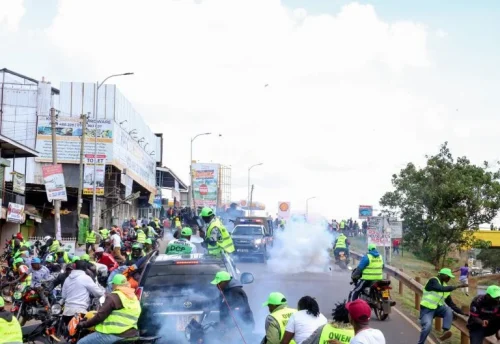
“This is a call to action on electoral violence in Kenya,” Karua said. “The escalating incidents of political violence witnessed in different parts of Kenya can no longer be dismissed as isolated confrontations between rival political supporters.”
Karua said that if evidence emerged of widespread or systematic attacks against civilians being organised, financed, directed or tolerated by people in authority, the ICC should consider investigating those responsible, including Ruto.
The opposition has also questioned how armed civilians can mobilise and attack politicians, journalists, citizens and, in some cases, police officers.
Civil society raises alarm
Human rights organisation Vocal Africa wrote to the ICC prosecutor on August 19, describing its submission as an early-warning communication under Article 15 of the Rome Statute.
It cited political intolerance, organised violence, ethnic mobilisation and weak accountability as factors that could increase the risk of serious rights violations.
The organisation pointed to incidents reported in Homa Bay, Mombasa, Nairobi, Kisumu, Kisii, Nyeri, Nyandarua, Nakuru and Kajiado.

Violence in Homa Bay on August 16 during activities linked to Linda Mwananchi left at least two people dead and scores injured, according to information cited by civil society groups. Journalists were also attacked.
The International Commission of Jurists-Kenya has separately called for increased regional and international monitoring of political tensions and gang mobilisation ahead of the 2027 polls.
The Armed Conflict Location & Event Data Project has also warned about politically connected groups involved in violence, describing the Homa Bay incident as a potentially dangerous signal for the coming election cycle.
Gachagua has repeatedly accused the government of failing to act against goons. After an attack on his convoy in Nakuru, he alleged that armed attackers used axes, stones and other weapons while police watched. He has dismissed Ruto’s anti-goon directives as political rhetoric.
What the ICC can do
The calls for ICC involvement do not mean the court has opened a case against the Kenyan government.
Under Article 7 of the Rome Statute, crimes against humanity require acts such as murder, torture or persecution to form part of a widespread or systematic attack directed against a civilian population.
A single political clash, even if deadly, would therefore not automatically qualify.
Article 15 allows the ICC prosecutor to assess information submitted by individuals, groups and organisations. If the legal requirements are met, the prosecutor can seek authorisation from ICC judges to open an investigation.

The debate comes as the ICC itself faces pressure from the United States, which is not a party to the Rome Statute. The Trump administration has imposed sanctions on senior ICC officials, while US Secretary of State Marco Rubio has accused the court of being politically motivated.
For Kenya, the controversy carries particular weight because of the country’s earlier ICC experience following the 2007–08 post-election violence.
Ruto’s pledge that his government will “deal with” goons is now likely to face close scrutiny as political tensions rise ahead of 2027.
The government insists domestic institutions can handle the problem. Opposition leaders and civil society groups argue that the pattern warrants international attention.
The question now is whether the reported violence remains a series of domestic criminal cases or develops into evidence of a wider or systematic campaign that could meet the ICC’s strict legal threshold.
