


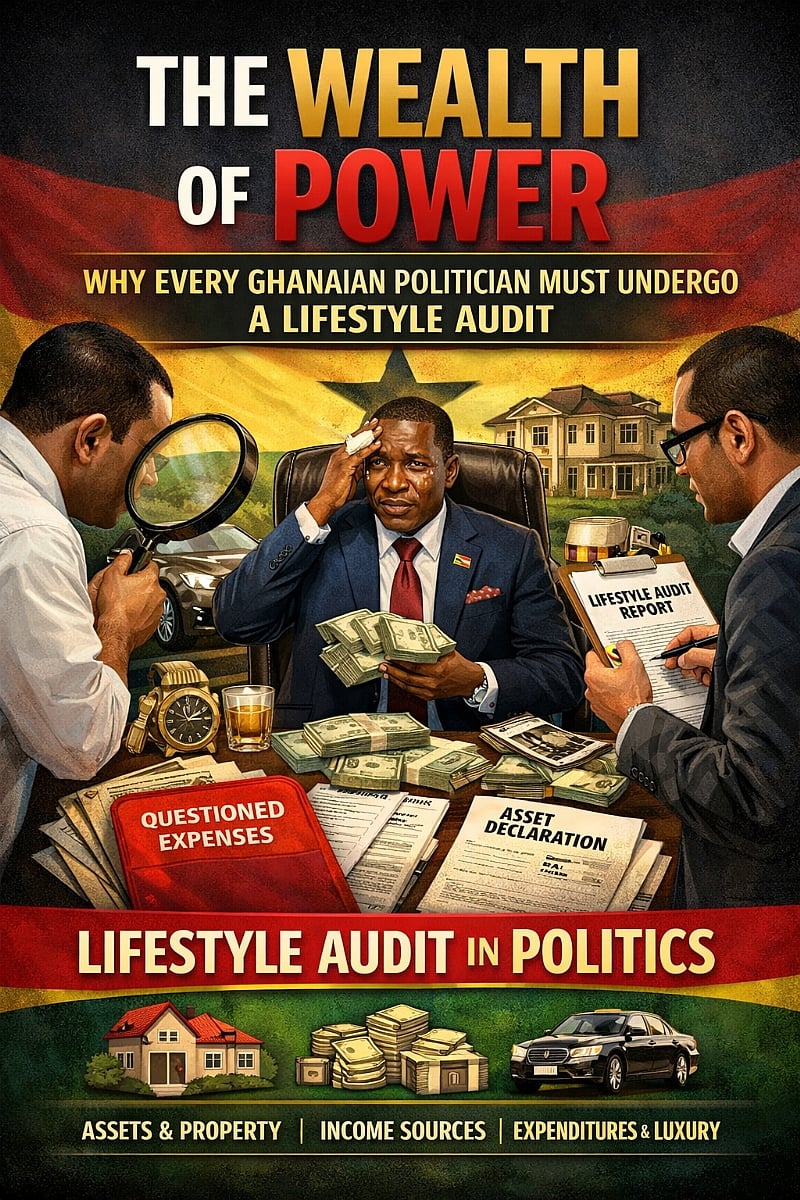
In the heart of Ghana’s bustling cities and quiet rural communities, a silent yet pervasive question lingers among citizens: How do politicians—many of whom entered public service with modest means—suddenly amass fortunes while the nation’s infrastructure crumbles, schools lack resources, and hospitals struggle with basic supplies? The disparity between the wealth of political elites and the economic hardships faced by ordinary Ghanaians is not merely a matter of coincidence but a glaring symptom of systemic corruption, lack of transparency, and a broken accountability framework.
For decades, Ghana has grappled with corruption, with investigations often focusing on where public funds disappear rather than how politicians accumulate wealth beyond their declared incomes. Yet, the real question remains unanswered: Where does the wealth come from before it becomes untraceable? The answer lies in lifestyle audits—a rigorous, independent assessment of a politician’s financial dealings that could expose the truth behind unexplained fortunes.
What Is a Lifestyle Audit?
A lifestyle audit is a comprehensive, data-driven examination of a public official’s financial activities, comparing their declared assets, income, and expenditures against the lifestyle they project. Unlike traditional asset declarations, which are often static and self-reported, lifestyle audits provide a dynamic, real-time analysis of wealth accumulation. Key components include:
- Income and Salary Verification
- Cross-checking declared salaries against actual earnings from government payrolls, contracts, and other official sources.
-
Investigating undeclared income streams, such as consultancies, speaking engagements, or offshore accounts.
-
Asset and Property Analysis
- Mapping all declared and undeclared properties, both locally and internationally, using public land registry databases and satellite imagery.
-
Examining ownership structures of businesses, farms, and commercial ventures linked to politicians or their families.
-
Luxury Asset Tracking
- Auditing high-value purchases such as luxury vehicles, private jets, yachts, and high-end real estate (e.g., [IMAGE_2] showcasing a politician’s offshore property).
-
Investigating the financing of these assets—whether through personal savings, loans, or suspicious transactions.
-
Financial Transaction Scrutiny
- Analyzing bank statements, credit card expenditures, and cryptocurrency holdings for inconsistencies.
-
Detecting shell companies, front businesses, or hidden trusts used to launder illicit gains.
-
Travel and Lifestyle Expenditures
- Reviewing international travel records, especially for politicians who frequently fly first-class or stay in five-star hotels.
-
Comparing declared travel allowances with actual expenses, including those of family members.
-
Family and Associated Wealth
- Investigating the financial dealings of spouses, children, and close associates, as many corrupt schemes operate through family trusts or offshore entities.
-
Assessing whether children’s education (e.g., elite foreign universities) or marriages align with declared family incomes.
-
Gifts, Donations, and Political Financing
- Tracing large donations received during campaigns, especially from unknown or foreign sources.
- Investigating whether “gifts” from businesses or individuals align with procurement contracts awarded to those entities.
At its core, a lifestyle audit asks one critical question: Can this politician’s wealth be reasonably explained by their legitimate income? If not, the audit becomes a public tool for accountability, forcing leaders to justify their financial status.
Why Are Lifestyle Audits Necessary for Ghana’s Political Elite?
Politics in Ghana—and across much of Africa—has become synonymous with financial enrichment, raising ethical and moral concerns. The reality is stark:
– A politician who earns a government salary of GH₵100,000 per month cannot afford a GH₵1 million mansion, two luxury SUVs, and send their children to Harvard without unexplained income.
– Why do some MPs and ministers own multiple businesses, private schools, and agricultural farms while public schools lack textbooks?
– How do politicians suddenly acquire foreign passports, second homes, or offshore bank accounts within years of taking office?
These are not questions of envy but of democratic integrity. If public office is meant to serve the people, then wealth accumulation should not be a byproduct of corruption but a result of honest service. Lifestyle audits serve as a deterrent and a corrective mechanism, ensuring that:
– Public funds are not diverted into private pockets.
– Corruption is exposed before it becomes systemic.
– Citizens regain trust in their leaders.
The Unasked Questions: Why Do Politicians Get Richer While Ghana Struggles?
The frustration among Ghanaians is palpable. Every day, they witness contradictions that underscore a broken system:
– Why do politicians campaign in modest cars but return in armored luxury convoys?
– Why are public hospitals underfunded while politicians invest in private healthcare facilities abroad?
– Why do some MPs own private airports while domestic airports lack basic amenities?
– Why do corruption scandals (e.g., the GH₵1.2 billion procurement fraud case) emerge repeatedly, yet no one is held accountable?
These questions point to a fundamental failure of governance: politics as a business, not a public service. If corruption is the opportunity cost of development, then lifestyle audits are the first step toward reclaiming that cost.
How Can Lifestyle Audits Transform Ghana?
If implemented effectively, lifestyle audits could revolutionize Ghana’s fight against corruption by:
1. Restoring Public Accountability
– Politicians would think twice before misusing public funds if they know their every purchase, loan, and asset acquisition is under scrutiny.
– Example: If a minister declares ownership of a GH₵5 million villa but their salary and allowances only account for GH₵2 million, an audit would flag this discrepancy.
- Ensuring Better Use of Public Resources
- Roads, schools, and hospitals would receive funding if politicians cannot siphon money into offshore accounts or luxury lifestyles.
-
Example: The Accra-Kumasi highway project, delayed for years due to corruption, could finally be completed if funds are not diverted to politicians’ private ventures.
-
Boosting Investor Confidence
- Foreign and domestic investors are more likely to commit capital to Ghana if they see transparency in leadership.
-
Example: Countries like Singapore and Estonia, which enforce strict asset declarations, attract FDI by reducing perceived corruption risks.
-
Rebuilding Public Trust
- The EITI (Extractive Industries Transparency Initiative) and other anti-corruption bodies have made progress, but public skepticism remains high.
-
Example: If citizens could track a politician’s wealth in real-time via a public portal, they would no longer question whether their leaders are serving the nation or themselves.
-
Deterring Corruption Before It Happens
- Corruption thrives in secrecy. Lifestyle audits expose financial irregularities before they escalate.
- Example: The GH₵100 million “ghost projects” in the Greater Accra Region could be prevented if procurement decisions were linked to politicians’ financial disclosures.
Will Lifestyle Audits Eliminate Corruption Completely?
No single measure can eradicate corruption, but lifestyle audits significantly reduce opportunities for illicit enrichment. By making wealth accumulation transparent, they:
– Disrupt bribery schemes (if a politician’s wealth doesn’t match their income, they can’t accept kickbacks).
– Expose procurement fraud (if a contractor suddenly owns a politician’s child’s school, red flags should rise).
– Prevent embezzlement (if every GH₵100,000 spent on a “private jet” is audited, theft becomes harder).
– Stop money laundering (if politicians must declare all assets, illicit funds have nowhere to hide).
Countries that have implemented lifestyle audits—such as the UK, South Africa, and Rwanda—have seen a decline in high-profile corruption cases. Ghana can learn from their lessons in transparency and enforcement.
Should Lifestyle Audits Be Public?
Absolutely. Public office is funded by taxpayers, and citizens have the right to know how their money is being used. A public lifestyle audit system would:
– Allow Ghanaians to verify whether their leaders’ wealth aligns with their salaries.
– Expose patterns of corruption (e.g., if multiple politicians from the same party suddenly own luxury villas in Dubai, it raises suspicions).
– Encourage self-regulation (if politicians know their financial dealings are publicly scrutinized, they may avoid risky transactions).
Transparency is the antidote to corruption. If asset declarations remain hidden documents, they serve no purpose. Ghana needs a digital platform where citizens can track politicians’ wealth in real-time.
How Should Lifestyle Audits Be Conducted?
A three-phase approach would ensure effectiveness:
1. Before Assuming Office (Pre-Employment Audit)
- Politicians must declare:
- All bank accounts (local and offshore).
- Properties, vehicles, and businesses (with proof of ownership).
- Investments, debts, and liabilities.
- Family assets (to prevent shell companies).
- Verification: Independent agencies (e.g., ECC, Ghana Revenue Authority) cross-check declarations with land registries, financial databases, and global asset trackers.
2. During Office (Ongoing Monitoring)
- Real-time tracking of:
- Major acquisitions (e.g., a politician suddenly owning a GH₵2 million car).
- Procurement contracts (if a politician’s relative wins a GH₵50 million government contract, it triggers an investigation).
- Tax compliance (if a politician declares no income but owns a luxury yacht, the discrepancy is flagged).
- International travel (if a minister flies first-class 10 times a year on a GH₵15,000/month salary, it’s suspicious).
- Technology plays a key role: AI and blockchain can detect anomalies in financial transactions, while satellite imagery can verify undeclared properties.
3. After Leaving Office (Exit Audit)
- Politicians must submit a final asset declaration before leaving office.
- Independent investigations should compare:
- What they owned before office.
- What they acquired during office.
- What they own after leaving office.
- Unaccounted wealth triggers legal consequences, including asset forfeiture and imprisonment.
Regular audits (every 2 years) would make corruption nearly impossible to conceal.
Can Technology Make Lifestyle Audits More Effective?
Yes. Ghana can leverage digital innovation to create a real-time public accountability system, such as:
– A National Asset Declaration Portal where citizens can:
– Search politicians’ declared assets.
– See changes in wealth over time.
– View procurement contracts linked to politicians.
– Report suspicious transactions.
– Blockchain for Transparency: Every financial declaration could be immutable and verifiable, preventing tampering.
– AI-Powered Fraud Detection: Algorithms could flag unusual spending patterns (e.g., a politician suddenly buying multiple properties in London).
– Open Data Integration: Linking land registries, tax records, and bank databases would create a comprehensive financial profile of every public official.
Imagine a Ghana where:
– A citizen can type a politician’s name into a portal and see every property, bank account, and business they own.
– Procurement data is public, so citizens can track where their tax money goes.
– Corruption is exposed before it becomes a scandal.
This is not just dreaming—it’s possible with the right technology and political will.
What Are Ghanaians Saying? The Growing Demand for Accountability
Across town halls, social media, and radio debates, Ghanaians are united in their frustration:
– “Why do politicians live like kings while we struggle to eat?” – A market woman in Kumasi.
– “If you want to serve the people, prove it by not stealing from them.” – A student in Accra.
– “We know corruption exists, but we don’t know who is doing it. Lifestyle audits would change that.” – A civil servant in Tamale.
The public sentiment is clear: Ghanaians want transparency, not empty promises. They are tired of corruption scandals that never lead to justice. They demand:
✅ Stronger anti-corruption laws.
✅ Real-time financial tracking of politicians.
✅ Meaningful consequences for illicit enrichment.
What Are Politicians Saying? The Pushback and Counterarguments
While many Ghanaians support lifestyle audits, some politicians resist the idea, citing:
1. “It’s Politically Motivated”
– Some argue that audits could be used to target opponents rather than fight corruption.
– Counterpoint: If audits are independent and data-driven, they serve the public, not politics.
- “It Violates Privacy”
- Politicians claim that personal finances should not be public.
-
Counterpoint: Public office is not private. If you take public money, your finances become public concern.
-
“Asset Declarations Already Exist”
- Some point to existing laws (e.g., Public Financial Management Act) as sufficient.
-
Counterpoint: Existing systems are weak. Many politicians lie on declarations, and no one verifies them.
-
“Anti-Corruption Agencies Should Be Strengthened Instead”
- Others argue that more resources for ECC and EFCC would solve the problem.
- Counterpoint: Strengthening agencies is necessary but not sufficient. Without transparency and real-time monitoring, corruption will persist.
The truth is simple: Lifestyle audits are not about persecution—they are about accountability. If a politician has nothing to hide, they have nothing to fear.
What Is the Government Doing? Progress and Gaps
Successive Ghanaian governments have taken steps toward transparency:
– Asset Declaration Requirements (since 2007, under the Public Financial Management Act).
– Strengthening Anti-Corruption Bodies (ECC, EFCC, Anti-Corruption Bureau).
– Procurement Reforms (e.g., e-Procurement system to reduce fraud).
– Financial Auditing Mechanisms (e.g., Auditor-General’s Office investigations).
However, public trust remains low because:
❌ Many corruption cases take years to resolve.
❌ Politicians often lie on declarations and get away with it.
❌ Lack of real-time monitoring means corruption happens in plain sight.
The solution is not just more laws—it’s enforcement and transparency. Lifestyle audits would fill the gaps** left by weak implementation.
Imagine a New Ghana: Where Corruption Is Harder Than Honesty
What if every minister, MP, and local chief executive underwent mandatory lifestyle audits? What if Ghanaians could track their leaders’ wealth in real-time? The possibilities are transformative:
🔹 Fewer people would contest elections for money—if corruption is exposed, politics would become less lucrative.
🔹 Public projects would finally get completed—if politicians cannot siphon funds, roads, schools, and hospitals would improve.
🔹 Hospitals would receive proper funding—if corruption is reduced, healthcare would no longer be a luxury.
🔹 Youth would have jobs—if public money stays in the economy, unemployment would decline.
🔹 Ghana would develop at a sustainable pace—if leaders serve the people, not themselves.
This is not fantasy—it’s a realistic vision if Ghana adopts lifestyle audits as a national priority.**
Final Thoughts: Accountability Is the Foundation of Development
Ghana is not lacking resources. It is not lacking talent. It is not lacking opportunities.
What Ghana lacks is accountability. Every GH₵1 billion stolen is a GH₵1 billion that could have built a hospital, a school, or a job. Every unexplained mansion is a dream stolen from a child who cannot afford healthcare.
Lifestyle audits are not about embarrassing politicians. They are about:
✔ Protecting democracy.
✔ Preserving public trust.
✔ Ensuring leadership is a sacred responsibility, not a lucrative business.**
If a politician’s wealth is honestly earned, then a lifestyle audit proves their integrity.
If public office has become a pathway to unexplained riches, then every Ghanaian deserves to know.
The question is no longer whether Ghana needs lifestyle audits.
The real question is: If politicians have nothing to hide, why should they fear transparency?
Ghana’s future depends on one simple truth: A nation that cannot account for its leaders’ wealth cannot develop. The time for lifestyle audits is now.
