


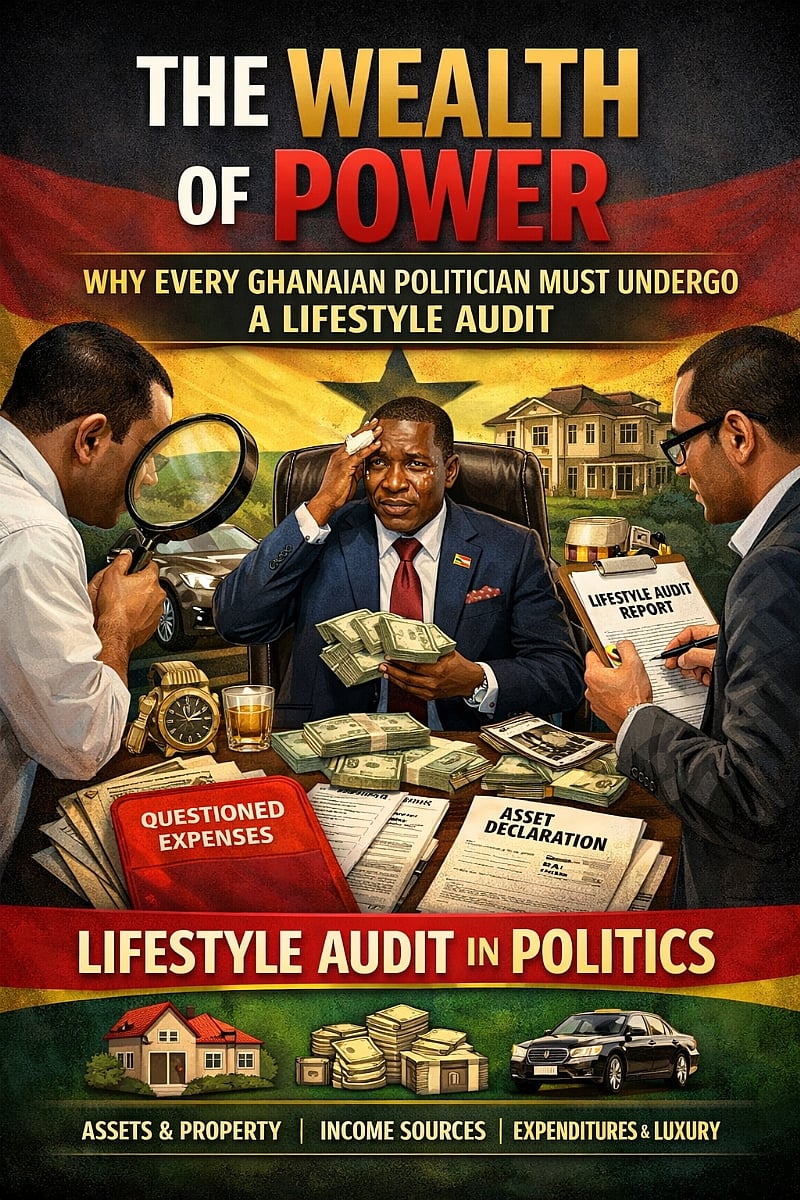
The Unspoken Truth: How Politics Became a Wealth-Building Machine in Ghana
In the quiet corners of Ghanaian homes, the question lingers like an unspoken curse: “If politics is meant to serve the people, why do so many politicians emerge from office wealthier than the institutions they were elected to lead?”
This is not a question of envy. It is a question of justice. It is a question of trust. And most importantly, it is a question of survival—for a nation that watches its roads crumble, its schools rot, and its hospitals collapse, all while its leaders live in mansions and jet off to foreign vacations on taxpayer-funded trips.
Yet, despite the public’s growing frustration, Ghana’s fight against corruption has remained reactive—focused on uncovering stolen funds after the fact, rather than preventive, ensuring that wealth accumulation aligns with declared income before misappropriation even begins.
The solution? Lifestyle audits.
But what exactly are lifestyle audits? Why are they necessary? And how could they transform Ghana’s political landscape—for the better?
What Is a Lifestyle Audit? The Missing Link in Ghana’s Anti-Corruption Fight
A lifestyle audit is not a witch hunt. It is not an invasion of privacy. It is a scientific, data-driven assessment that compares a public official’s declared assets, income, and financial disclosures against the lifestyle they publicly exhibit.
Unlike traditional financial audits, which focus on where money goes, lifestyle audits ask:
– Where did the money come from?
– Can this person’s wealth be reasonably explained by their legitimate earnings?
– Are there glaring inconsistencies between their public service salary and their private wealth?
A comprehensive lifestyle audit examines:
1. Income and Salary Verification
– Does the politician’s declared salary match their actual earnings, including allowances, bonuses, and off-book payments?
– Are there unexplained income streams from private businesses, consulting gigs, or foreign remittances?
- Asset Ownership and Property Holdings
- How many properties does the politician own? Are they all declared?
- Do they own multiple luxury homes—some in Ghana, others abroad—while the nation’s housing crisis worsens?
-
Are there unregistered land deals or shell companies masking ownership?
-
Luxury Purchases and Vehicles
- A politician earning a moderate government salary suddenly owns a Porsche, a private jet, or a fleet of luxury SUVs—how?
-
Are these assets legally acquired, or are they gifts from foreign entities, kickbacks, or embezzled funds?
-
Investments and Business Interests
- Does the politician have stakes in private companies, banks, or real estate firms?
-
Are these businesses declared as conflicts of interest, or are they operating in the shadows while public contracts are awarded?
-
Family and Dependents’ Wealth
- Why do politicians’ children attend elite foreign universities (costing millions) when their parents’ declared income is far below such expenses?
-
Are family members listed as beneficiaries in offshore accounts or unregistered businesses?
-
Travel and Expenditure Patterns
- A politician frequently jets to Dubai, London, or the Maldives—who is footing the bill?
-
Are taxpayer-funded trips being misused for personal vacations?
-
Bank Accounts and Financial Transactions
- Do they have multiple bank accounts in Ghana and abroad?
-
Are there suspicious transactions—large cash deposits, sudden transfers to unknown entities, or shell companies?
-
Gifts, Donations, and Undeclared Income
- Politicians often receive “gifts”—cash, properties, or businesses—from businessmen, foreign governments, or even their own constituents.
- Are these legitimate donations, or are they bribes, kickbacks, or embezzled funds?
At its core, a lifestyle audit does not judge morality. It exposes discrepancies—and forces politicians to prove the legitimacy of their wealth.
If the answer is “I earned this honestly”, then the audit confirms transparency.
If the answer is “I cannot explain this”, then the audit triggers investigations.
Why Ghana’s Politicians Must Undergo Lifestyle Audits: The Case for Accountability
Ghana’s political class has long operated under a code of impunity. While ordinary citizens struggle to pay school fees, hospital bills, and rent, their leaders live in opulence.
Here are the hard questions that lifestyle audits would force politicians to answer:
✅ How does a politician who started with nothing suddenly own 10 luxury homes on a government salary?
✅ Why do politicians’ children attend Ivy League universities while Ghana’s public schools lack basic textbooks?
✅ How do public officials own private jets while airport infrastructure collapses?
✅ Why do politicians campaign in modest cars but return in armored luxury convoys after winning elections?
✅ How do some politicians leave office richer than when they entered, while public institutions they were supposed to develop remain in ruins?
These are not conspiracy theories. They are facts that Ghanaians see every day.
And yet, no one is asking the right questions.
Instead of waiting for scandals to erupt, Ghana should prevent corruption before it happens—by ensuring that every politician’s wealth aligns with their public service earnings.
How Lifestyle Audits Could Transform Ghana’s Development
If implemented properly and transparently, lifestyle audits could revolutionize Ghana’s political and economic landscape in the following ways:
1. Restoring Public Trust in Leadership
- Trust is the foundation of democracy. When citizens see that their leaders cannot hide their wealth, they believe in the system again.
- Transparency builds confidence—and confidence attracts investment, both local and foreign.
2. Ensuring Public Funds Are Used for Public Good
- Every Kwacha spent on roads, schools, and hospitals should benefit the people.
- If politicians know their assets are being audited, they are less likely to embezzle funds for private luxury.
- Imagine if 50% of corruption funds were redirected to healthcare, education, and job creation—what could Ghana achieve?
3. Deterring Corruption Before It Starts
- Corruption thrives in secrecy. Lifestyle audits expose financial irregularities before they become unrecoverable losses.
- Common forms of corruption that would be curbed:
- Bribery (politicians taking kickbacks for contracts)
- Procurement fraud (awarding deals to fake companies)
- Embezzlement (stealing public funds for private use)
- Money laundering (hiding ill-gotten gains in offshore accounts)
- Conflict of interest (using public office for personal financial gain)
4. Attracting Foreign and Local Investment
- Investors want stability. Countries with strong anti-corruption measures (like Singapore, Norway, and Estonia) attract more capital.
- If Ghana proves it is serious about transparency, multinationals and Ghanaian entrepreneurs will invest with confidence.
5. Holding Politicians Accountable After They Leave Office
- Many corrupt officials escape justice because they “retire” and vanish.
- Exit audits (checking a politician’s wealth before and after leaving office) would ensure no one walks free with stolen funds.
Will Lifestyle Audits Stop Corruption Completely?
No. Corruption is a global problem, and no single measure can eliminate it entirely.
However, lifestyle audits would make corruption far harder to commit—because:
✔ The risk of exposure is too high.
✔ Politicians would think twice before stealing.
✔ Citizens would have the tools to hold leaders accountable.
Countries like South Africa, Kenya, and Nigeria have tried asset declaration laws, but implementation has been weak.
Ghana must go further—with real-time monitoring, digital transparency, and strong enforcement**.
Should Lifestyle Audits Be Public? The Case for Transparency
Absolutely.
Public office is funded by taxpayers. If citizens pay politicians’ salaries, they have the right to know:
✅ What assets the politician declared before taking office.
✅ What they acquired during their term.
✅ What they own after leaving office.
Transparency is not optional—it is a democratic necessity.
If Ghana hides asset declarations, it allows corruption to thrive in the dark.
If Ghana publishes them, it forces accountability and restores public faith**.
How Can Ghana Implement Effective Lifestyle Audits?
A well-structured lifestyle audit system would include three key phases:
1. Pre-Office Declaration (Before Taking Office)
- Mandatory asset disclosure for all politicians (presidential candidates, MPs, CEOs of public institutions).
- Details required:
- Bank accounts (local and foreign)
- Properties (landed and unlanded)
- Vehicles (registered and unregistered)
- Business interests (direct and indirect)
- Investments (stocks, bonds, real estate)
- Liabilities and debts
2. In-Office Monitoring (During Their Term)
- Independent audits by neutral institutions (not political appointees).
- Key areas to monitor:
- Sudden wealth increases (e.g., owning a luxury villa after one year in office).
- Conflicts of interest (e.g., a minister owning a company that wins public contracts).
- Suspicious transactions (e.g., large cash deposits with no explanation).
- Family wealth growth (e.g., children suddenly attending Harvard).
3. Post-Office Exit Audits (After Leaving Office)
- Final asset declaration to check for unexplained wealth.
- If discrepancies are found, legal action should follow.
- Example: If a politician declared GH₵50,000 in assets but owns GH₵50 million after leaving office, investigations must begin.
Can Technology Make Lifestyle Audits More Effective?
Yes.
Ghana can leverage digital tools to make asset declarations transparent and verifiable:
✅ A Public Asset Declaration Portal where citizens can track politicians’ wealth in real-time.
✅ Blockchain technology to prevent tampering with financial records.
✅ AI-driven anomaly detection to flag suspicious transactions.
✅ Automated cross-checking with bank records, property databases, and flight logs**.
Imagine a world where:
– Every Ghanaian can see how much a minister’s wealth grew in one year.
– No politician can hide offshore accounts or shell companies.
– Corruption becomes harder to commit because every move is recorded.
What Are Ghanaians Saying? The Growing Demand for Accountability
Ghanaian citizens are tired of empty promises.
From market stalls to university lecture halls, the same questions echo:
❓ “Why do politicians live like kings while we struggle?”
❓ “Why are our roads in ruins but their mansions are brand new?”
❓ “Why do corruption scandals keep happening?”
❓ “Why can’t we trust our leaders?”
The public sentiment is clear:
“If you want to serve the people, prove it by serving—not stealing.”
Ghanaians are not asking for perfection. They are asking for honesty.
They are not demanding wealth confiscation. They are demanding transparency.
What Are Politicians Saying? The Pushback and Counterarguments
Not all politicians support lifestyle audits. Some argue against them, citing:
🔹 “It’s politically motivated.” (Fear of targeted investigations against opponents.)
🔹 “It violates privacy.” (While public officials have no privacy when using public funds.)
🔹 “Asset declarations already exist.” (But enforcement is weak, and audits are rare.)
These concerns are valid—but they can be addressed:
✔ Audits must be independent and non-partisan (not controlled by political parties).
✔ Privacy laws must protect citizens, not corrupt officials.
✔ Existing laws must be strengthened, not ignored.
The real goal is not to persecute politicians.
The real goal is to ensure that public office is a sacred trust, not a path to personal wealth**.
What Is the Government Doing? The Reality of Weak Enforcement
Ghana has laws on paper—but implementation is the problem.
Successive governments have introduced:
✅ Asset declaration requirements (but most politicians ignore them).
✅ Anti-corruption agencies (like ECCP and NACPA), but cases drag on for years.
✅ Financial audits (but many reports are buried).
✅ Procurement reforms (but kickbacks still happen).
The issue is not the laws—it’s the lack of enforcement.
If Ghana seriously wanted to fight corruption, it would:
✔ Mandate real-time lifestyle audits.
✔ Publish asset declarations publicly.
✔ Prosecute corrupt officials without delay.
✔ Use technology to track wealth growth.
Imagine a New Ghana: Where Corruption Is Harder Than Honesty
What if every minister, MP, and public official had to undergo a lifestyle audit?
What if every Ghanaian could see:
📌 What a politician owned before taking office.
📌 What they acquired during their term.
📌 What they own after leaving office.
What if corruption became the risky choice, while honesty became the safe one?
The benefits would be transformative:
✔ Public projects would finally get completed.
✔ Hospitals would have medicine and staff.
✔ Schools would have teachers and textbooks.
✔ Youth would have jobs and opportunities.
✔ Ghana would develop at the speed we all desire.**
Final Thoughts: The Choice Is Clear
Ghana does not lack resources.
Ghana does not lack talent.
Ghana does not lack opportunities.
What Ghana lacks is accountability.
The greatest tragedy of corruption is not the money stolen.
It is the dreams stolen—from millions of Ghanaians who work hard, pay taxes, and still struggle while their leaders live in luxury**.
Lifestyle audits are not about embarrassing politicians.
They are about protecting democracy.
They are about restoring public trust.
They are about ensuring that leadership remains a sacred responsibility, not a lucrative business.
If a politician’s wealth is honestly earned, then a lifestyle audit becomes a badge of honor.
But if public office has become a pathway to unexplained riches, then every Ghanaian deserves to know.
The real question is not whether Ghana needs lifestyle audits.
The real question is: If politicians have nothing to hide, why should they fear transparency?
By: [Author Name]
[Contact Information Removed per Instructions]
