


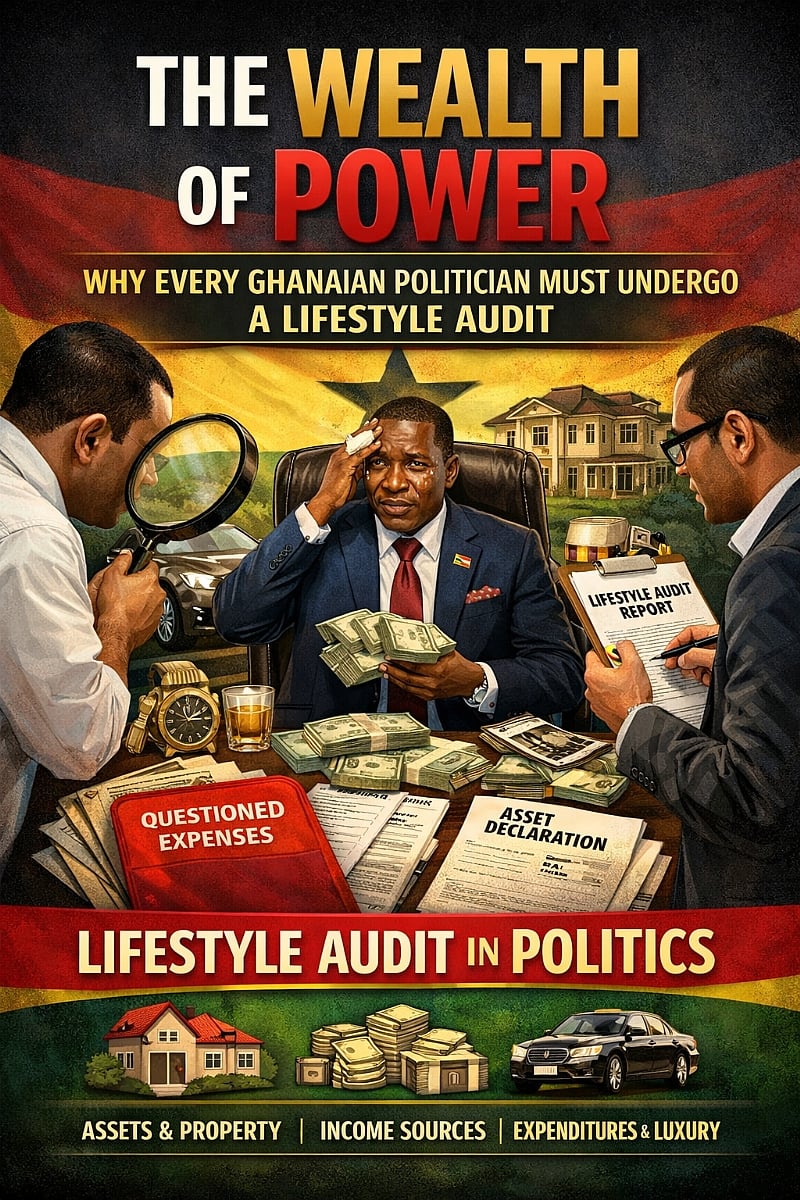
The Unspoken Truth: How Politics Became a Wealth-Building Machine in Ghana
In the quiet corners of Ghanaian households, the same question lingers like an unanswered riddle: “If politics is meant to serve the people, why do so many politicians emerge from office wealthier than the institutions they were elected to lead?”
This is not merely a matter of curiosity—it is a cry for justice. While ordinary Ghanaians grapple with soaring costs of living, inadequate healthcare, crumbling infrastructure, and job scarcity, a select few in positions of power seem to thrive financially in ways that defy logic. How does a politician who once struggled to afford basic necessities suddenly own multiple luxury vehicles, foreign properties, and private schools for their children? How do public servants accumulate fortunes while the very systems they oversee remain underfunded and dysfunctional?
The answer lies not in the theft itself, but in the systemic failure to prevent such accumulation before it happens. Ghana’s anti-corruption efforts have historically focused on reactive investigations—digging up missing funds after the fact. But what if the solution lies in proactive measures? What if we demanded lifestyle audits for every politician, ensuring their wealth aligns with their declared income?
What Is a Lifestyle Audit—and Why Does Ghana Need It?
A lifestyle audit is a rigorous, independent assessment that cross-references a politician’s declared assets, income, and expenditures against the visible markers of their wealth. Unlike traditional financial audits, which focus on accounting discrepancies, lifestyle audits examine the real-world evidence of a politician’s financial status, including:
- Residential and commercial properties (both local and abroad)
- Luxury vehicles and high-end transportation (private jets, yachts, or multiple high-end cars)
- Education and extracurricular expenses for children (elite international schools, private tutors, or overseas university placements)
- Investments and business interests (directorships in private companies, real estate portfolios, or offshore accounts)
- Travel and leisure expenditures (private vacations, memberships in exclusive clubs, or frequent international flights)
- Family wealth and inherited assets (properties, businesses, or trusts passed down to relatives)
- Gifts, donations, and unexplained windfalls (cash transfers, “loans” that never materialize, or sudden financial gifts)
- Bank account activity and digital financial footprints (cryptocurrency holdings, offshore shell companies, or irregular transactions)
At its core, a lifestyle audit asks one simple but damning question:
“Can this politician’s current wealth be reasonably explained by their legitimate salary, allowances, and declared assets?”
If the answer is no, then the public has a right to demand answers.
The Moral and Economic Case for Mandatory Lifestyle Audits
Politics should never be a fast-track to personal enrichment. The very purpose of public office is to serve the people, not to exploit public trust for private gain. Yet, in Ghana, the inverse has become disturbingly common:
- How does a Member of Parliament (MP) who earns a modest salary suddenly own a $500,000 mansion in Accra or London?
- Why do ministers who campaign in second-hand vehicles return to office in luxury convoys worth millions?
- How do political families send their children to Ivy League universities or Swiss boarding schools when the declared income of the parent in office is barely sufficient for basic living?
- Why do some politicians build private hospitals while public health facilities remain understaffed and poorly equipped?
- How do local leaders acquire multiple businesses—from supermarkets to construction firms—while their constituencies lack basic infrastructure like paved roads, clean water, or reliable electricity?
These are not questions of envy or suspicion—they are questions of accountability. If a politician’s wealth cannot be transparently explained, then the public has every right to demand clarity, consequences, and reform.
The Broader Impact: How Lifestyle Audits Could Transform Ghana
If implemented effectively and transparently, lifestyle audits could dramatically reduce corruption and restore public trust in Ghana’s political system. Here’s how:
1. Restoring Public Accountability
- Politicians would think twice before misappropriating public funds if they knew their every financial move was under scrutiny.
- Unexplained wealth triggers automatic investigations, making corruption far harder to conceal.
- Citizens regain confidence in the system when they see that public office is not a license to steal.
2. Ensuring Better Use of Public Resources
- If politicians knew their assets were being audited, they would be less likely to divert funds from schools, hospitals, and roads to private bank accounts.
- Foreign and local investors would be more willing to invest in Ghana if they saw strong anti-corruption measures in place.
- Public projects would finally get completed—because corrupt officials would no longer have the incentive to abandon them.
3. Reducing Opportunities for Illicit Enrichment
Corruption thrives in secrecy. Lifestyle audits expose the truth by:
– Unmasking bribery schemes (sudden wealth with no clear source)
– Stopping procurement fraud (contracts awarded to shell companies)
– Preventing embezzlement (discrepancies between declared and actual assets)
– Blocking money laundering (offshore accounts, cryptocurrency transfers)
– Eliminating conflicts of interest (politicians profiting from public contracts)
Countries like Singapore, Norway, and Botswana have successfully used asset declaration and lifestyle audits to minimize corruption. Ghana could learn from their models.
Why Public Lifestyle Audits Are Non-Negotiable
Some argue that asset declarations are already required under Ghana’s laws. However, paper declarations are not enough—transparency is key.
- Citizens should have access to real-time updates on politicians’ wealth.
- Independent institutions (not tied to government) should conduct regular audits.
- Whistleblowers and journalists should be protected when exposing discrepancies.
- Consequences must be severe—from asset forfeiture to criminal prosecution for those found guilty of illicit enrichment.
If politicians have nothing to hide, then they should welcome transparency. If they do, then lifestyle audits are not an attack—they are a necessity.
How Could Ghana Implement Effective Lifestyle Audits?
A comprehensive, technology-driven approach is essential. Here’s how it could work:
1. Pre-Office Declarations (Before Taking Office)
Every politician should publicly declare:
– All bank accounts (local and offshore)
– Properties and land holdings (with proof of ownership)
– Vehicles and luxury assets (registration details, purchase history)
– Business interests (directorships, partnerships, investments)
– Liabilities and debts (loans, mortgages, pending legal cases)
2. Mid-Term Monitoring (While in Office)
Independent bodies should track:
– Major financial transactions (sudden large deposits, unexplained gifts)
– Procurement deals (conflicts of interest, overpriced contracts)
– Tax compliance (avoidance or evasion penalties)
– Family wealth accumulation (children’s education, private businesses)
3. Post-Office Audits (After Leaving Office)
Even after leaving politics, officials should submit final asset declarations, with:
– Exit audits to verify no assets were hidden.
– Investigations into unexplained wealth (if discrepancies are found).
– Public disclosure of final assets (so citizens know if they gained or lost wealth in office).
4. Digital Transparency Portals
Ghana could launch a real-time public database where citizens can:
– Compare a politician’s declared salary to their accumulated wealth.
– Track changes in their asset portfolio over time.
– See public contracts awarded to their relatives or associates.
– Report suspicious activity anonymously.
This digital accountability system would make corruption nearly impossible to hide.
The Public Sentiment: Ghanaians Are Tired of Empty Promises
The frustration among ordinary Ghanaians is palpable. In town hall meetings, social media debates, and late-night taxi conversations, the same questions echo:
- “Why do politicians seem untouchable by economic hardship?”
- “Why do public services remain poor despite massive government spending?”
- “Why do corruption scandals keep emerging, yet no one is held accountable?”
- “Is politics really the most profitable business in Ghana?”
The demand is clear: “If you want to serve the people, prove you are serving—not stealing.”
Ghanaians are not asking for perfection—they are asking for basic fairness. They want to know:
✅ Did this politician’s wealth grow because of hard work, or because of public office?
✅ Are they using their position to build the nation, or to build their own empires?
✅ Will their children inherit a better Ghana, or a debt-ridden legacy?
The Politicians’ Stance: Resistance and Reasons
Not all politicians support lifestyle audits. Some strongly oppose the idea, citing:
❌ “It’s politically motivated” – Fear of targeted investigations against opponents.
❌ “It violates privacy” – While legitimate, public office is not private—it is funded by taxpayers.
❌ “Asset declarations already exist” – True, but enforcement is weak, and transparency is lacking.
❌ “Anti-corruption agencies should focus on investigations” – While true, preventive measures are far more effective.
However, these concerns can be addressed:
– Audits should be conducted by independent bodies, not political appointees.
– Privacy laws should protect personal details, but public financial disclosures should not.
– Existing laws must be strengthened with teeth—real consequences for non-compliance**.
The real question is not whether lifestyle audits are necessary—it is whether Ghana’s leaders have the courage to implement them.
What the Government Is (and Isn’t) Doing
Successive Ghanaian governments have taken steps toward transparency:
✔ Asset declaration laws (though poorly enforced)
✔ Anti-corruption agencies (like the ECCJ and ACJ)—but cases drag on for years
✔ Procurement reforms (to reduce kickbacks and favoritism)
✔ Financial auditing mechanisms (though often superficial)
Yet, public trust remains shattered. Why?
– Corruption allegations take years to resolve (if they ever do).
– Many cases are dropped or watered down due to political interference.
– Impunity persists—high-profile officials rarely face jail time**.
Without mandatory lifestyle audits, Ghana’s anti-corruption efforts remain reactive, not preventive—like closing the barn door after the horse has bolted**.
A Vision for a Corruption-Free Ghana
Imagine a Ghana where:
🔹 Every minister, MP, and local leader undergoes mandatory lifestyle audits before, during, and after office.
🔹 Citizens can track their politicians’ wealth in real time on a public digital portal.
🔹 Unexplained wealth automatically triggers investigations, not excuses.
🔹 Politicians enter office knowing that illicit enrichment will be publicly exposed.
🔹 Public projects are finally completed—because corrupt officials have no incentive to sabotage them**.
In this Ghana:
– Hospitals would be fully equipped, not ghost hospitals.
– Schools would have teachers, books, and electricity.
– Youth would have jobs, not desperation.
– Roads would be paved, not death traps.
– Ghana would finally develop at the pace we all deserve.
The Final Truth: Transparency Is the Only Path Forward
Ghana is not lacking in resources. It is not lacking in talent. It is not lacking in opportunities.
What Ghana lacks is accountability.
The greatest tragedy of corruption is not the money stolen—it is the dreams stolen from millions who continue to struggle while their leaders hoard wealth.
Lifestyle audits are not about embarrassing politicians. They are about:
✅ Protecting democracy from those who exploit it.
✅ Restoring public trust in leaders who claim to serve.
✅ Ensuring that leadership remains a sacred responsibility, not a lucrative business**.
If a politician’s wealth is honestly earned, then a lifestyle audit is a badge of integrity.
But if public office has become a pathway to unexplained riches, then every Ghanaian deserves to know.
The question is no longer whether Ghana needs lifestyle audits.
The real question is:
“If politicians have nothing to hide, why should they fear transparency?”
