


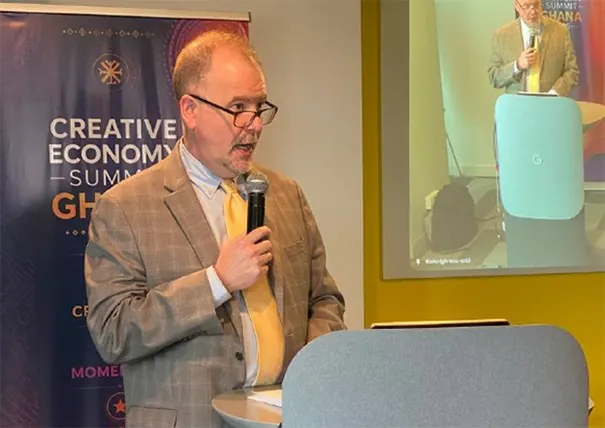
Ghana’s creative sector stands at the precipice of unprecedented growth, yet its full potential remains untapped without strategic policy interventions, robust infrastructure, and sustained investment. At the Creative Economy Summit held at the Google AI Community Center in Accra, diplomats, policymakers, and industry leaders convened to discuss how Ghana can harness its cultural wealth to drive economic prosperity. A key figure at the event, Rolf Olson, Chargé d’Affaires of the U.S. Embassy in Ghana, emphasized the critical role government policies play in unlocking job creation, attracting foreign investment, and positioning Ghana as a global leader in creative industries.
The Government’s Pivotal Role in Creative Sector Development
Olson underscored that government officials hold the decision-making power to shape the creative economy’s trajectory through well-designed policies, favorable tax structures, and strong intellectual property (IP) protections. These measures are essential for ensuring that Ghana maximizes the value of its cultural exports—whether in film, music, fashion, or digital content—and fosters an environment where international investors feel confident in contributing to the sector’s growth.
“Contract sanctity matters,” Olson stressed, highlighting the need for legal frameworks that protect creators’ rights and ensure fair compensation for their work. Without these safeguards, artists, writers, and producers may struggle to monetize their talent, stifling innovation and discouraging long-term investment. The Chargé d’Affaires also called for streamlined production financing mechanisms, which would enable Ghanaian creatives to scale their projects without excessive financial barriers.
Global Demand for Authentic Storytelling: A Strategic Opportunity
The summit explored how Ghana’s rich cultural narratives—rooted in its history, traditions, and contemporary experiences—present a goldmine of opportunities in an increasingly globalized media landscape. Olson cited the success of Nollywood films on platforms like Netflix as proof that high-quality, culturally authentic content resonates worldwide. Whether set in Denmark, India, or Ghana, compelling storytelling transcends borders, attracting audiences and opening doors for collaboration.
“Good storytelling is resonant anywhere in the world,” Olson remarked. “How many different countries can now watch a show because it’s simply well-made and deeply rooted in its cultural context?” This global appetite for authentic, diverse narratives positions Ghana to become a major player in the international creative market, provided it invests in the right infrastructure and talent development.
Empowering Creatives and Investors for Sustainable Growth
Beyond policy, Olson urged Ghanaian creatives to reclaim narrative control—to ensure their stories are told on their own terms, free from external impositions. “Insist that your story be told in your own voice,” he advised, emphasizing the importance of cultural authenticity in content creation. This principle is not just an artistic ideal but a business imperative, as audiences increasingly seek genuine connections with the creators behind their favorite media.
For investors, Olson advocated for early-stage capital deployment to build the infrastructure necessary for scaling creative enterprises. Just as technology, manufacturing, and agriculture require foundational investments, the creative sector thrives on access to funding, training, and distribution networks. By investing in co-working spaces, digital platforms, and skill development programs, Ghana can create an ecosystem where the next generation of filmmakers, musicians, and designers can operate at scale, driving both economic and creative innovation.
A Blueprint for Bilateral Collaboration and Economic Impact
The summit was framed as a starting point for deeper Ghana-U.S. collaboration in the creative industries, with the potential to generate economic opportunities for both nations. Olson reaffirmed the U.S. Embassy’s commitment to working with Ghanaian government agencies, creative professionals, and investors to strengthen bilateral ties through the arts. Such partnerships could lead to joint ventures, knowledge exchange, and investment flows, further solidifying Ghana’s position in the global creative economy.
“Like any other sector, this sector creates jobs, builds competitive advantage, attracts investment, and supports entrepreneurship and innovation,” Olson noted. The creative economy is not merely an industry—it is a driver of national development, capable of reducing unemployment, fostering innovation, and positioning Ghana as a cultural and economic hub in West Africa.
The Path Forward: Policy, Investment, and Cultural Leadership
For Ghana to fully capitalize on its creative potential, a multi-stakeholder approach is essential. Policymakers must prioritize legislative reforms that protect IP rights, simplify tax incentives for creative businesses, and ensure fair compensation for creators. Investors should channel funds into infrastructure, training, and digital platforms that empower artists to reach global audiences. Meanwhile, creatives must leverage their unique voices to produce content that stands out in an increasingly competitive market.
The Creative Economy Summit served as a call to action, reinforcing that Ghana’s creative sector is not just about talent—it is about systemic support. By building a robust ecosystem that nurtures innovation, protects intellectual property, and attracts investment, Ghana can turn its cultural assets into a sustainable engine of economic growth, ensuring that its stories are not only told but celebrated worldwide.
