


When Ghana’s National Information Technology Agency published a concept note on a national document wallet in mid-June, the broad strokes were already clear: citizens would eventually store digital versions of their Ghana Card, driver’s licence, and tax records on their phones.
Private companies — not the government — would build the apps that hold them. What was missing was the architecture underneath that promise.
A presentation deck NITA circulated ahead at its Early Market Engagement session this week supplies that missing layer. It walks through how the Ghana Electronic Document Wallet, or GEDW, would actually function: who signs a document, how a verifier checks it’s genuine, and what stops a participating company from quietly building a monopoly on Ghanaians’ personal records.
The Core Idea Hasn’t Changed, But the Plumbing Is Clearer
The basic design is the one Tech Labari reported on previously: wallets won’t store actual documents. They’ll hold encrypted references — essentially secure pointers — while the original birth certificate, transcript, or business registration certificate stays with the agency or company that issued it.
When a bank or employer needs to verify something, the wallet retrieves it live from the source, with the citizen’s consent logged at every step.
The new material clarifies how that consent flow is meant to work in practice. The deck lays out a six-step journey: an issuer signs a document using a government-issued digital certificate, its existence is published as discoverable metadata, a citizen’s wallet picks it up, the citizen views and manages it, grants time-bound consent to share it, and the requesting institution retrieves and verifies it.
This is a process the presentation claimed can happen in seconds rather than the days a manual check currently takes.
A Public Key Infrastructure Already Exists — and the Wallet Will Lean on It
Perhaps the most consequential detail in the deck is how heavily GEDW depends on a piece of infrastructure NITA already operates: Ghana’s national Public Key Infrastructure, anchored by an offline root certificate authority.
Under the hierarchy NITA describes, that root authority delegates trust down to a government certificate authority — covering ministries and state platforms — and a separate civil and commercial authority overseeing licensed sub-authorities that can issue certificates to banks, fintechs, telecoms, universities, and the wallet providers themselves.
In effect, every credential placed in a Ghanaian’s digital wallet would carry a verifiable chain of signatures tracing back to that single root. The presentation framed this as the difference between a document that is “trusted” because an institution’s letterhead looks official and one that is mathematically provable — tamper-evident, time-stamped, and impossible for an issuer to later deny having signed.
The Legal Groundwork Is Older Than the Project
NITA’s presentation made a point of showing that it isn’t asking Parliament for new authority to make digital signatures legally binding — that already exists. The presentation cited Ghana’s Electronic Transactions Act of 2008, which gives electronic records the same legal standing as paper ones, alongside the Data Protection Act of 2012 and the Cybersecurity Act of 2020.
A still-pending Data Harmonisation Bill is described as the next piece needed to standardize how data is classified and shared across public and private institutions.
That distinction matters for how quickly the project could move. Pilots and licensing, in theory, don’t have to wait on fresh legislation — only on NITA finishing the technical standards and accreditation rules that turn the legal framework into something software can actually use.
Government Regulates. It Doesn’t Compete.
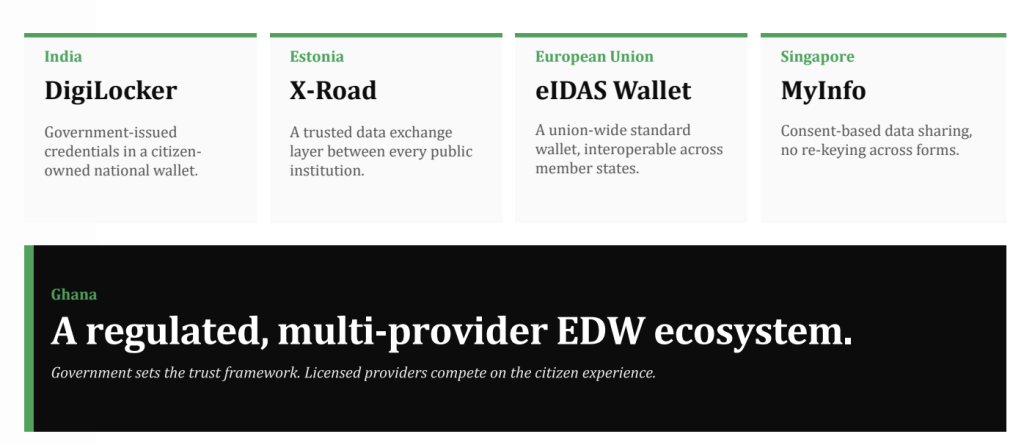
The presentation was explicit about a structural choice that separates Ghana’s approach from India’s DigiLocker, where the state runs the wallet directly. NITA’s plan instead splits the system into roles: the agency sets standards, licenses participants, and operates the trust infrastructure, while licensed Electronic Wallet Service Providers — private companies — build and operate the actual wallet apps citizens use, competing on design, pricing, and added features like automated KYC checks for businesses.
The pitch to industry is the inverse of the pitch to citizens: where citizens are promised less paperwork, companies are being offered a new regulated market — wallet apps, enterprise document services, compliance tooling — built on top of infrastructure NITA, not any single vendor, controls.
What’s Still Open
The presentation closed not with answers but with eight questions NITA says it needs the market to help settle: which documents should be digitized first, what licensing bar should apply to wallet providers, how revenue should be split among issuers, wallets, and the regulator, and how the system stays usable for Ghanaians without smartphones or reliable data access.
NITA’s own roadmap places the project in its second of seven phases — early market engagement — with standards development, licensing, and a pilot involving early issuers still ahead. The agency has been careful, in both the concept note and this deck, to frame the current moment as consultation rather than commitment.
Whether that consultation produces a workable national standard, or simply a well-designed slide deck, will depend on phases that haven’t started yet.
