


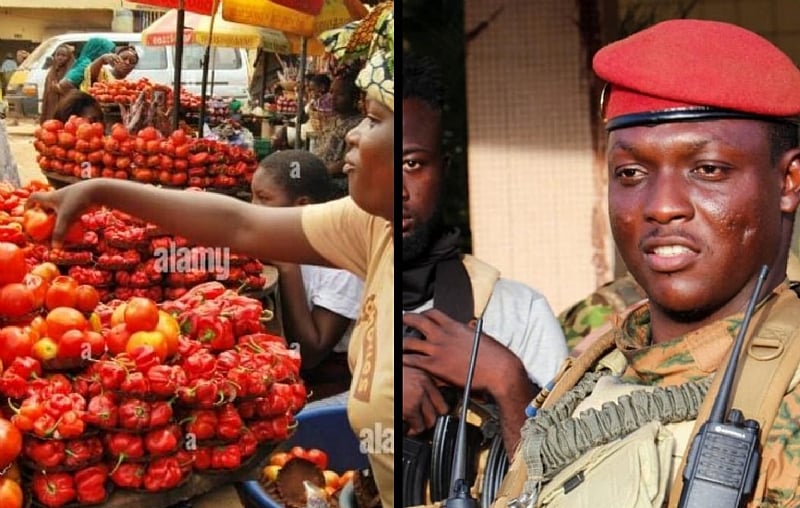
A wave of relief and appreciation is sweeping through sections of tomato sellers in Kumasi and beyond following the decision by Burkina Faso’s military leader, President Ibrahim Traoré, to lift the ban on tomato exports to Ghana.
The announcement has been met with widespread praise from traders whose livelihoods were severely affected by the halt in cross‑border tomato trade.
However, while many traders are celebrating the return of their primary source of income, others hold a contrasting view. They argue that maintaining the ban could have served as a wake‑up call for Ghanaian authorities to finally prioritize the country’s underdeveloped agricultural sector.
For traders like Madam Margaret Donkoh and Adwoa Foriwaa, who operate at the Bantama Market in Kumasi, imported tomatoes from Burkina Faso form the backbone of their business. They explained that tomato trading has sustained their families for years, enabling them to support their children’s education.
“When we heard about the ban, we were almost driven to despair,” they told the Correspondent.
Another trader at Bantama, Afua Mansah, shared similar sentiments. She noted that tomato trading requires relatively low capital, making it an accessible source of income for many women. The ban, she said, left her with insufficient resources to continue operating.
“I was ready to pack up and return to my village because I didn’t have enough capital to continue,” she recounted. “But thank God, when I heard that President Ibrahim Traoré had lifted the ban.”
The expressions of gratitude extended beyond Bantama. At the Asafo Market in Kumasi, tomato sellers also commended President Traoré. Ekua Afriyie, who has relied on imported tomatoes from Burkina Faso for the past five years to support her family, expressed her joy. She emphasized that she has been in the tomato business for six years and depends on it entirely for her livelihood.
Similar reactions were recorded in Obuasi and Ejisu, where traders described the lifting of the ban as welcome news.
Despite the widespread relief, dissenting voices emerged from Offinso, where Kofi Ababrese argued that the ban should have remained in place. He believes President Traoré’s action should serve as a lesson to Ghanaian leaders, whom he accused of neglecting the nation’s agricultural development.
“We have a Ministry of Agriculture with officials holding PhD degrees, earning huge salaries and allowances, yet we still import tomatoes from Burkina Faso,” Ababrese said. “What benefit do we get from these officials?”
He added that if he had the opportunity to speak with President Traoré, he would urge him to reinstate the ban to expose what he described as the “laziness and ignorance” of Ghanaian leaders who fail to prioritize citizens’ welfare.
Concluding the series of interviews, Kwabena Minka from Effiduase interpreted President Traoré’s decision as a wake‑up call for Ghana. He believes the situation should push leaders to rethink and revamp the country’s agricultural sector.
Minka expressed support for any initiative that would keep the ban in place long enough to compel authorities to find lasting solutions to Ghana’s agricultural challenges.
