


Tuesday 21st July, 2026 10:37 PM|

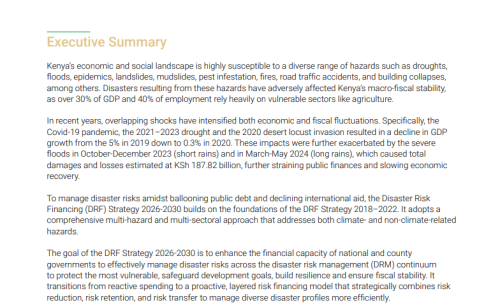
The National Treasury has sounded the alarm over the growing economic cost of climate-related disasters, warning that the Ksh187.82 billion in damages and losses caused by the devastating 2023 and 2024 floods is evidence that extreme weather is becoming a major threat to the country’s fiscal stability and long-term economic growth.
The warning is contained in the newly launched Disaster Risk Financing Strategy 2026-2030, which argues that the increasing frequency and severity of floods, droughts and other disasters are placing unprecedented pressure on public finances, forcing the government to rethink how it finances disaster response.
“Disasters continue to jeopardise the lives and livelihoods of people, national and county development, and economic stability,” Treasury Cabinet Secretary John Mbadi says in the foreword to the strategy.
According to the Treasury, the October-December 2023 short rains and the March-May 2024 long rains caused total damages and losses estimated at Ksh187.82 billion, further straining public finances and slowing Kenya’s economic recovery.
The report says the destruction exposed the country’s vulnerability to climate shocks at a time when public debt remains elevated and external development financing is shrinking.
The Treasury warns that Kenya’s economy remains highly exposed because more than 30 per cent of the country’s Gross Domestic Product (GDP) and over 40 per cent of employment depend on climate-sensitive sectors, particularly agriculture.
“Kenya’s economic growth has historically exhibited pronounced sensitivity to major disaster events, particularly droughts, floods, pest infestation and epidemics,” the strategy states.
Climate crises
The document notes that recent years have seen multiple overlapping shocks, including the Covid-19 pandemic, the 2021-2023 drought, the desert locust invasion and the 2023-2024 floods, that have compounded economic losses and weakened fiscal resilience.
It cites the combined impact of Covid-19, drought and locust invasions, which saw Kenya’s GDP growth plunge from 5 per cent in 2019 to just 0.3 per cent in 2020, underscoring how disasters can rapidly derail economic performance.
The Treasury says the 2024 floods were among the most destructive in recent history, displacing approximately 278,380 people, causing around 291 deaths, affecting more than 412,000 people across 38 counties and damaging roads, schools, health facilities, bridges, water systems and other critical infrastructure.

Beyond the immediate humanitarian crisis, the government says rebuilding damaged infrastructure diverts scarce public resources away from development priorities, increasing pressure on an already constrained national budget.
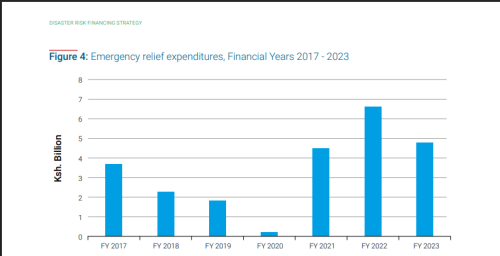
The strategy notes that between 2017 and 2023, the government spent about Ksh23.87 billion on emergency relief alone, excluding the much larger costs associated with reconstruction and long-term recovery.
The Treasury warns that the country’s traditional approach to disaster financing is becoming increasingly unsustainable.
“Financing for disasters is mainly reactive, significantly relying on ex-post budget reallocations, supplementary budgets and humanitarian assistance,” the strategy says, adding that such approaches often result in delayed responses and inefficient use of public resources.
Instead, the government wants to shift towards pre-arranged disaster financing that makes resources available before disasters strike or immediately after they occur.
Kenya fiscal concerns
The strategy proposes a comprehensive financing model built around three pillars: risk reduction, risk retention and risk transfer, including greater investment in disaster preparedness, contingency funds, sovereign insurance, catastrophe bonds and other innovative financing instruments.
Treasury argues that investing in preparedness is ultimately cheaper than repeatedly financing disaster recovery.
The warning comes as Kenya grapples with growing fiscal constraints. The strategy points to rising public debt and declining international aid, noting that Official Development Assistance (ODA) fell by 23.1 per cent in 2025, the sharpest annual decline on record, with projections indicating further reductions.
“This creates an urgent need to identify new and innovative sources of public and private finance to support financial resilience in Kenya,” the document states.
Looking ahead, the Treasury cautions that climate change is expected to increase the frequency and intensity of extreme weather events, exposing Kenya to even greater economic losses unless investment in resilience keeps pace.
The strategy concludes that integrating disaster risk into every stage of public budgeting and expanding financing tools will be critical to protecting Kenya’s economy from future climate shocks.
After a flood bill of nearly Ksh188 billion, the Treasury’s message is unequivocal: climate disasters are no longer just humanitarian emergencies; they have become a serious economic and fiscal risk that Kenya can no longer afford to ignore.
