


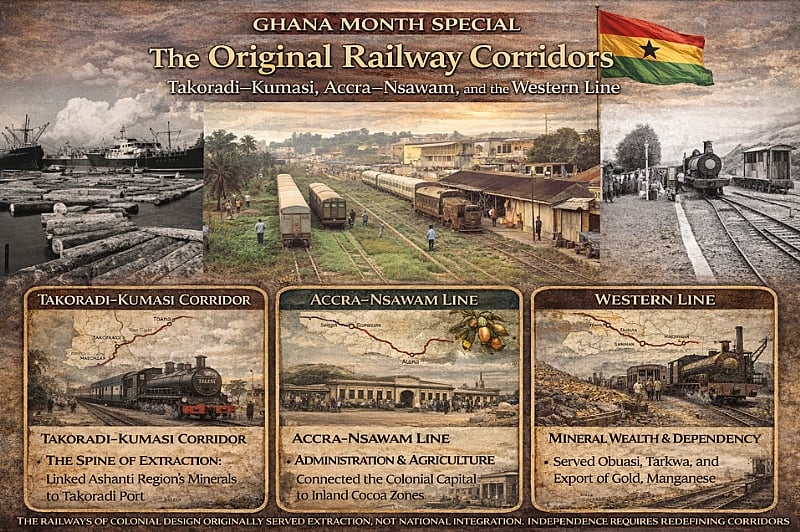
March is a month of reflection for Ghana. Independence was declared in 1957, but long before that political milestone, steel rails had already begun shaping the economic geography of the Gold Coast. To understand Ghana’s transport future, we must revisit the original railway corridors that defined its past: the Takoradi–Kumasi line, the Accra–Nsawam line, and the broader Western Line network.
These were not just transportation routes. They were economic instruments. They determined which towns grew, which industries flourished, and which regions were integrated, or isolated.
The Takoradi–Kumasi Corridor: The Spine of Extraction
The Takoradi–Kumasi railway corridor was the backbone of the colonial rail system. Constructed in the early 1900s, it linked the mineral-rich Ashanti region to the coastal port of Takoradi. Its logic was straightforward: move cocoa, gold, timber, and manganese efficiently from inland production zones to ships bound for Europe.
Kumasi, already a historic commercial center of the Asante Kingdom, became even more economically central because of the railway. Takoradi Harbour, completed in 1928, transformed into a major export gateway because rail connected it directly to resource zones. But the line’s purpose was never national integration. It was economic extraction. Towns along the route grew not because they were population centers, but because they sat on a logistics chain serving foreign markets.
This corridor teaches us a critical lesson: infrastructure design reflects political priorities. The Gold Coast railway map was drawn to serve imperial trade, not internal connectivity.
The Accra–Nsawam Line: Administration and Agricultural Movement
The Accra–Nsawam line, completed in 1908, connected the colonial administrative capital to inland agricultural zones. Compared to the Western Line, it was shorter and less mineral-focused. Its role was administrative and agricultural, linking cocoa-growing areas and facilitating movement between Accra and the hinterland. Yet even here, the structure remained outward-facing. The railway strengthened Accra’s role as a governance hub while enabling resource flow to the coast.
After independence in 1957, Accra grew rapidly as the political capital of a sovereign nation. However, the railway that connected it inland did not expand proportionally to match population growth and urbanization. Road transport gradually overtook rail, reshaping mobility patterns. The question we must ask during Ghana Month is this:
Did independence lead to a redesign of rail corridors to serve citizens, or did it preserve inherited alignments?
The Western Line: Mineral Wealth and Structural Dependency
The broader Western Line extended beyond Takoradi–Kumasi, serving mining towns such as Tarkwa and Obuasi. Gold and manganese were the lifeblood of this corridor. The rail system ensured heavy bulk transport from mines to port, something roads at the time could not efficiently handle. Technically, it was a smart engineering decision. Rail is ideal for bulk commodities over long distances. Economically, however, it reinforced dependency on raw material exports.
Even today, many of the rehabilitation projects in Ghana’s rail sector focus on the Western Line because freight demand still exists there. That continuity tells us something profound: colonial economic geography continues to influence modern infrastructure priorities.
Independence and the Unfinished Redesign
When Ghana gained independence in 1957, it inherited approximately 947 kilometers of narrow-gauge railway. The network was functional but aging. Post-independence leadership envisioned modernization and expansion. Yet over decades, underinvestment, road competition, and inconsistent maintenance weakened the system.
The inherited structure posed a dilemma:
- Should Ghana expand along existing extraction corridors?
- Should Ghana redesign railways to promote industrialization and regional integration?
That strategic question remains relevant today.
Lessons for Ghana Month
Reflecting on the Takoradi–Kumasi corridor, the Accra–Nsawam line, and the Western Line reveals five critical lessons:
- Infrastructure is political. Rail alignments mirror economic priorities.
- Extraction logic shaped the original network. Integration was secondary.
- Urban growth outpaced rail modernization. Roads filled the gap.
- Bulk freight remains rail’s comparative advantage. Especially minerals and cocoa.
- Independence requires redesign, not inheritance.
Political sovereignty was declared in 1957. But transport sovereignty requires intentional engineering choices about gauge standardization, corridor expansion, maintenance culture, and multimodal integration.
Moving Forward: From Corridor to Network
If Ghana is to fully leverage its rail history, the next phase must focus on:
- Upgrading narrow gauge to standard gauge strategically
- Connecting ports, industrial parks, and inland water transport systems
- Embedding data-driven asset management
- Funding maintenance as reliably as new construction
- Harmonizing future corridors with ECOWAS regional plans
The original railway corridors were not mistakes. They were rational within their context. But Ghana in 2026 is not the Gold Coast of 1908. Ghana Month should not only celebrate independence. It should challenge us to redefine the purpose. The Takoradi–Kumasi line carried cocoa and gold. The Accra–Nsawam line supported administration and agriculture. The Western Line powered mineral exports.
The next generation of corridors must carry industrialization, regional trade, and economic sovereignty. True independence is not only declared. It is engineered.
Author: Joseph Fuseini ([email protected])
