
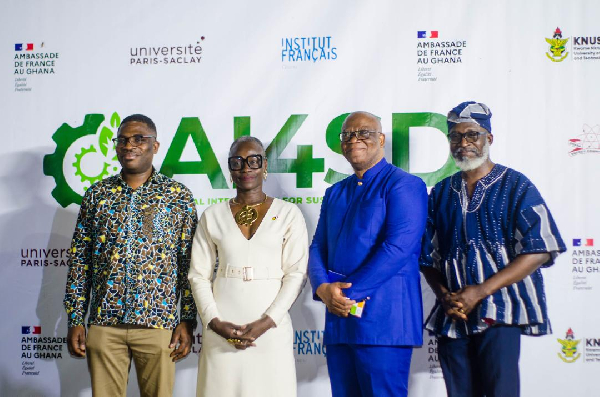
 Dr Daniel Adjei, Diarra Dime’ Labille, Prof Jerry Kponyo, Prof Boakye-Dampare at the event
France’s push for responsible artificial intelligence and digital innovation took centre stage in Ghana as the French Embassy, Kwame Nkrumah University of Science and Technology (KNUST) and France’s Université Paris‑Saclay formally launched the second phase of the AI4SD (Artificial Intelligence for Sustainable Development) programme.
The ceremony, held in KNUST’s newly‑renovated Innovation Hub, was attended by senior university officials, French diplomatic representatives, Ghanaian ministers and a delegation of youth entrepreneurs.
The event marked the start of a three‑year, €12 million investment aimed at equipping Ghana’s next generation with the technical skills and entrepreneurial know‑how needed to turn AI‑driven ideas into practical, locally‑relevant solutions.
“Responsible AI” and gender balance at the heart of the programme
French Ambassador to Ghana Diarra Dimé‑Labille opened the launch, describing AI4SD as “a cornerstone of France’s broader commitment to promoting digital innovation and responsible artificial intelligence.”
She stressed that the programme’s “central objective … is to create opportunities for young people by equipping them with skills to turn ideas into practical solutions.”
The ambassador highlighted the initiative’s inclusion agenda, announcing that the second phase will set aside a dedicated fund for at least 30 % female‑led AI start‑ups – a target that dovetails with France’s 2025 Gender‑Tech Initiative.
“Gender inclusivity is essential for better, more relevant innovation,” Dimé‑Labille said. “Together we are turning ideas into solutions that will improve lives across our continent.”
KNUST professor lauds the collaborative model
Prof Jerry John Kponyo, project lead for AI4SD at KNUST, thanked the French Embassy and the university’s vice‑chancellor for “unwavering support in making this vision a reality.”
He called the partnership “a clear demonstration of how collaboration can drive global development,” noting that the programme will blend classroom instruction with hands‑on incubator work.
“The AI4SD platform will host a series of hackathons, mentorship circuits and industry placements that directly link our trainees with Ghanaian firms and French tech partners,” Prof. John Kponyo said. “Our aim is to graduate not just AI engineers, but innovators who can embed ethical standards into every line of code.”
Technical partner reports early successes
Representing Université Paris‑Saclay, Dr. Daniel Adjei, Fonds Équipe France (FEF) AI4SD Project Lead, presented the results of the pilot year. He highlighted three flagship models now in trial:
Crop‑Guard AI, a machine learning tool that predicts cocoa‑farm pest outbreaks with 87 % accuracy, potentially reducing pesticide use by up to 30 %.
Medi‑Chat, a bilingual chatbot that triages common childhood illnesses in remote communities, cutting referral times by half.
Energy‑Optima – a predictive‑analytics system for mini‑grid operators that improves load‑balancing and lowers electricity costs for low‑income neighbourhoods.
“These pilots are proof that AI, when rooted in local data and community input, can deliver tangible benefits,” Dr. Daniel Adjei said.
A new ecosystem takes shape
The launch coincided with the opening of the AI4SD Innovation Lab, a 1,200‑square‑metre facility that will house high‑performance computing clusters, a data‑civic lab and co‑working space for start‑ups.
The lab is designed to accommodate up to 150 trainees per year, with a special track for women and other under‑represented groups.
Minister of Communications, Digitalisation and Innovation, Samuel Nartey George, hailed the partnership as “a catalyst for the digital transformation of Ghana’s economy.”
He announced that the ministry will align its national AI strategy with AI4SD’s curriculum, facilitating graduates’ entry into public‑sector projects on smart cities, e‑governance and climate monitoring.
Looking ahead
Phase 2 will roll out six new curriculum modules covering AI ethics, data sovereignty and low‑resource model deployment, alongside a scholarship programme for 200 Ghanaian students 40 % of whom will be women.
A new partnership with the African Union’s Digital Development Agency will see the programme’s best‑in‑class solutions piloted in neighboring West African nations by 2027.
The ceremony closed with a student demo: a prototype called Water‑Watch, an AI‑enabled sensor network that alerts small‑scale farmers to irrigation leaks. Developed during the first AI4SD hackathon, the project received a €15,000 seed grant from the French Embassy.
Funding and timeline
AI4SD is jointly funded by the French Ministry for Europe and Foreign Affairs, the European Union’s Horizon Europe programme and Ghana’s Ministry of Education.
The initiative will run through 2029, with periodic reviews to assess impact on employment, gender parity and sustainable‑development outcomes.
As Ambassador Dimé‑Labille summed up, “The future of AI in Ghana is collaborative, inclusive, and purpose‑driven.” The launch marks a concrete step toward that vision, turning research labs into engines of sustainable growth for Ghana and the wider region.

