
As the government scrambled to put a Band-Aid on the national water crisis, the sheer scale of ineptitude and incompetence in Johannesburg told the story of a city drowning in broken promises.
President Cyril Ramaphosa acknowledged the enormity of the problem in his state of the nation address this week, saying he would personally take charge of a national water crisis committee.
But in Johannesburg, a city of about 6-million people and the economic hub of the country, residents are still in the dark — despite multiple media conferences and the creation of a provincial water crisis war room — as to why hundreds of thousands of them are without water. Some have had no water for almost a month.
Even the vaunted “water throttling” that residents were told would finally solve the problem backfired amid claims that it may have caused even more harm by prolonging outages.

Meanwhile, it has emerged that a new system introduced by Joburg Water to deal with complaints made the situation even worse. The utility’s latest quarterly report for July-September 2025 reveals an entity in crisis. Among the issues raised are that:
- Staff do not understand how to work a new field services management system, resulting in delays in resolving problems;
- Only 41.27% of water bursts were repaired within 48 hours, way off the target of 90%;
- Only 66% of sewer blockages were resolved within 24 hours, against a target of 95%;
- The number of bursts per month rose to an average of 4,519, from 2,960 for the same period in 2024;
- Performance standards stipulating that response teams should attend to a minimum of three major bursts and three other water-related jobs in any given day were not met;
- Staff remuneration ballooned past the budgeted R470m to R523m. Of the excess, R38.2m was attributed to overtime costs; and
- Of the performance contracts that 2,675 employees were meant to sign, only 421 — about one in six — did so.
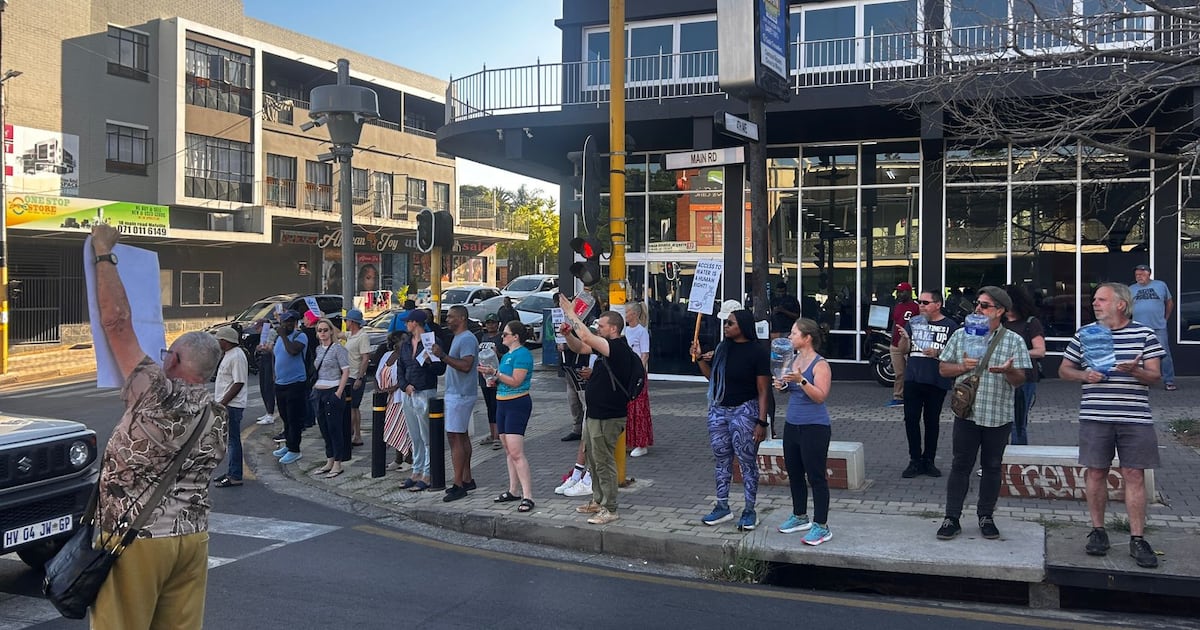
This week social media showed protesting residents in heated confrontations with the officials and “showering” in the rain.
Gauteng premier Panyaza Lesufi tried to placate angry constituents by saying he, too, was a victim of water cuts — he even had to resort to checking into a hotel so he could shower. This backfired badly, forcing him into an embarrassing apology. And mayor Dada Morero’s call on residents to “shower together” similarly backfired, with a deluge of social media jokes and memes.
“Water justice” activist Ferrial Adam said that throttling — a stopgap measure to reduce high water demand by intentionally lowering pressure or limiting flow — should have been delayed until the system stabilised. Even reservoirs bypassed by the main network were affected by widespread outages.
“And to this day, Joburg Water cannot explain where the fault is. Is it pump stations?” asked Adam, who heads WaterCAN, which describes itself as “a national initiative dedicated to safeguarding South Africa’s water resources through citizen-driven action”.
The problem is that when Rand Water sneezes, Joburg Water comes down with Covid because the system is fragile, there’s inadequate storage
— Ferrial Adam, WaterCAN
“We’re now in a situation where water is being shifted from one system to another, while they are not finding or fixing the problem. And then when the water comes back, we will still want to know what caused this. Rand Water will not answer to civil society — only to municipalities and government ministers, spinning off accountability,“ she said.
“The problem is that when Rand Water sneezes, Joburg Water comes down with Covid because the system is fragile, there’s inadequate storage. We should have overcome the issues easily and quickly stabilised things, but ageing infrastructure and lack of maintenance were then further impacted when Rand Water decided to implement water throttling from February 2.”
Danny Nunes, operations manager for the Melville Security Initiative and founder of Creass Community Services, a small business dedicated to maintaining public spaces, said residents were angry and frustrated.
“We are not all water engineers, but we can google and educate ourselves, and it’s disgusting to see that Joburg Water is not telling us what they can. We can see the Rand Water stats for ourselves every day, and nothing is making sense. We have gone weeks without water and nobody can say what the real problem is.”
The information vacuum is not new. Water expert Anthony Turton told the Sunday Times that when he worked as a spokesperson for the Council for Scientific & Industrial Research in the early 2000s, he was told to play down the extent of the looming national water crisis.
“We had to be careful with our wording,” he said. “The outcome has been known from as early as 2002, but the communications messaging had to be softened to avoid panic. The outcome is still a predictable systemic collapse.”
Adam said that although Johannesburg’s plight was in the spotlight because the city is the economic hub of the country, no part of the country was immune and the crisis should be declared a national disaster, with urgent work to stabilise the system.
“For some places intermittent water supply is the norm, and something they’ve been living with for 12 years or more.”
By yesterday, Joburg Water said the system remained constrained “due to high demand”. It said while some gains had been made, “overall demand in the Johannesburg water system exceeds available capacity and may slow system recovery”.
Adam warned that restarting dry systems would likely trigger pipe bursts and leaks. “They are going to need to map the restoration to work out which areas are experiencing air locks and where there are closed valves.”
There is no doubt that this all comes down to institutional failure. It’s government failure and politicians playing the blame game
— Carin Bosman, water use expert
Water use expert Carin Bosman, founder of Carin Bosman Sustainable Solutions, said it was easy to make Rand Water the scapegoat but Joburg Water’s actions could also be the cause of the metro’s crisis.
“There is no doubt that this all comes down to institutional failure. It’s government failure and politicians playing the blame game. The DA shut up when the water budget was cut, and now when the taps are dry, they stand up and say, ‘We’re taking this to court.’ And it’s the ratepayers who are landed with the legal costs,” she said.
“It’s not in the interests of the people and shows no understanding of the depth of the problem.”
Bosman said politicians who ignored or deviated from maintenance budgets submitted by technical teams should be held accountable.
On the ground, the human toll is mounting. Some communities have gone up to 23 days without running water from the municipality, relying on boreholes and/or private trucks. Many residents have to start queueing for water at 2am to avoid crime; some spend thousands of rand on storage tanks.
“Every litre lost to leakage represents a loss of revenue for the city,” Turton said. “Systemic failure doesn’t happen as one big bang. It’s more about a series of dominoes that fall. This means that there is no sense of urgency. Each little domino that has been stabilised is falsely claimed as a final victory; it isn’t.”
The City of Johannesburg this week announced that an intergovernmental “water war room” had been established to address the crisis, bringing together the municipality, Rand Water and representatives from provincial and national government. It is headed by Gauteng MEC for co-operative governance, Jacob Mamabolo.
Gauteng government spokesperson Elijah Mhlanga said members had been meeting daily since Monday. The war room let them “pool resources and have one central point of understanding” of the province-wide crisis.
“We get reports from the five corridors of the province. We identify hot spots. We deploy teams to attend to those hot spots,” Mhlanga said. Those deployed to the effort were senior officials who could act with urgency and they had restored the water supply in several areas, including Midrand and Soshanguve.

