
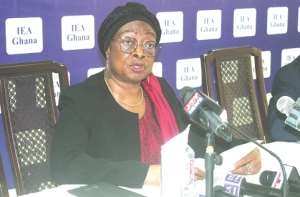
The Institute of Economic Affairs (IEA) Ghana has rejected the proposed truncated sliding-scale mineral royalty regime, and rather called for a new mining policy anchored on full national ownership.
The Institute described the proposed regime as a perpetuation of the outdated colonial structures that continued to export the nation’s wealth whilst keeping the citizens poor.
Justice Sophia Akuffo, a former Chief Justice, and a Distinguished Fellow of the IEA, made the call at a press conference in Accra on Tuesday.
The proposed regime, which was contained in a draft Minerals and Mining (Royalty) Regulations 2025, currently before Parliament, maintained the colonial royalty-based regime with either a graduating scale or a capped system of royalties across the mining sector.
The sliding scale provides for a five per cent to 12 per cent royalties for Gold and Lithium and a five per cent flat rate for diamond, bauxite, manganese, salt, limestone and iron ore.
A sliding-scale mineral royalty is a payment system where royalty rates paid by mining companies to the government increase when commodity prices rise and decrease when commodity prices fall.
Referencing a Reuters publication dated January 15, 2026, the IEA raised further concerns about the pronouncement by Mr Isaac Tandoh, Acting Chief Executive Officer of the Minerals Commission, that a draft bill to be presented to Parliament by March 2026 sought to introduce a nine per cent to 12 per cent sliding-scale royalty regime in the mining sector.
The IEA said the position was “confounding and contradictory to President Mahama’s position on natural resources.”
The Institute pointed out that the President had on different occasions emphasised that Ghana must have sovereignty over its natural resources in order to create wealth and prosperity for citizens.
Among the notable platforms where President Mahama affirmed his position were during the opening of the National Economic Dialogue on March 3, 2025, during his speech at the 80th Session of the United Nations General Assembly, and on January 22, this year when he addressed global political and business leaders at the World Economic Forum in Davos.
“For us at the IEA, the President’s position demonstrates a clear presidential commitment to reforming the mining sector primarily for the good of Ghana,” Justice Akuffo noted.
She emphasised that: “Ghana must have full ownership of its natural and mineral resources at all points in time; and must exercise this ownership right by engaging the private sector, local and foreign expertise… and maximize benefits for the country’s industrial transformation.”
The former Chief Justice said the practice of a nation taking ownership of its natural resources was not new, noting that it had been implemented profitably in countries like Norway, Botswana, Chile, Burkina Faso, Niger, Mali and several members of the Organisation of the Petroleum Exporting Countries (OPEC).
“Ownership ensures secondary benefits, including job creation, technology transfer, community development, and long-term structural transformation of a nation,” she added.
GNA
