


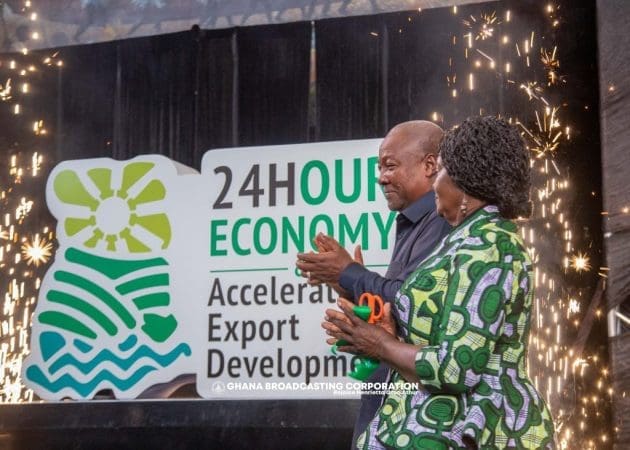
The government is transforming the 24 Hour Economy Secretariat into a full statutory Authority, bringing Ghana closer to operationalizing a round the clock economic model aimed at boosting productivity, job creation, and investment across sectors.
President John Dramani Mahama announced Thursday during a visit to the Ghana Publishing Company that Cabinet has approved the 24 Hour Economy Authority Bill for submission to Parliament. Once enacted, the Authority will replace the existing secretariat and widen the scope of activities supporting continuous business operations nationwide.
“I’m happy to note that the committee has finished considering it and it’s supposed to go onto the floor of Parliament to set up the 24 Hour Authority, which would then open the way for implementation and registration of all the businesses that will be involved in the 24 hour economy initiative,” the President stated.
The new Authority is expected to serve as the central coordinating body for the policy’s implementation, regulating participating businesses, setting operational standards, and administering incentives to encourage extended operations. The President explained that the Authority will clearly spell out incentives available to businesses that sign on to the initiative, with early adopters like Ghana Publishing Company positioned to benefit significantly.
The 24 Hour Economy initiative, which was launched nationally in July 2025, is designed to expand Ghana’s productive base beyond the traditional eight hour workday, fostering new avenues of growth in manufacturing, logistics, services, and agriculture.
Government spokesman Felix Ofosu Kwakye revealed that the initiative has received a budget allocation of GHS110 million to support operationalization. He explained the program requires government systems and incentives to thrive, noting that substantive undertakings necessitate proper manpower and established ground rules.
Several large public institutions are already experimenting with extended operations. The Ghana Publishing Company has adopted a two shift model, while the Passport Office and Ghana’s foreign missions have rolled out round the clock services. Both Tema and Takoradi ports now operate 24 hours to boost trade efficiency and reduce congestion.
The Ministry of Interior has established a dedicated 24 hour economy policing secretariat to provide continuous security support across the country. Cabinet has also approved amendments to the Ghana Investment Promotion Centre (GIPC) Act and the Labour Act to accommodate the new economic model, addressing worker protection while creating incentives for businesses to extend operational hours.
Minister of Youth Development and Empowerment George Opare Addo emphasized that complete implementation is realistically expected by the end of 2026, acknowledging that the transition requires significant legislative and structural shifts. “Everyone who is honest will see that the work is meeting expectations and we are on track,” he stated.
However, business readiness remains mixed. While large institutions report early benefits such as improved service delivery and better infrastructure use, many small and medium sized enterprises (SMEs) caution that operating around the clock requires significant shifts in cost structures, labour strategies, and demand forecasting.
Extended hours mean higher electricity bills, increased staffing needs, and security concerns, particularly for informal traders and microbusiness owners who typically operate within daylight hours. Many businesses have expressed concerns about the performance of the Electricity Company of Ghana (ECG) and Ghana Water Company Limited (GWCL), noting that electricity and water services remain unreliable in several areas.
The Food and Beverages Association of Ghana (FABAG) recently described ECG and GWCL as major obstacles to economic development, noting chronic mismanagement, corruption, and inadequate service delivery. The association warned that recent utility tariff increases would place additional strain on businesses already facing high operational costs, potentially forcing SMEs to close, reduce employment, or raise prices.
Low quality service has been the leading complaint against both utilities. Between January and October 2024, the Public Utilities Regulatory Commission (PURC) received 1,477 complaints out of 1,891 total complaints centered on subpar service delivery. Customers reported power outages, phase offs, low voltage, irregular water supply, discolored water, burst pipes, and low water pressure.
ECG reported a 23 percent transmission loss in 2023, impacting affordability and accessibility. Frequent power outages have historically affected businesses, with the African Development Bank indicating that Ghana loses approximately $2.1 billion annually due to unreliable electricity supply.
To address infrastructure concerns, the proposed Authority is expected to offer a certification programme, access to financing, and targeted incentives for businesses ready to adopt round the clock operations. According to the official 24H+ programme portal, certified businesses may unlock financing, tax benefits, and expert training, elements critical for competitiveness in a 24 hour market environment.
The initiative complements broader economic transformation efforts, including export development and industrialization, with government projections suggesting the potential to create millions of jobs and stimulate both local and foreign investment. The policy connects directly to employment generation programs like the One Million Coders Programme, which is training young Ghanaians for digital jobs.
President Mahama revealed that the 24 hour economy concept extends to local development, with new expenditure guidelines for District Assembly Common Fund allocations requiring 25 percent of funds to support infrastructure that enables continuous economic activity.
Residents of Ashaiman expressed mixed reactions to the implementation. John Ekow, an airline staff member, noted that some public institutions had already adopted round the clock operations, while Gideon Ayinedenaba, a social media manager, described the policy as a positive initiative that could absorb significant numbers of unemployed youth while increasing production.
Ghana’s success in this economic transformation hinges on several key factors, including infrastructure reliability, labour market adaptation, demand stimulation, and security measures to protect workers and customers at all hours. For many Ghanaian businesses, the transition raises questions about cost viability, consumer behavior after traditional business hours, and access to financing and incentives.
The government maintains that the 24 Hour Economy has high potential to unlock productivity and generate jobs, particularly among youth and in sectors like logistics, manufacturing, and services. However, critics argue that without addressing fundamental infrastructure challenges, particularly in electricity and water supply, the ambitious policy may struggle to achieve its objectives.
