


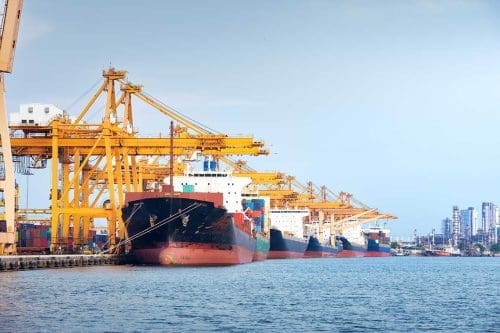
Ghana continues to trade more extensively with Europe than with its African neighbors despite hosting the secretariat of the African Continental Free Trade Area (AfCFTA), raising questions about structural bottlenecks that limit intra-African commerce.
Trade data shows the European Union remains one of Ghana’s largest trading partners, accounting for a significant share of exports including cocoa, gold, oil, and processed agricultural products, as well as imports such as machinery, pharmaceuticals, and manufactured goods. By contrast, intra-African trade represents a relatively modest portion of Ghana’s total trade volumes.
In 2022, Ghana’s top five export destinations were Switzerland and Liechtenstein, China, the United States, the United Arab Emirates, and India, according to the Ghana Trade Fact Sheet published by the Trade Unions in AfCFTA organization. Europe and Asia accounted for approximately 77 percent of Ghana’s total imports that year, while imports from Africa into Ghana stood at just 11 percent.
Kwame Oppong Ntim, Director of Agribusiness at the Ministry of Trade, Agribusiness and Industry (MOTAI), attributes the imbalance to historical trade patterns and structural challenges that predate AfCFTA.
“Ghana’s trade orientation toward Europe did not begin today. It is the result of decades of structured trade relationships, harmonized standards, predictable logistics and established financing systems that make doing business with Europe relatively straightforward,” Oppong Ntim explained during recent public remarks.
He noted that European markets offer clear regulatory frameworks, stable demand, and long-standing trade agreements that reduce uncertainty for exporters. African markets, though geographically closer, are often fragmented by differing standards, customs procedures, and infrastructure gaps.
AfCFTA, which officially commenced trading in January 2021 and is headquartered in Accra, was designed to address many of these challenges by creating a single African market for goods and services. The agreement aims to boost intra-African trade by reducing tariffs, eliminating non-tariff barriers, and promoting value addition across the continent.
However, implementation gaps continue to limit the agreement’s full potential. “AfCFTA is not a magic wand. While the framework exists, countries are at different stages of readiness. Issues such as customs digitization, trade facilitation, mutual recognition of standards and transport connectivity are still works in progress,” Oppong Ntim said.
One major constraint is infrastructure. High transportation costs, limited rail connectivity, and inefficient ports and border posts make trading within Africa more expensive and time-consuming than shipping goods to Europe. For many Ghanaian exporters, it is often cheaper and faster to send goods to Rotterdam or Antwerp than to neighboring African markets.
Another factor is the structure of Ghana’s exports. The country’s export basket remains dominated by primary commodities, many of which are demanded more consistently by European markets. Gold accounted for 38 percent of exports in 2022, mineral fuels and oils represented 31 percent, and cocoa made up 12 percent, according to the Ghana Trade Fact Sheet. Together, agriculture and extractive products accounted for about 80 percent of the country’s exports.
African economies often produce similar raw materials, limiting opportunities for complementary trade unless value addition increases. “Until we significantly scale up agro-processing and manufacturing, intra-African trade will remain limited,” Oppong Ntim said. “Africa cannot trade raw materials with itself at scale; value addition is the real game changer.”
Access to trade finance also plays a role. European buyers typically have stronger access to credit, insurance, and structured payment systems, reducing risks for Ghanaian exporters. Smaller African markets may struggle with payment delays and currency risks, discouraging cross-border trade.
Despite these challenges, Ghana has taken steps to position itself as a leader in AfCFTA implementation. The country participated in the Guided Trade Initiative (GTI), launched by the AfCFTA Secretariat in September 2022 to pilot commercially meaningful trade under the agreement. Ghana assisted 30 companies to obtain Certificates of Origin to export goods under the initiative.
However, the National AfCFTA Coordination Office indicated that only a few companies actively traded under the GTI. Goods imported into Ghana under the initiative included tea and batteries from Kenya, coffee beans from Rwanda, meat products and cement from Egypt, and tea and dried fruits from Cameroon. Two Ghanaian companies reportedly exported palm oil products to Kenya and ceramics to Cameroon under the program.
Ghana concluded the Interim Economic Partnership Agreement (EPA) with the European Union in 2007, a goods-only reciprocal free trade agreement ratified in 2016. Covering about 78 percent of Ghana’s tariff lines, the Interim EPA ensures continued preferential access for Ghanaian exports while gradually liberalizing imports from Europe.
The agreement provides stable market access that many African markets cannot yet match. Ghana also benefits from the African Growth and Opportunity Act (AGOA), which provides duty-free access to US markets for eligible products.
Oppong Ntim said targeted support for agribusiness and manufacturing firms would be critical to shifting trade patterns. Speaking at the 2025 Africa We Want Summit in December, he emphasized the need for businesses to adopt a borderless mindset.
“A business that starts in Accra should be able to scale to Kigali, Cape Town, Tunis and beyond,” he said, calling on entrepreneurs to take advantage of continental market integration.
He outlined several government initiatives to support enterprise development, including a forthcoming Agribusiness Policy that will enforce higher standards in packaging and product quality to help local producers compete in regional and global markets. The Ghana Enterprise Agency is implementing a progressive licensing scheme with sponsored technical assistance to help selected firms become export ready.
The Government of Ghana has adopted the National AfCFTA Policy Framework and Action Plan, focusing on seven key areas including development of trade policy, trade facilitation, enhancing productive capacity, trade-related infrastructure, trade finance, trade information, and factor market integration.
Customs officers received training in preparation for AfCFTA implementation, with the goal of building on preferential trade Ghana enjoys under the Economic Community of West African States (ECOWAS) to take advantage of new AfCFTA preferences.
As AfCFTA continues to evolve, analysts believe the gap between Ghana’s trade with Europe and Africa could narrow over time. However, doing so will require sustained policy reforms, infrastructure investment, and private sector readiness.
The World Bank projects that by 2035, AfCFTA implementation could increase total export volumes by approximately 29 percent compared to baseline scenarios, with intracontinental exports experiencing a substantial upswing exceeding 81 percent. Countries including Ghana are expected to see export values rise significantly.
“For now, Europe remains Ghana’s dominant trade partner,” Oppong Ntim said. “But with the right investments and full AfCFTA implementation, Africa can become not just a political priority, but a commercially viable destination for Ghanaian goods.”
