


A Growing Crisis: Human-Elephant Conflict in Kenya’s Amboseli Ecosystem
In the vast, semi-arid landscapes of southern Kenya, where the golden savannas of Amboseli National Park stretch toward the Tanzanian border, a persistent challenge threatens both wildlife and local communities: human-elephant conflict (HEC). For decades, farmers like Dominic Mutua, a smallholder from Inkoisuk Village—just 30 kilometers (19 miles) from the park—have faced relentless raids by elephants on their crops. His testimony underscores the severity of the issue:
“We spent countless nights guarding our fields, chasing elephants away with torches and noise. The stress was unbearable, and the losses to our livelihoods were devastating.”
The 2025 Kenya Wildlife Service (KWS) census revealed a staggering 42,072 elephants roaming the country, with 1,903 residing in and around Amboseli. Unlike many protected areas with secure perimeters, Amboseli lacks a physical fence, allowing elephants to roam freely across 8,093 square kilometers (3,125 square miles) of rangelands, wetlands, and wildlife corridors—much of which overlaps with agricultural land. This unchecked movement has led to economic devastation for farmers, retaliatory killings of elephants, and a cycle of violence that endangers both species.
The Scale of the Problem: Decades of Conflict and Loss
Data from the International Fund for Animal Welfare (IFAW) highlights the severity of the issue. Between 2010 and 2020, the Amboseli ecosystem alone recorded over 9,000 human-wildlife conflict incidents, with nearly half involving elephants. These encounters result in crop destruction, injuries, and fatalities—both for humans and elephants. For instance, in 2020 alone, retaliatory killings by farmers contributed to a significant decline in elephant populations in conflict-prone areas.
The problem is exacerbated by land scarcity. With 200,000 people living within the broader Amboseli region, agricultural expansion has encroached upon wildlife corridors, forcing elephants into direct contact with human settlements. The 392 sq km (151 sq mi) park itself cannot sustain the ecosystem without the health of surrounding lands, making conflict resolution a community-wide priority.
A Technological Solution: Thermal Drones in Conservation
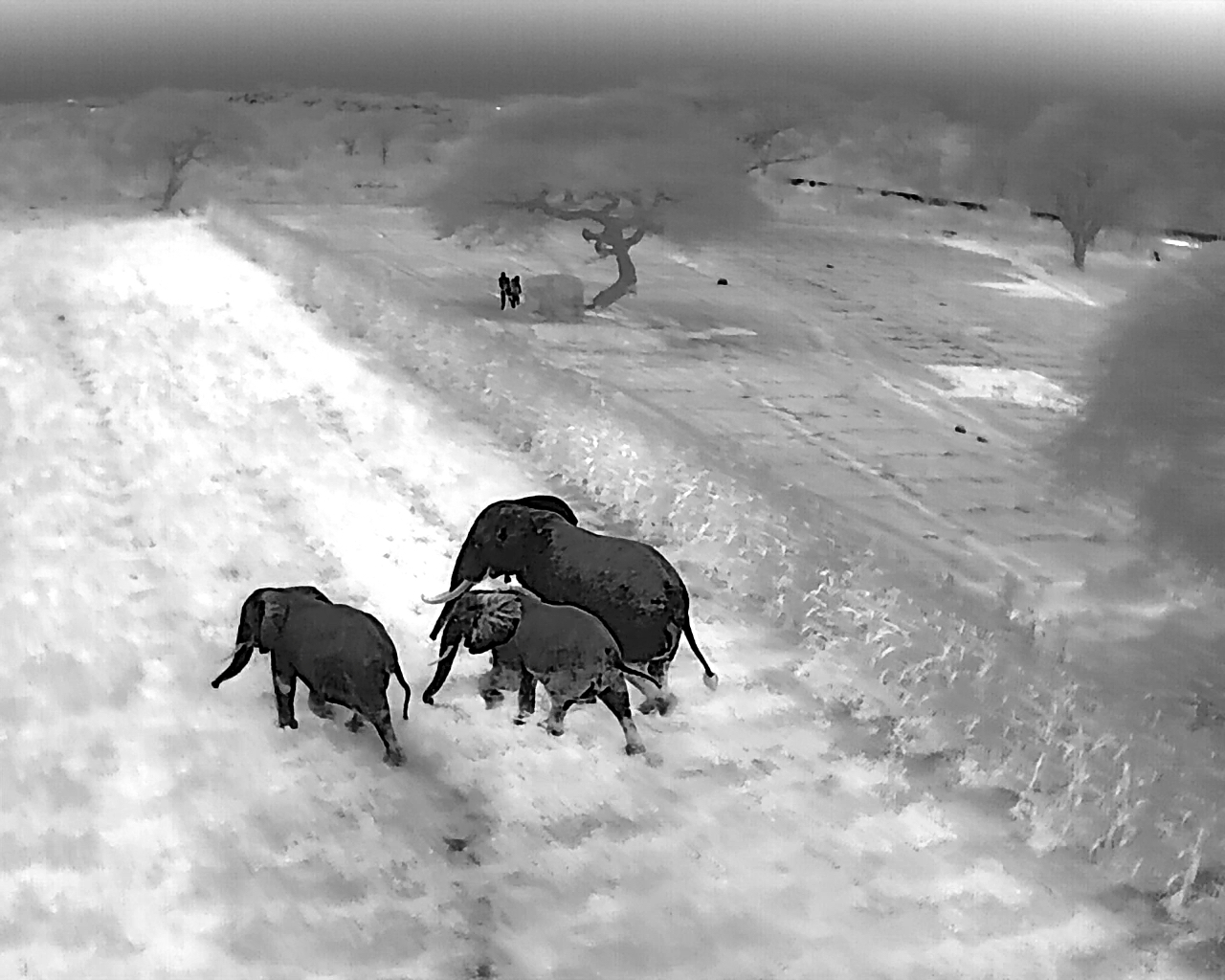
In response to this crisis, conservationists have turned to cutting-edge technology: thermal drones. These unmanned aerial vehicles (UAVs) equipped with infrared sensors enable real-time monitoring of elephant movements, even under low-light conditions. Deployed by organizations like the Big Life Foundation, a U.S.-based nonprofit, these drones serve multiple critical functions:
- Early Warning Systems – By detecting elephant herds before they reach farms, drones allow proactive intervention, reducing sudden encounters.
- Non-Lethal Deterrence – The buzzing sound of drone propellers mimics the threat of predators, causing elephants to retreat without harm.
- Habitat and Movement Tracking – Thermal imaging helps map migration patterns, identify high-risk zones, and assess habitat degradation.
- Anti-Poaching Surveillance – Drones patrol remote areas, deterring poachers and providing evidence for law enforcement.
Amy Baird, Deputy Director of the Big Life Foundation, emphasizes the dual benefits of this approach:
“Beyond data collection, drones act as a force multiplier—they give rangers and communities an edge in managing conflicts without resorting to violence.”
Real-World Impact: Success Stories from Amboseli
Since their large-scale deployment in 2026, thermal drones have demonstrated tangible results. Between May and June 2026 alone, drones were activated in 78 conflict incidents within and around Amboseli:
- 33 successful interventions saw elephants guided back into the park after crossing crop protection fences.
- In additional cases, drones were used for wildlife monitoring, poaching prevention, and habitat assessment.
Jeremy Goss, Program Director at Big Life Foundation, notes a clear reduction in retaliatory violence:
“Thanks to drones, we’ve seen fewer elephant injuries and deaths from human retaliation. This technology is cost-effective, scalable, and far safer than traditional methods like chili oil or thunder flashes.”
Farmers like John Olekina, a 54-year-old father of four from Kimana Sanctuary—a community-managed reserve linking Amboseli to Chyulu Hills and Tsavo West—have firsthand experience with the drones’ effectiveness:
“The drones don’t just scare elephants—they detect them at night, when the risk is highest. It’s a game-changer for us.”
Why Thermal Drones Outperform Traditional Methods
While strategies like fencing, rapid-response rangers, and noise deterrents have had limited success, thermal drones offer superior precision and adaptability. Key advantages include:
- 24/7 Monitoring – Unlike human patrols, drones operate day and night, covering vast areas efficiently.
- Minimal Disturbance – When flown strategically at higher altitudes, drones do not stress wildlife as much as low-altitude flights.
- Cost Efficiency – Compared to permanent fencing or large ranger teams, drones provide long-term savings with immediate results.
However, challenges remain. Elephants are highly intelligent—studies, including one published in Scientific Reports (2025), show that prolonged exposure to drones can lead to habituation. To mitigate this, conservationists adhere to strict flight protocols, ensuring drones are used only for deterrence, not observation, when elephants are near human settlements.
Cross-Border Challenges: The Role of Tanzania
Amboseli’s elephants are not confined by national borders. They migrate across Kenya and Tanzania, spending 80% of their time outside protected areas. While Kenya’s Civil Aviation Authority (KCAA) allows drone operations with proper permits, Tanzania’s regulations are stricter. The Tanzania Civil Aviation Authority (TCAA) and TANAPA (Tanzania National Parks Authority) require special authorization before drones can operate within Tanzanian parks.
This jurisdictional complexity limits the transboundary effectiveness of drone-based solutions. Conservationists argue that coordinated cross-border policies are essential for long-term success, as elephants do not recognize political boundaries.
The Future of Drones in Wildlife Conservation
The experimental use of drones in Kenya began in the early 2010s, with widespread adoption between 2014 and 2016. Since then, KWS and NGOs have integrated UAVs into anti-poaching, habitat mapping, and conflict mitigation programs.
Sospeter Kiambi, a senior conservation researcher at KWS, highlights the critical role of drones in an era of rapid land transformation:
“With Nairobi’s expansion pushing deeper into wildlife corridors, real-time tracking is no longer optional—it’s a necessity. Drones give us the tools to prevent conflicts before they escalate.”
As technology advances, AI-driven drone analytics could further enhance predictive modeling, allowing conservationists to anticipate elephant movements and preemptively secure high-risk areas.
A Community-Driven Solution
The success of drone deployment in Amboseli is not just a technological triumph—it is a collaboration between conservationists, governments, and local communities. Farmers like Dominic Mutua now see drones as more than just a tool—they are a lifeline:
“The drones have reduced our losses by 60% since they started flying. For the first time, we feel hope instead of fear.”
This shift from conflict to coexistence underscores the potential of innovative solutions in preserving Kenya’s wildlife heritage while protecting the livelihoods of those who live alongside it.
Conclusion: A Model for Global Conservation
Amboseli’s drone program serves as a blueprint for human-wildlife conflict resolution in highly pressured ecosystems. By combining cutting-edge technology with community engagement, Kenya is proving that sustainable coexistence is achievable—without compromising either wildlife survival or human welfare.
As the Big Life Foundation’s Jeremy Goss concludes:
“This is not just about saving elephants—it’s about saving the future of shared landscapes where humans and wildlife can thrive together.”
With further refinements in drone technology and cross-border cooperation, the Amboseli model could inspire similar initiatives worldwide, offering a scalable, humane solution to one of the planet’s most pressing conservation challenges.
