


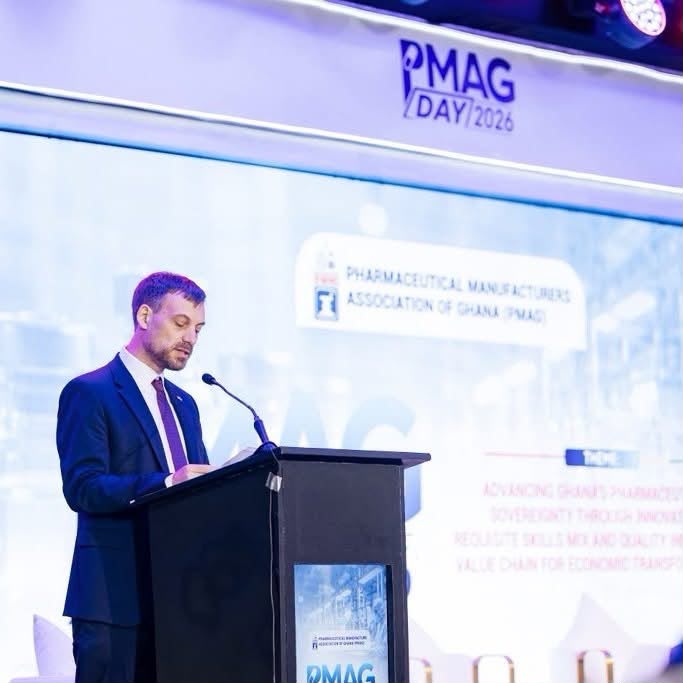
Ghana’s pharmaceutical sector is at a critical juncture, with stakeholders calling for urgent action to bolster domestic drug manufacturing as a cornerstone of national health security and economic resilience. The 2026 Pharmaceutical Manufacturers Association of Ghana (PMAG) Day, held in Accra to commemorate the association’s 27th anniversary, served as a pivotal platform for dialogue on how Ghana can transition from reliance on imports to self-sufficiency in essential medicines and vaccines.
Under the theme “Building a Resilient and Competitive Pharmaceutical Industry,” the event brought together policymakers, industry leaders, researchers, and international partners to explore strategies for strengthening local production, enhancing innovation, and ensuring quality control within Ghana’s pharmaceutical ecosystem. The discussions underscored the need for pharmaceutical sovereignty—the ability to produce critical medicines domestically—as a strategic imperative for health system robustness, economic independence, and preparedness for future health crises.
The Imperative of Pharmaceutical Sovereignty
A resilient pharmaceutical industry is not merely an economic necessity but a public health imperative. The COVID-19 pandemic exposed the vulnerabilities of over-reliance on foreign suppliers, with supply chain disruptions leading to shortages of life-saving drugs and vaccines. Ghana, like many African nations, faces persistent challenges in access to affordable, high-quality medicines, particularly in rural and underserved communities.
Key stakeholders at the PMAG Day emphasized that local manufacturing is the most sustainable solution to these challenges. By investing in domestic production facilities, research and development (R&D), and skilled workforce development, Ghana can:
– Reduce dependency on imports, lowering costs and mitigating risks from global supply chain disruptions.
– Improve access to essential medicines, particularly for chronic and infectious diseases that disproportionately affect vulnerable populations.
– Boost industrial diversification, contributing to Ghana’s Vision 2040 and Industrialization Agenda by creating high-value jobs and fostering innovation.
– Enhance health security, ensuring rapid response capabilities during outbreaks and emergencies.
Key Strategies for a Competitive Pharmaceutical Sector
The discussions at the PMAG Day highlighted several actionable strategies to achieve these goals:
1. Expanding Local Vaccine and Medicine Production
One of the most pressing areas of focus was the scaling up of vaccine and medicine manufacturing. Currently, Ghana imports the majority of its pharmaceutical needs, leaving it vulnerable to external shocks. To address this, stakeholders proposed:
– Government incentives for pharmaceutical companies to invest in local production lines, including tax breaks, subsidies, and streamlined regulatory approvals.
– Public-private partnerships (PPPs) to co-fund research and production facilities, particularly for critical vaccines (e.g., COVID-19, malaria, and yellow fever) and essential drugs (e.g., antibiotics, antiretrovirals, and cancer treatments).
– Capacity building in biotechnology and pharmaceutical engineering to ensure Ghanaian scientists and engineers can design and operate advanced manufacturing plants.
2. Strengthening Quality Control and Regulatory Frameworks
Ensuring consistent quality and safety of locally produced medicines is paramount. The Ghana Food and Drug Authority (GFDA) and other regulatory bodies were urged to:
– Enhance inspection and certification processes to prevent substandard or counterfeit drugs from entering the market.
– Adopt international standards (e.g., Good Manufacturing Practices (GMP), World Health Organization (WHO) prequalification criteria) to build trust in domestic products.
– Invest in advanced testing laboratories to support quality assurance at every stage of production.
3. Fostering Innovation and Research Collaboration
Innovation is the driving force behind cost-effective, high-quality medicines. The PMAG Day emphasized the need for:
– Increased funding for pharmaceutical research, particularly in disease-specific areas such as malaria, tuberculosis, and non-communicable diseases (NCDs).
– Collaboration between universities, research institutions (e.g., Kwame Nkrumah University of Science and Technology (KNUST), Noguchi Memorial Institute for Medical Research), and private sector players to develop generic and biosimilar drugs.
– Patent pooling and technology transfer agreements** to leverage global pharmaceutical advancements while ensuring affordability for Ghanaian patients.
4. Attracting Foreign and Domestic Investment
To accelerate industrial growth, stakeholders called for targeted investment policies, including:
– Special Economic Zones (SEZs) for pharmaceutical manufacturing, offering tax holidays, duty-free imports of raw materials, and infrastructure support.
– Partnerships with multinational pharmaceutical companies to establish joint ventures and licensing agreements for local production.
– Financial incentives for startups and SMEs in the pharmaceutical sector, such as low-interest loans, grants, and venture capital support.
5. Deepening Regional and International Cooperation
Given the transnational nature of health threats, collaboration with global partners is essential. The German Embassy and European Union (EU) reaffirmed their commitment to supporting Ghana’s pharmaceutical sector through initiatives like the PharmaVax Ghana Programme, implemented by GIZ (Deutsche Gesellschaft für Internationale Zusammenarbeit).
This programme, part of the Team Europe Initiative on Manufacturing and Access to Vaccines, Medicines, and Health Technologies in Africa (MAV+), aims to:
– Strengthen Ghana’s pharmaceutical infrastructure by improving regulatory systems, training workforce, and enhancing production capabilities.
– Promote sustainable manufacturing through knowledge transfer, technology access, and market linkages.
– Expand Africa’s collective capacity to produce vaccines and medicines, reducing continental dependence on imports.
The EU Ambassador to Ghana, Rune Skinnebach, and German Deputy Head of Cooperation, Daniel Boehme, highlighted that international cooperation remains critical in addressing infectious diseases, antimicrobial resistance, and emerging health threats that do not respect borders.
Government and Industry Commitments
The event featured high-level participation from Minister of Health, Kwabena Mintah Akandoh, and Presidential Advisor on the 24-Hour Economy, Augustus Goosie Tanoh, who reaffirmed the government’s unwavering support for the pharmaceutical sector. Key commitments included:
– Accelerating the implementation of the National Pharmaceutical Policy to align production with national health priorities.
– Establishing a Pharmaceutical Task Force to oversee the scaling up of local manufacturing and emergency response mechanisms.
– Prioritizing pharmaceuticals in the National Industrialization Plan to ensure sustained investment and policy stability.
The Path Forward: A Call to Action
The PMAG Day concluded with a unified call to action for all stakeholders—government, private sector, academia, and development partners—to work collaboratively toward pharmaceutical sovereignty. The road ahead requires:
✅ Immediate policy reforms to simplify licensing, reduce bureaucratic hurdles, and attract investment.
✅ Strategic public-private partnerships to fund R&D and production facilities.
✅ Investment in human capital, including vocational training and university programs in pharmaceutical sciences.
✅ Strengthened regional integration to leverage collective expertise and resources across Africa.
✅ Sustainable financing mechanisms, such as pharmaceutical levies on imported drugs to fund local production.
Conclusion: A Healthier, More Resilient Ghana
Pharmaceutical sovereignty is not just about economic self-reliance—it is about protecting lives, empowering communities, and securing Ghana’s future. By investing in local manufacturing, innovation, and collaboration, Ghana can transform its pharmaceutical sector into a driver of economic growth, a shield against health crises, and a model for Africa.
As the PMAG Day demonstrated, the time for talk is over—the time for action is now. With unified commitment and strategic execution, Ghana can achieve a resilient, competitive, and self-sufficient pharmaceutical industry that ensures health security for all citizens.
