


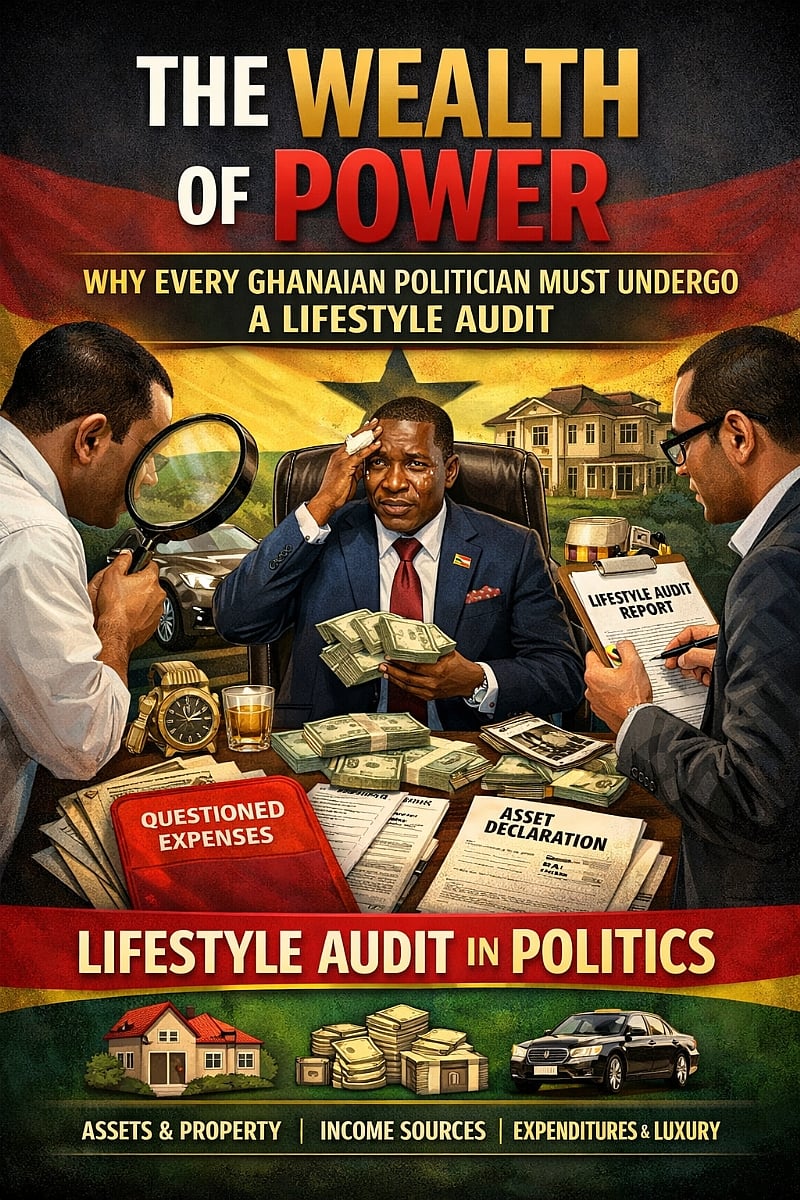
The Silent Crisis: How Politics Became a Wealth Machine in Ghana
In the quiet corners of Ghanaian homes, on the backseats of trotro vehicles, and in the late-night debates of social media forums, a question lingers unspoken but undeniable:
If politics is meant to serve the people, why do so many politicians emerge from office wealthier than the institutions they were elected to lead?
This is not a question of envy. It is a question of accountability. How does a public servant—someone who once struggled to make ends meet—suddenly own multiple luxury properties, drive high-end vehicles, and send their children to elite foreign universities, all while the average Ghanaian grapples with rising costs, underfunded schools, and crumbling infrastructure?
The answer, many argue, lies in corruption—but not just the theft of public funds. It lies in the unexplained accumulation of wealth by those entrusted with managing public resources. While Ghana has made strides in anti-corruption efforts, the focus has largely been on post-theft investigations—tracking where stolen money disappears. Yet, the real question should be:
Where did the wealth come from in the first place?
This is where lifestyle audits become not just a tool, but a necessity.
What Is a Lifestyle Audit—and Why Does Ghana Need It?
A lifestyle audit is a comprehensive, independent assessment that examines the financial trajectory of a politician by comparing their declared assets, income, and public disclosures against the lifestyle they lead. Unlike traditional financial audits, which focus on transactions, a lifestyle audit asks:
- Can their wealth be reasonably explained by their declared salary and legitimate income?
- Do their assets align with their public financial disclosures?
- Are there unexplained gaps between their financial statements and their actual living standards?
A thorough lifestyle audit would scrutinize:
- Income and Salary Verification
- Are their declared salaries accurate?
-
Do they have additional income sources not disclosed?
-
Property and Landed Assets
- How many properties do they own?
- Were any acquired during their tenure in office?
-
Are there undeclared properties in their name or that of family members?
-
Luxury Purchases and Vehicles
- Do they own multiple high-end cars, yachts, or private jets?
-
Were these acquired through legitimate means?
-
Investments and Business Interests
- Do they have stakes in private companies?
-
Were any businesses established or expanded during their political career?
-
Domestic and International Travel
- Are their travel expenses proportional to their declared income?
-
Do they frequently fly first-class or stay in luxury hotels?
-
Bank Accounts and Financial Transactions
- Are there unexplained deposits or large cash transactions?
-
Do they have accounts in offshore jurisdictions?
-
Family-Owned Assets
- Do their spouses or children own properties, businesses, or assets that were not declared?
-
Were any assets transferred to family members during their political career?
-
Gifts, Donations, and Undeclared Income
- Have they received substantial gifts, loans, or donations from private entities?
- Were any of these transactions properly documented?
At its core, a lifestyle audit exposes the gap between what politicians claim to earn and what they actually possess. If the discrepancy cannot be justified, it raises serious red flags about potential corruption, conflict of interest, or financial misconduct.
The Uncomfortable Truth: Why Politicians Are Among the Richest in Ghana
Ghana, like many developing nations, has a disturbing paradox: while the majority of citizens struggle with poverty, unemployment, and inadequate public services, politicians and their families often live in opulence.
Why is this happening?
- Politics as a Wealth Accumulation Strategy
- For some, entering politics is not about service—it is about access to public funds, contracts, and opportunities that allow for rapid wealth accumulation.
-
Unlike entrepreneurship, which requires risk, investment, and time, politics offers instant financial rewards through procurement contracts, land grabs, and favoritism.
-
The Culture of Impunity
- Many politicians believe they are above scrutiny—that their positions shield them from consequences.
-
When corruption is discovered, investigations are slow, inconsistent, or politically motivated, discouraging accountability.
-
The Abandonment of Public Projects
- While politicians build luxury mansions, roads remain unpaved, schools lack basic facilities, and hospitals operate without essential supplies.
-
This double standard—where public resources fund private wealth—fuels public distrust.
-
The Myth of “Sacrifice”
- Politicians often claim they “sacrifice” for the nation, yet their children attend expensive foreign universities, they drive luxury vehicles, and they own multiple properties.
-
Where is the real sacrifice when the people they serve are left behind?
-
The Erosion of Public Trust
- When citizens see their leaders living in excess while public services deteriorate, disillusionment grows.
- This trust deficit makes it harder to attract investment, implement reforms, and build a prosperous, united nation.
Can Lifestyle Audits Save Ghana?
The short answer: Yes—but only if implemented correctly.
A well-structured lifestyle audit system could:
1. Restore Public Accountability
- Politicians would think twice before misappropriating funds if they know their every financial move is under scrutiny.
- The fear of exposure would act as a deterrent against corruption.
2. Ensure Better Use of Public Funds
- If money meant for schools, hospitals, and infrastructure is not being diverted into private pockets, these sectors would finally receive the funding they need.
- Imagine completed roads, functional hospitals, and job-creating industries—instead of ghost projects and abandoned contracts.
3. Boost Investor Confidence
- Foreign and local investors prefer transparent, low-corruption environments.
- If Ghana publicly audits its leaders’ wealth, it sends a strong signal that corruption will not be tolerated, making the country more attractive for business.
4. Rebuild Public Trust
- When citizens see that their leaders cannot hide their wealth, distrust turns into hope.
- Transparency proves that public office is a responsibility, not a personal bank account.
5. Reduce Opportunities for Corruption
- Corruption thrives in secrecy. Lifestyle audits expose financial discrepancies, making it harder to launder money, embezzle funds, or engage in kickbacks.
- Common forms of corruption—such as bribery, procurement fraud, and money laundering—would become far more difficult to conceal.
Will Lifestyle Audits Eliminate Corruption Completely?
No. Corruption is adaptive—it will find new ways to operate if not properly addressed. However, lifestyle audits would make it significantly harder by:
- Exposing financial inconsistencies before money is stolen.
- Creating a culture of accountability where politicians think twice before engaging in corrupt practices.
- Making corruption more visible, allowing for faster investigations and prosecutions.
Countries like South Africa, Nigeria, and Kenya have experimented with asset declaration and lifestyle audits, with mixed but promising results. While some politicians have faced legal consequences, others have voluntarily disclosed assets to avoid scrutiny. The key is consistency, independence, and public transparency.
Should Lifestyle Audits Be Public?
Absolutely.
Public office is funded by taxpayers. If citizens pay politicians’ salaries, they have the right to know:
✅ What assets politicians declared before taking office.
✅ What they acquired while in power.
✅ What they own after leaving office.
Transparency is the foundation of democracy. If asset declarations remain hidden documents, they become useless. The public deserves access to this information to hold leaders accountable.
Imagine a digital portal where every Ghanaian could:
– Track a politician’s wealth over time.
– Compare their declared salary to their actual assets.
– See if their children’s education expenses match their financial disclosures.
This real-time transparency would force politicians to live within their means—or face public backlash.
How Can Ghana Implement Effective Lifestyle Audits?
A well-structured lifestyle audit system should operate in three phases:
1. Before Assuming Office (Pre-Entry Audit)
- Politicians must fully disclose:
- Bank accounts (local and offshore).
- Properties (owned or co-owned).
- Vehicles and luxury assets.
- Business interests and investments.
- Liabilities and debts.
- This baseline data ensures comparison over time.
2. During Office (Ongoing Monitoring)
- Independent institutions (such as the Anti-Corruption Bureau (ACB) or a dedicated Lifestyle Audit Commission) should:
- Monitor major financial transactions (e.g., sudden property purchases, business expansions).
- Verify procurement contracts to ensure no conflicts of interest exist.
- Check tax compliance—are they paying their fair share?
- Audit family members’ assets—since corruption often involves shell companies and hidden wealth.
- Regular audits (every 1-2 years) would make it impossible to hide wealth.
3. After Leaving Office (Exit Audit)
- Politicians must submit a final asset declaration before leaving office.
- If they gain significant wealth during their tenure, investigations should be mandatory.
- Post-office audits would ensure that no wealth is unaccounted for.
Can Technology Make Lifestyle Audits More Effective?
Absolutely.
Ghana can leverage digital tools to enhance transparency and accountability, such as:
✔ A Public Asset Declaration Portal
– Where citizens can view politicians’ financial disclosures in real time.
– AI-driven alerts for suspicious transactions (e.g., sudden large deposits).
✔ Blockchain for Transparent Record-Keeping
– Immutable ledgers would prevent fraudulent alterations to financial records.
– Smart contracts could automatically flag discrepancies.
✔ Real-Time Spending Trackers
– Politicians could be required to link their bank accounts to a public spending tracker, showing how every kobo is used.
✔ Whistleblower Protection & Anonymous Tips
– A secure platform where citizens can report suspicious wealth accumulation without fear of retaliation.
By combining technology with strict enforcement, Ghana could create a system where corruption is not just detected—but prevented.
What Are Ghanaians Saying? The Growing Demand for Accountability
The frustration among ordinary Ghanaians is palpable. In radio talk shows, social media debates, and public forums, citizens repeatedly ask:
🔹 “Why do politicians seem untouchable by economic hardship?”
🔹 “Why do public services remain inadequate despite massive government spending?”
🔹 “Why do corruption scandals keep emerging, yet no one is held accountable?”
🔹 “Is politics really about serving Ghana—or is it the easiest way to get rich?”
The public sentiment is clear: “If you want to serve the people, prove that you are serving—not stealing.”
Ghanaians are no longer willing to accept excuses. They want:
✅ Stronger anti-corruption laws with real enforcement.
✅ Full transparency in politicians’ financial dealings.
✅ Meaningful consequences for illicit enrichment.
What Are Politicians Saying? The Pushback Against Lifestyle Audits
While many Ghanaians demand greater accountability, some politicians resist lifestyle audits, citing concerns such as:
🚫 “It’s politically motivated.”
– Some argue that audits could be used to target opponents rather than fight corruption.
🚫 “It violates privacy.”
– Politicians claim that personal financial matters should not be publicly scrutinized.
🚫 “Asset declarations already exist.”
– They point to existing laws (such as the Public Financial Management Act) and argue that strengthening enforcement is enough.
🚫 “It could discourage honest public servants.”
– A few believe that excessive scrutiny might drive away capable leaders.
These concerns are valid—but not insurmountable.
The solution is a well-regulated, independent, and politically neutral system where:
✔ Audits are conducted by impartial bodies (not political appointees).
✔ Privacy is protected—only financial discrepancies are exposed, not personal details.
✔ Consequences are clear—those found guilty of corruption face legal action.
✔ Transparency is mandatory—citizens deserve to know how their leaders spend public money.
The real goal is not political persecution—it is public accountability.
What Is the Government Doing? Progress and Gaps
Successive Ghanaian governments have taken steps to combat corruption, including:
✅ Asset Declaration Requirements (for public officials).
✅ Strengthening of Anti-Corruption Bodies (ACB, EFCC, etc.).
✅ Procurement Regulations to prevent favoritism in contracts.
✅ Financial Auditing Mechanisms to track public spending.
✅ Public Financial Management Reforms to improve transparency.
However, public confidence remains low because:
🔸 Implementation is inconsistent—some politicians ignore declarations.
🔸 Investigations take years—many corruption cases remain unresolved.
🔸 Enforcement is weak—even when corruption is proven, punishments are lenient.
Without strict enforcement, even the best laws become meaningless.
A Vision for a New Ghana: What Could Happen If Lifestyle Audits Were Mandatory?
Imagine a Ghana where:
🌟 Every Minister, MP, and Local Chief Executive undergoes a mandatory lifestyle audit.
🌟 Citizens can track a politician’s wealth from day one of their tenure.
🌟 Unexplained wealth automatically triggers investigations.
🌟 Corruption becomes harder than honesty.
In this scenario:
✔ Fewer people would enter politics for money—because the risks outweigh the rewards.
✔ Public projects would finally get completed—since funds would not be diverted.
✔ Hospitals would be properly funded—no more ghost hospitals or abandoned clinics.
✔ Schools would improve—with teachers paid on time and classrooms equipped.
✔ Youth would have jobs—because corrupt elites won’t hoard resources.
This is not a fantasy. It is a realistic possibility if Ghana commits to real accountability.
Final Thoughts: The Choice Before Ghana
Ghana is not lacking in resources. It is not lacking in talent. It is not lacking in opportunities.
What Ghana often lacks is accountability.
The greatest tragedy of corruption is not just the money stolen—it is the dreams stolen from millions of Ghanaians who struggle daily because public resources are siphoned into private pockets.
Lifestyle audits are not about embarrassing politicians. They are about:
🔹 Protecting democracy.
🔹 Preserving public trust.
🔹 Ensuring leadership remains a sacred responsibility—not a lucrative business.
If a politician’s wealth is honestly earned, then a lifestyle audit proves their integrity.
But if public office has become a pathway to unexplained riches, then every Ghanaian deserves to know.
The real question is no longer whether Ghana needs lifestyle audits.
The question is: If politicians have nothing to hide, why should they fear transparency?
By: Patrick Belebang Yagsori
📞 +233240292413
📧 [email protected]
