


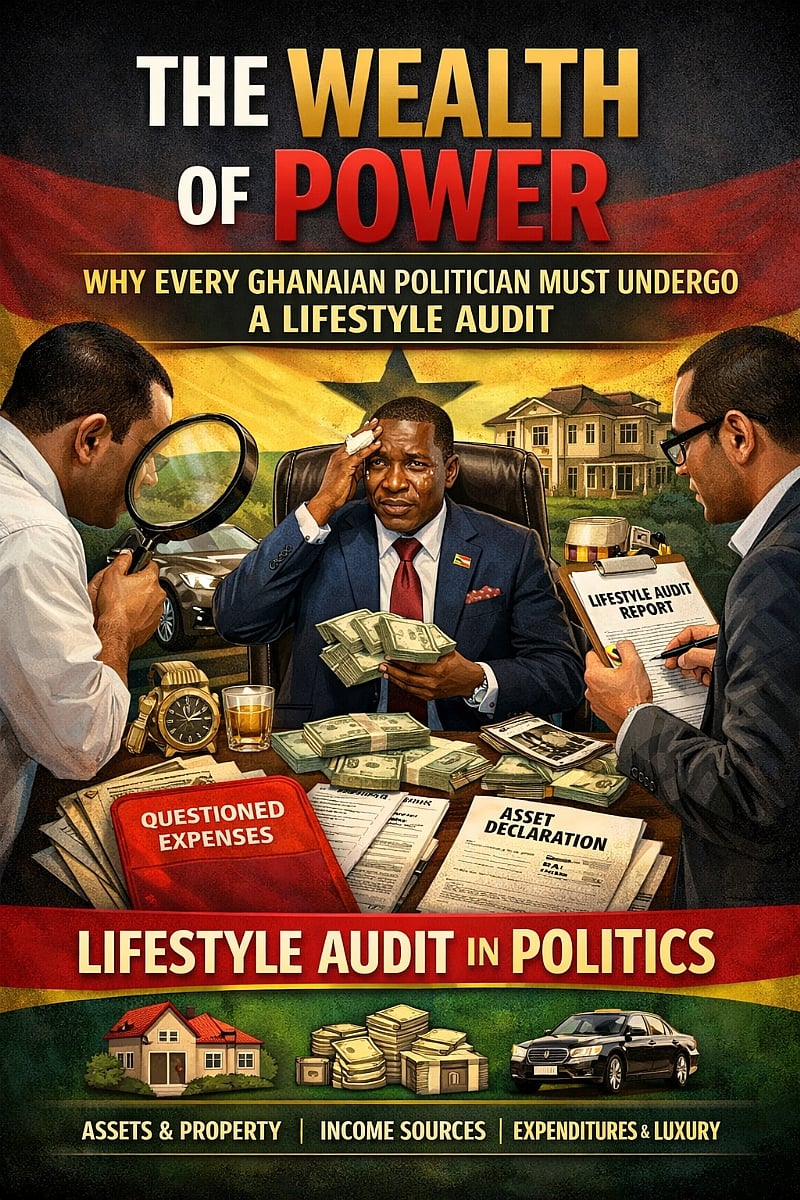
The Unspoken Truth: How Politics Became a Wealth-Building Machine in Ghana
In the quiet corners of Ghanaian homes, the question lingers unspoken: “If politics is meant to serve the people, why do so many politicians emerge from office richer than the institutions they were elected to lead?” The frustration is palpable—seen in the crowded streets where potholes remain unfilled, in the schools without textbooks, and in the hospitals where basic supplies are scarce. Meanwhile, some politicians live in mansions, drive luxury cars, and send their children to elite foreign universities—all while the average Ghanaian struggles to afford basic necessities.
This disparity isn’t just a matter of perception; it’s a systemic failure of accountability. For decades, Ghana has grappled with corruption, but the focus has largely been on after-the-fact investigations—tracking stolen funds once they’ve vanished. Yet, the real question remains unanswered: Where does the wealth come from before it disappears?
This is where lifestyle audits—a rigorous, independent assessment of a politician’s financial dealings—become not just necessary, but indispensable.
What Is a Lifestyle Audit, and Why Does Ghana Need It?
A lifestyle audit is a comprehensive, data-driven examination of a public official’s financial activities, comparing their declared assets, income, and expenditures against the lifestyle they publicly display. Unlike traditional asset declarations, which are often voluntary or poorly enforced, a lifestyle audit goes further by:
- Cross-referencing declared income with visible wealth (e.g., properties, vehicles, investments).
- Analyzing spending patterns—luxury travel, private schools for children, high-end real estate purchases.
- Tracking financial transactions—unexplained bank deposits, offshore accounts, or sudden business ventures.
- Investigating family assets—properties, businesses, or assets held by spouses or relatives.
- Examining public contracts and procurement deals—whether politicians benefit financially from government tenders.
- Monitoring post-office wealth—do politicians retain or grow their wealth after leaving public service?
At its core, a lifestyle audit asks one critical question: Can a politician’s wealth be reasonably explained by their legitimate salary and declared assets? If not, the public has a right to demand answers.
The Shocking Reality: How Politicians Become Millionaires While Ghana Struggles
The numbers tell a disturbing story. According to the Transparency International Ghana Corruption Barometer, nearly 60% of Ghanaians believe corruption has worsened in the past five years. Yet, despite public outrage, few politicians face meaningful consequences for financial misconduct.
Consider these glaring contradictions:
- From Struggle to Luxury: Many politicians enter office with modest means—yet within four to eight years, they own multiple properties, luxury vehicles, and offshore investments. How?
- The Mansion Paradox: While Ghanaian cities suffer from unpaved roads and collapsing infrastructure, some politicians live in multi-million cedis mansions with private pools and security details.
- The Education Gap: Children of politicians attend expensive international schools (often costing $50,000–$100,000 per year), yet their parents’ declared salaries barely cover a fraction of that cost.
- The Post-Office Windfall: Some politicians increase their wealth after leaving office, suggesting they used their positions to amass private fortunes.
- The Luxury Convoys: Campaigning in modest vehicles but ruling in armadas of Mercedes and SUVs—where does the money come from?
These are not isolated cases. They are systemic patterns that suggest politics in Ghana has become less about service and more about self-enrichment.
Why Lifestyle Audits Are the Key to Breaking the Cycle
If Ghana is serious about reducing corruption, improving public trust, and ensuring fair development, lifestyle audits must become a mandatory, transparent, and enforceable practice. Here’s how they can transform the political landscape:
1. Restoring Public Accountability
- Politicians will think twice before embezzling public funds if they know their every financial move is under scrutiny.
- Real-time monitoring of asset declarations could expose sudden wealth spikes that don’t align with declared income.
2. Ensuring Public Funds Reach Their Intended Beneficiaries
- If roads, schools, and hospitals are funded by taxpayers, citizens deserve to know:
- Where the money goes.
- Why some projects are abandoned.
- Why corruption scandals keep emerging.
- Lifestyle audits would deter misappropriation by making corrupt officials financially vulnerable.
3. Boosting Investor Confidence
- Foreign and local investors hesitate to commit capital to Ghana due to perceived corruption risks.
- Transparent asset declarations and lifestyle audits would signal to investors that Ghana is serious about good governance.
4. Rebuilding Public Trust
- A 2022 Afrobarometer survey found that only 28% of Ghanaians trust their government.
- When politicians voluntarily submit to audits, it sends a message: “We have nothing to hide.”
- Publicly accessible audit reports would allow citizens to hold leaders accountable in real time.
5. Making Corruption Harder to Conceal
Corruption thrives in secrecy. Lifestyle audits expose financial irregularities by:
– Tracking unexplained bank deposits.
– Investigating sudden business ventures.
– Revealing conflicts of interest.
– Detecting money laundering schemes.
Countries like Singapore, Norway, and Botswana have successfully implemented strict asset declaration laws, leading to lower corruption rates. Ghana can learn from their models.
The Case for Public Lifestyle Audits: Why Transparency Must Be Mandatory
Some argue that lifestyle audits invade privacy. But here’s the truth:
- Public office is funded by taxpayers. If citizens pay politicians’ salaries, they have the right to know how those funds are used.
- Asset declarations should not be hidden. They should be publicly accessible, like company financial reports.
- Corruption is a public problem. The more transparent the system, the harder it is for officials to hide illicit wealth.
Imagine a digital portal where every Ghanaian could:
✅ See a politician’s declared assets before, during, and after office.
✅ Compare their salary to their accumulated wealth.
✅ Track public contracts awarded to companies linked to politicians.
✅ Report suspicious financial activities in real time.
This level of transparency would make corruption a financial liability—not a reward.
How Ghana Can Implement Effective Lifestyle Audits
For lifestyle audits to work, they must be:
✔ Independent – Conducted by neutral institutions (not political appointees).
✔ Regular – Annual or bi-annual audits to prevent “one-time declarations.”
✔ Public – Real-time updates so citizens can monitor their leaders.
✔ Enforced – Strict penalties for false declarations or hidden wealth.
A Step-by-Step Implementation Plan
| Phase | Action Required | Key Focus Areas |
|———–|———————-|———————-|
| Before Taking Office | Mandatory asset declaration (properties, bank accounts, businesses, debts) | Prevents politicians from entering office with hidden wealth. |
| During Office | Real-time monitoring of:
– Major purchases (vehicles, real estate).
– Procurement deals (conflicts of interest).
– Family assets (spouses, children).
– Tax compliance. | Detects sudden wealth accumulation. |
| After Leaving Office | Exit audits – Verifies if wealth matches declared assets. | Ensures politicians do not retain ill-gotten gains. |
| Post-Office Tracking | Continuous monitoring for 5–10 years after leaving office. | Prevents “revolving door” corruption. |
Technology can play a crucial role:
– AI-driven financial analysis to detect anomalies in spending.
– Blockchain-based asset tracking to prevent fraudulent declarations.
– Citizen reporting portals where Ghanaians can flag suspicious activities.
The Public’s Demand: Why Ghanaians Are Calling for Change
The frustration among ordinary Ghanaians is palpable. In town hall meetings, social media debates, and radio discussions, the same questions resurface:
- “Why do politicians live in luxury while our roads are broken?”
- “Why do they send their kids to foreign schools on government salaries?”
- “Why do corruption scandals keep emerging despite laws?”
- “Is politics just a way to get rich, or are they really serving Ghana?”
The answer is clear: Ghanaians want accountability. They are tired of empty promises and want leaders who serve, not steal.
A 2023 Ghanaian opinion poll revealed that:
– 72% of respondents believe politicians enrich themselves at the expense of the public.
– 65% support stricter financial disclosure laws.
– 89% want public officials to undergo mandatory lifestyle audits.
The message is unmistakable: If you want to serve Ghana, prove it by being transparent.
The Politicians’ Stance: Resistance and Counterarguments
Not all politicians support lifestyle audits. Some oppose them on principle, arguing:
- “It’s an invasion of privacy.”
-
Rebuttal: Public office is not private. Taxpayers fund salaries, and citizens have a right to know.
-
“It’s politically motivated.”
-
Rebuttal: If a politician has nothing to hide, they should welcome transparency.
-
“Asset declarations already exist.”
-
Rebuttal: Current systems are weakly enforced. Lifestyle audits add real-time monitoring.
-
“It discourages honest public servants.”
- Rebuttal: If a politician’s wealth is legitimately earned, they have nothing to fear.
The truth is, lifestyle audits are not about punishing politicians—they’re about ensuring that public office remains a sacred trust, not a pathway to wealth**.
What Ghana’s Government Must Do Now
Successive governments have taken steps toward anti-corruption:
– Asset declaration laws (though poorly enforced).
– Anti-corruption agencies (ECC, EFCC, ACG).
– Procurement reforms (to reduce kickbacks).
– Financial audits (though often delayed).
But the problem is enforcement. Many corruption cases take years to investigate, and few officials face real consequences.
The solution?
✅ Mandate lifestyle audits for all ministers, MPs, CEOs of public institutions, and local leaders.
✅ Create a public digital portal where citizens can track financial disclosures.
✅ Strengthen anti-corruption bodies with independent investigators.
✅ Implement strict penalties for false declarations or hidden wealth.
The Vision of a Corruption-Free Ghana
Imagine a Ghana where:
✔ Every politician’s wealth is publicly verified.
✔ Public funds go to roads, schools, and hospitals—not private bank accounts.
✔ Corruption is so costly that it’s financially irrational to engage in it.
✔ Ghanaians trust their leaders because they see transparency in action.
This is not a distant dream—it’s a realistic possibility if Ghana adopts mandatory lifestyle audits.
Final Thought: The Choice Is Clear
Ghana does not lack resources. It does not lack talent. It does not lack opportunity.
What Ghana lacks is accountability.
The greatest tragedy of corruption is not the stolen money—it’s the stolen dreams. The schools that never get built, the hospitals that lack medicine, the youth who cannot find jobs—all because public resources are diverted into private pockets.
Lifestyle audits are not about embarrassing politicians. They are about:
✅ Protecting democracy.
✅ Restoring public trust.
✅ Ensuring leadership is a sacred responsibility, not a lucrative business.
If a politician’s wealth is honestly earned, then a lifestyle audit is a badge of integrity.
But if public office has become a pathway to unexplained riches, then every Ghanaian deserves to know.
The question is no longer whether Ghana needs lifestyle audits.
The real question is: If politicians have nothing to hide, why should they fear transparency?
By: [Author Name]
(Contact: [Email] | [Phone])
