


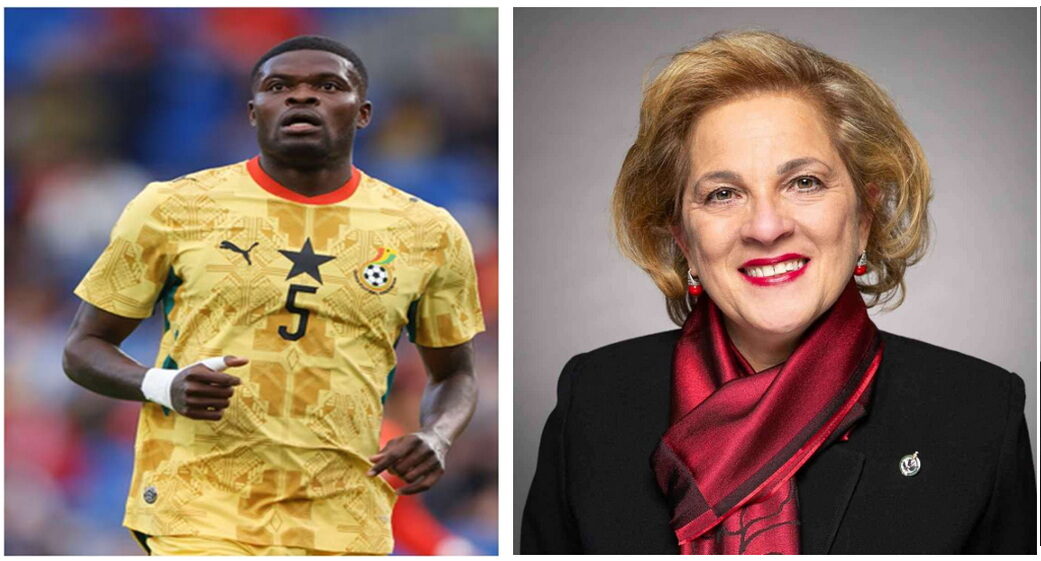
Thomas Partey and Lena Diab, Minister of Immigration, Refugees & Citizenship, Canada
The sudden and dramatic decision by Canadian authorities to deny entry to Ghana’s star midfielder, Thomas Partey, ahead of the national team’s opening FIFA World Cup fixture against Panama on Wednesday, June 17, has sparked significant legal, diplomatic, and sporting controversy. What initially appeared to be a routine administrative visa dispute has evolved into a complex international legal and diplomatic issue. In response to the ban, Ghana’s foreign affairs ministry and football association have lodged a formal protest, asserting that excluding an unconvicted elite athlete is fundamentally unfair, discriminatory, and against the Rule of Law. Meanwhile, Canada has remained tight-lipped, invoking privacy protocols to keep the definitive legal basis of the refusal under wraps, while FIFA has prudently retreated, deferring strictly to Canada’s sovereign authority over its own borders.
The Missing Document
At the epicenter of this brewing international standoff lies a missing document— the official visa refusal letter that may have been issued to Partey. This administrative artifact holds the precise legal rationale that could either vindicate
or expose Canada’s decision-making process. Until it surfaces, the dispute forces us to confront a profound and unsettling systemic question: can a constitutional state lawfully use its immigration powers to exclude a foreign national based purely on serious criminal allegations that have never been tested or proven in a court of law? The core tension of modern transnational movement exists precisely here: the unyielding criminal presumption of innocence routinely collides with the risk-focused and highly discretionary machinery of state immigration law.
The Legal Schism: Presumption of Innocence vs. Immigration Risk
To understand why this dispute has reached a diplomatic standstill, one must untangle two inherently conflicting legal philosophies. Ghana’s vehement defense of Partey, who is also the Deputy Captain of the Black Stars, the national team, relies almost entirely on the presumption of innocence. Currently facing serious, unresolved criminal charges in the United Kingdom relating to allegations of rape and sexual assault, Partey has entered formal pleas of not guilty. Under both British and international human rights frameworks, he remains legally innocent until a jury of his peers decides otherwise. Ghana argues that denying entry on the basis of unproven allegations risks imposing consequences before Partey’s criminal liability has been established.
However, international immigration law functions on an entirely separate axis. While criminal law is punitive, reactive, and retrospective—demanding absolute certainty before depriving a human being of liberty—immigration control is preventive, prospective, and protective. Sovereign states are not tasked with determining a traveler’s ultimate moral or criminal guilt at a port of entry; rather, they perform forward-looking assessments of public safety and statutory risk. Consequently, an individual’s right to the presumption of innocence does not grant them an unbridled passport to cross international borders.
Inside the Canadian Framework: IRPA Section 36
Should the refusal letter reveal that Canada issued a formal finding of inadmissibility, Canadian statutory law provides a robust mechanism under Section 36(1)(c) of the Immigration and Refugee Protection Act (IRPA). This strict provision dictates that a foreign national can be deemed inadmissible for “serious criminality” if they have committed an act outside Canada that, if perpetrated within Canadian borders, would constitute an offense punishable by a maximum prison term of at least 10 years. Crucially, Section 36(1)(c) explicitly notes that a formal conviction is not a prerequisite for exclusion. The law empowers visa
officers to rely on conduct-based assessments rather than waiting for a slow- moving foreign criminal justice system to reach a final verdict.
Because the allegations leveled against Partey in the United Kingdom—rape and aggravated sexual assault—carry maximum sentences well exceeding the 10-year statutory benchmark under the Criminal Code of Canada, they seamlessly trigger the “serious criminality” threshold. The pivotal question is how a visa officer can lawfully determine that an act was “committed” when a trial is still pending. The answer lies in landmark Canadian jurisprudence. In the seminal Supreme Court of Canada decision in Mugesera v. Canada, the Court established that immigration decision-makers operate under a “reasonable grounds to believe” evidentiary standard. This threshold requires significantly more than mere suspicion or rumor, yet falls substantially short of the civil “balance of probabilities” and completely bypasses the rigorous criminal standard of “beyond a reasonable doubt.” In practice, formal criminal charges, prosecutorial findings, and supporting evidentiary materials from British police may provide Canadian immigration authorities with sufficient information to conclude that the statutory threshold has been met.
Furthermore, as clarified in Tran v. Canada, while immigration officers must adhere to precise statutory interpretations of seriousness and their rulings remain fully subject to judicial review for reasonableness, Canadian courts grant immense deference to these preventive border measures.
The Federal Court’s decision in Hill v. Canada (Minister of Public Safety and Emergency Preparedness) further illustrates the breadth of Canada’s criminal inadmissibility regime. In that case, the Court reaffirmed that immigration authorities are entitled to assess foreign conduct independently of the outcome of criminal proceedings and may rely on credible and compelling evidence of underlying acts even where no Canadian conviction exists. The decision underscores the principle that immigration law is not designed to punish past wrongdoing but to manage prospective risks associated with admitting foreign nationals into Canada.
While each case turns on its own facts, Hill reinforces the proposition that Canadian immigration officials are not necessarily required to await the conclusion of criminal trials abroad before making admissibility determinations. For critics of Canada’s decision, the case highlights the expansive discretion vested in immigration authorities; for defenders, it provides further jurisprudential support for preventive border measures grounded in public safety considerations.
The Easier Path: Pure Administrative Discretion
It is entirely plausible, however, that Canada skipped the complex mechanism of a formal Section 36 inadmissibility finding altogether. Instead, immigration authorities may have relied on the broad, discretionary denial of a Temporary Resident Visa (TRV). Under this pathway, an applicant bears the legal burden to convince an officer that they fulfill all entry criteria, including being of good character and posing zero risk to public order. A pending criminal prosecution for a violent offense is a self-evident basis for an officer to exercise sweeping statutory discretion to refuse a visa, insulated from the strenuous evidentiary hurdles required to declare someone formally inadmissible.
Even if Canadian authorities concluded that Partey was inadmissible under IRPA, the law provides a potential mechanism for temporary entry. Through a Temporary Resident Permit (TRP), immigration authorities may authorize entry where the benefits of admission outweigh any identified risks. Participation in a FIFA World Cup would likely constitute the type of exceptional circumstance capable of supporting such an application. Whether Canada considered or rejected this option remains unknown.
Comparative Law: Global Parallels and the Multi-Host Crisis
Canada’s position is far from anomalous; it aligns with a broader, unyielding trend across common law jurisdictions. Australia possesses broad character-based exclusion powers under Section 501 of its Migration Act—most famously demonstrated when it first canceled tennis star Novak Djokovic’s visa on January 6, 2022, and again on January 14, after a federal circuit court overturned the first cancellation, proving that sporting prestige offers no immunity against border laws. Similarly, the United Kingdom wields wide “conducive to the public good” exclusion mandates, and New Zealand routinely denies entry to individuals entangled in active foreign criminal proceedings.
However, the Partey case exposes a severe operational structural flaw for the future of global sports governance. As major tournaments—such as the FIFA World Cup and the Olympic Games—increasingly transition to complex, multi-host formats split across borders (such as the United States, Canada, and Mexico hosting this year’s World Cup), conflicting immigration regimes create an administrative nightmare. While the United States’ historical architecture places a heavy emphasis on formal convictions and offers established, high-profile waiver mechanisms
specifically optimized for international delegations and elite cultural events, Canada’s IRPA enforces a stricter, less flexible standard of criminal risk.
Conclusion: Sovereignty Over Sport
Ultimately, the Partey visa dispute underscores a sobering reality. If the refusal letter reveals that Canadian authorities anchored their decision in IRPA Section 36, backed by certified UK prosecutorial documents, Canada’s legal position would be significantly strengthened. International law generally recognizes the sovereign right of states to control admission into their territories, subject to limited treaty obligations.
While Ghana’s arguments regarding competitive equity and the presumption of innocence are compelling in the court of public opinion, they hold little currency at the border. And given the limited time available for mounting a legal challenge against Canadian immigration authorities before the match is played on Wednesday, June 17, Ghana’s viable option may be to step up its bilateral and diplomatic engagements with Canada for a waiver to enable Partey to feature in the game against Panama, which is just a few days away.
Finally, FIFA host-country guarantees are designed to facilitate the participation of players and officials. Although these guarantees do not override domestic immigration laws, the Partey dispute highlights the tension between sovereign border control and the expectation that qualified athletes will be able to compete in host nations. This risk leaves FIFA with a daunting systemic challenge: if multi- host nations cannot harmonize their border policies, the integrity of global tournaments will remain permanently at the mercy of localized, sovereign risk assessments.
The author, William Nyarko, is the Executive Director of the Africa Centre for International Law and Accountability (ACILA)
DISCLAIMER: The Views, Comments, Opinions, Contributions and Statements made by Readers and Contributors on this platform do not necessarily represent the views or policy of Multimedia Group Limited.
DISCLAIMER: The Views, Comments, Opinions, Contributions and Statements made by Readers and Contributors on this platform do not necessarily represent the views or policy of Multimedia Group Limited.
