

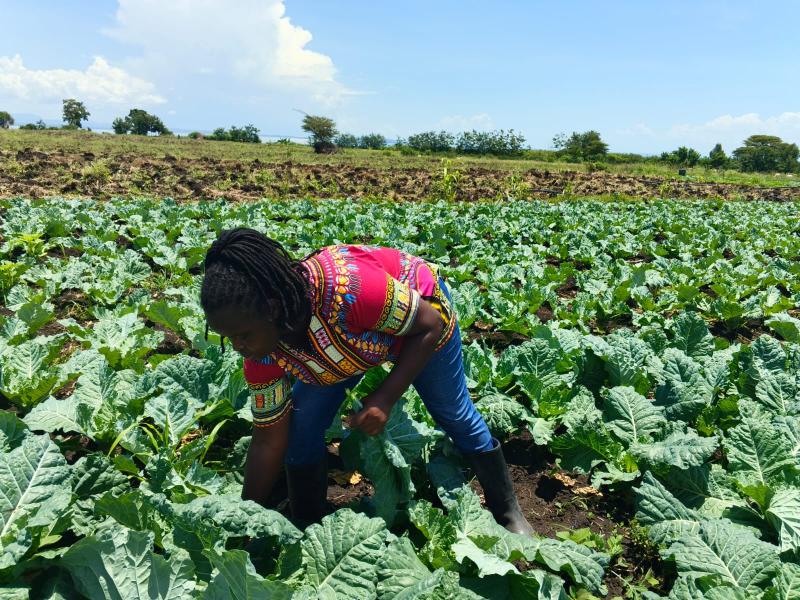
 Young farmer./FILE
 Experts
say climate-smart technologies and flexible financing could help young people
tap into agriculture while reducing the country’s dependence on food imports.
Kenya’s
persistent shortages of key food products such as eggs, milk, fish and honey
could become a major source of jobs and income for young people if financing
systems are redesigned to support agriculture and climate-smart technologies, a
new report has found.
The Food
Systems Analysis commissioned by FSD Kenya through the Green Finance for Youth
Employment (GFYE) project shows that while demand for food products continues
to rise, many young people are unable to invest in agribusiness due to limited
access to credit, lack of collateral and inadequate technical support.
The
study examined five agricultural value chains across 14 counties, including dairy,
horticulture, poultry, fisheries and aquaculture, and apiculture, which are considered
critical for food security and employment creation.
According
to the report, Kenya currently faces an annual deficit of five billion eggs,
between 6.5 and 7.5 billion litres of milk, 340,000 metric tonnes of fish and
5,500 metric tonnes of honey. The shortages are largely met through imports,
creating untapped opportunities for local youth-led enterprises.
Agriculture
remains one of Kenya’s most important economic sectors, contributing about 22.4
per cent directly to the country’s Gross Domestic Product and employing more
than 40 per cent of the population, according to government data.
However,
the report found that existing financial systems are poorly aligned with the
realities of farming and agribusiness.
The
analysis, based on data from 1,210 agri-enterprises, 88 key informant
interviews and 28 focus group discussions, revealed that 53 per cent of
agri-enterprises cited lack of collateral as the main barrier to accessing
credit. Another 43 per cent pointed to irregular income, while 16 per cent
cited weak financial records.
The researchers
noted that most financial institutions still offer rigid loan repayment
schedules with limited grace periods, making them unsuitable for farming
activities that rely on seasonal cash flows.
The
study also found that lenders rarely use alternative data such as mobile money
transactions, cooperative delivery records and digital platform histories to
assess borrowers, effectively locking out many viable youth enterprises.
At the
same time, the report identified green technologies as a major opportunity for
improving productivity and profitability in agriculture.
“In
poultry farming, for instance, replacing conventional feed with black soldier
fly protein and using solar-powered heating instead of grid electricity reduced
monthly production costs by 42 per cent and increased returns on investment
from 108 per cent to 260 per cent over a 16-month production cycle,” the report
stated.
In
addition, demand for technologies such as solar-powered cold storage
facilities, irrigation systems, solar incubators and modern beehives is also
growing across value chains.
Mariatu
Kamara, Country Director and Representative of the International Fund for
Agricultural Development (IFAD) in Kenya, said young people are central to
transforming Africa’s food systems and rural economies.
“Across
Africa, there is growing recognition that young people are central to the
transformation of our food systems and rural economies. Under IFAD14, we are
deepening our focus on creating opportunities for young people through
climate-resilient investments and support to the first mile of food systems,”
she said.
Kamara
said the main challenge facing youth participation in agriculture is not lack
of policies, but limited implementation and low confidence among financial
institutions to lend to young farmers.
“The
problem is really not about formulating policies. The issue is implementing the
policies that are already there and giving financial institutions the
confidence to provide loans to young people,” she said.
She
revealed that IFAD has invested close to Sh64.5 billion ($500 million) in
Kenya, with youth participation being a key focus across all projects.
She said
under its rural finance programmes, IFAD is working with the Agricultural
Finance Corporation (AFC), SACCOs and banks to provide de-risking facilities
and guarantee funds aimed at encouraging lending to young farmers.
Kamara
also said agricultural loans should be structured around farming cycles.
“You
cannot provide a loan to a poultry farmer and expect repayment the following
month. The loans must be structured around the realities of agriculture,” she
said.
She
warned that agriculture in Kenya is still largely viewed as a retirement
activity, yet the average age of farmers is estimated at about 60 years.
“We need
to make agriculture attractive and profitable for young people. Agriculture
should not be seen as a retirement job, but as a commercial activity capable of
moving people out of poverty,” she said.
FSD
Kenya Chief Executive Officer Rashmi Pillai said close to 800,000 young people
enter Kenya’s job market every year, yet less than half are interested in
agriculture or agri-related businesses.
“Kenya’s
food deficits are not only a food-security challenge; they are a
youth-employment opportunity, and green finance is the bridge between the two,”
Pillai said.
She said
climate change is reshaping agricultural financing needs and called for
increased investment in climate-smart technologies and innovative financing
models such as lease-to-own and pay-as-you-go systems.
The
report recommended restructuring agricultural financing to align with seasonal
cash flows, expanding credit access through alternative data instead of
traditional collateral requirements, and strengthening market linkages through
structured offtake agreements.
Researchers
say coordinated investment from policymakers, financial institutions and
private sector players will be critical in creating decent jobs for young
people while strengthening Kenya’s food systems.