


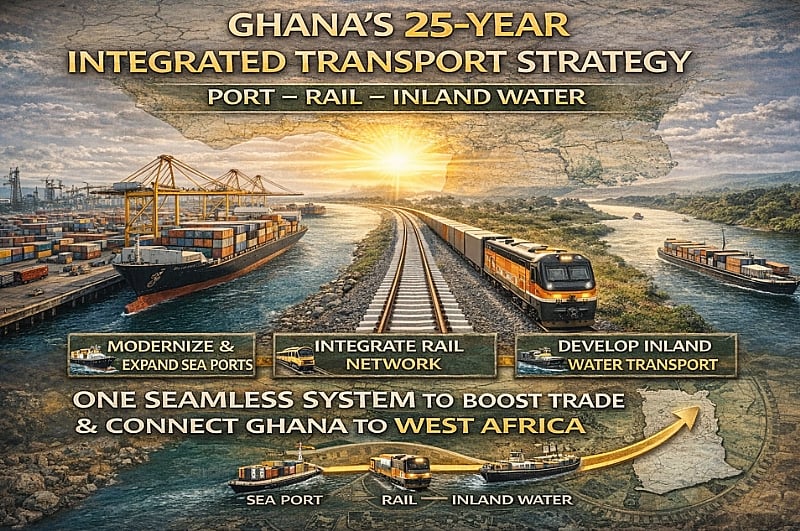
Ghana’s transport challenges are not new. What is new and increasingly urgent, is the realization that incremental, project-by-project thinking has failed. Roads are congested, railways are underdeveloped, ports are expanding without full inland integration, and inland water transport remains largely underutilized.
If Ghana is serious about becoming a regional logistics hub and unlocking its economic potential, it must adopt a 25-year transport strategy anchored in one central idea: integration. Not just roads. Not just rail. Not just ports. But a coordinated port–rail–inland water system that works as a single economic engine.
The Problem: Fragmented Thinking, Fragmented Outcomes
For decades, Ghana has developed its transport system in silos:
- Ports expand, but cargo evacuation remains road-heavy
- Rail projects are announced, but not fully integrated into logistics chains
- Inland water transport (especially the Volta Lake) remains underdeveloped
- Roads carry more than they should, leading to congestion, accidents, and rapid deterioration
The result is a high-cost transport economy, where moving goods from Tema to the north is more expensive than it should be, and less competitive regionally. This is not just inefficiency. It is lost economic opportunity.
Why a 25-Year Strategy Matters
Transport infrastructure is not a short-term investment. Railways, ports, and inland waterways are multi-generational assets. Ghana does not suffer from a lack of transport projects. Roads are expanded, ports are modernized, and railway master plans are repeatedly announced. Yet the fundamental problem persists: these systems are not designed to work together. As a result, the country continues to spend heavily on infrastructure while losing efficiency, increasing costs, and missing opportunities for regional leadership.
If Ghana is serious about long-term transformation, it must think beyond projects and begin designing a 25-year integrated transport strategy, one that deliberately connects ports, railways, and inland water systems into a single, coordinated logistics network.
The question is no longer what to build. The question is how to connect what we build into a system that actually works.
A 25-year strategy allows Ghana to:
- Plan corridors, not isolated projects
- Align infrastructure with industrial policy and spatial development
- Avoid costly policy reversals with every change of government
- Build systems that support future population growth and urbanization
Countries that have succeeded, from China to the Netherlands, did not build transport systems in electoral cycles. They built them across decades of coordinated planning. Ghana must do the same.
The Strategic Anchor: Ports as Gateways, Not Endpoints
Ghana’s maritime economy revolves around two major gateways: the Port of Tema and the Port of Takoradi. These ports handle the majority of imports and exports, making them critical to national and regional trade. But today, these ports function more as endpoints than distribution hubs.
Cargo arrives at Tema or Takoradi and is quickly transferred onto trucks, which then carry goods across the country and beyond. This over-reliance on road transport creates congestion, increases logistics costs, and accelerates road deterioration. More importantly, it reflects a deeper structural failure: the absence of efficient inland transport integration.
In a 25-year strategy, ports must be reimagined as multimodal logistics platforms, seamlessly connected to rail corridors and inland waterways. The goal should not be to move cargo faster out of ports, but to move it smarter across the entire national system.
Railways: The Missing Spine of the System
Every successful large-scale transport system in the world has one common feature: a strong railway backbone.
- Railways are uniquely suited for:
- Bulk freight movement
- Long-distance cargo transport
- Industrial logistics corridors
- Regional trade connectivity
Ghana’s existing and planned railway network, guided by national master plans, has the potential to serve exactly this role. Yet without proper integration with ports and inland transport systems, rail risks becoming isolated infrastructure rather than a functional system.
A 25-year strategy must therefore define railways not as standalone projects but as the primary freight carriers linking ports to the interior. This means.
- Direct rail connections from Tema and Takoradi ports to industrial zones
- Dedicated freight corridors for minerals, agriculture, and manufacturing
- Cross-border rail links to landlocked neighbors
Rail must become the default mode for heavy cargo, not the alternative.
Inland Water Transport, the Missing Link
If rail is the backbone, then inland water transport is Ghana’s untapped advantage. The creation of Lake Volta offers a unique opportunity for low-cost, energy-efficient cargo movement across the country. Yet decades after its creation, inland water transport remains underutilized, operating far below its potential.
In a long-term strategy, Lake Volta should not be treated as a secondary transport option. It should be developed as a core logistics corridor.
This requires:
- Development of inland ports along the lake
- Integration with rail terminals at key transfer points
- Modern cargo handling and container systems
- Scheduled barge services for bulk freight
Water transport is significantly cheaper than road transport for bulk goods. Ignoring this advantage is not just inefficient, it is economically unsustainable.
The Core Problem: Fragmented Planning
The reason Ghana’s transport system struggles is not technical, it is institutional.
- Ports are planned by maritime authorities.
- Railways are developed by railway agencies.
- Roads are managed by separate ministries.
- Inland water transport operates in isolation.
Each sector functions within its own policy framework, budget structure, and implementation timeline. The result is fragmentation. A 25-year strategy must therefore begin with institutional integration.
What a 25-Year Integrated Strategy Should Look Like
To move from fragmentation to integration, Ghana must adopt a system-based approach with clear long-term priorities.
1. Establish a National Multimodal Transport Authority
A single coordinating body should oversee the integration of ports, rail, and inland water transport. This authority must have the power to align investments, timelines, and policies across sectors.
2. Develop Integrated Logistics Corridors
Transport planning should focus on corridors, not modes. For example:
Tema → Inland rail terminal → Lake Volta → Northern Ghana
Takoradi → Mining zones → Rail freight → Export terminals
Each corridor must combine rail, water, and road systems into a unified logistics chain.
3. Invest in Intermodal Terminals
Cargo must be able to move seamlessly between ships, trains, and barges. This requires:
- Dry ports
- Inland container depots
- Rail-to-barge transfer facilities
Without these nodes, integration remains theoretical.
4. Commit to Policy Continuity Beyond Political Cycles
A 25-year strategy cannot depend on four-year political terms. It must be legally anchored, with bipartisan commitment to ensure continuity across governments.
The Cost of Not Thinking Long-Term
If Ghana continues on its current path, building infrastructure without integration, the consequences are predictable:
- Rising transport costs
- Increasing road congestion
- Underutilized rail investments
- Missed regional trade opportunities
In contrast, an integrated system could position Ghana as a logistics hub for West Africa, connecting coastal trade to inland markets efficiently.
Conclusion: Integration Is the Real Infrastructure
The future of Ghana’s transport system will not be determined by how many projects are launched, but by how well those projects connect. A 25-year strategy demands discipline, coordination, and long-term thinking. It requires moving beyond political announcements toward systemic design. Most importantly, it requires recognizing a simple truth: ports, railways, and inland waterways are not separate sectors, they are parts of a single national system. Until Ghana plans them that way, the country will continue to build infrastructure without building efficiency. But if it gets the integration right, Ghana will not just move goods, it will move its economy forward for generations.
Author: Joseph Fuseini ([email protected])
