
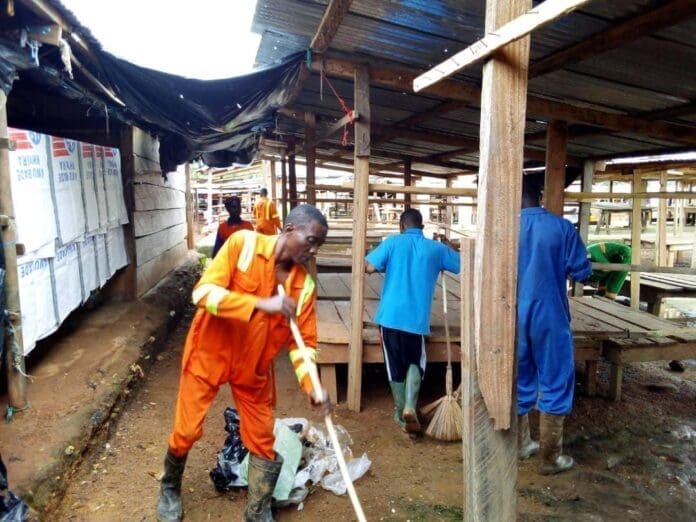

Traders at Bantama Market and the Racecourse Market in Kumasi once again refused to participate in a city-wide sanitation exercise on Saturday, February 28, 2026, defying a public directive from the Kumasi Metropolitan Assembly (KMA) and reigniting debate about enforcement, compliance, and the role of the informal sector in urban governance.
The exercise, which was rescheduled from its usual first Saturday of the month to February 28 to avoid a clash with Ghana’s 69th Independence Anniversary celebrations on March 6, had been widely publicised across all Kumasi-based media platforms. The KMA’s Public Relations Unit confirmed that the Assembly had issued advance notices to all market associations, schools, and the broader business community, and that commercial vehicles were barred from operating in designated areas between 6:00 am and 12:00 noon to facilitate the clean-up.
Despite the advance notice and commercial vehicle restrictions, trading continued at Bantama and Racecourse markets well past the start of the exercise, with KMA officials observing that large numbers of traders had opened stalls, arranged goods, and resumed normal commercial activity as though no directive had been issued.
KMA officials expressed frustration at what they described as a recurring pattern of non-compliance at the two markets in particular, warning that persistent defiance undermines the city’s public health ambitions and sets a poor example for compliance in other parts of the metropolis. The Bantama and Racecourse markets serve as two of Kumasi’s most active commercial zones, drawing thousands of traders and buyers daily, making their participation in sanitation exercises critical to achieving meaningful impact.
The boycott draws renewed attention to a longstanding tension between the KMA and segments of Kumasi’s large informal trader population. Governance experts and legal analysts have repeatedly urged the Assembly to prioritise dialogue with trader associations over punitive enforcement, arguing that over 60 percent of Ghana’s workforce operates in the informal sector, making coercive approaches counterproductive and legally contested.
The KMA has not yet publicly indicated what consequences, if any, will follow the February 28 boycott. Mayor Richard Ofori-Agyeman Boadi is expected to address compliance issues in the coming week as the Assembly continues its broader effort to restore sanitation order to Ghana’s second-largest city ahead of the Independence Anniversary celebrations.

