


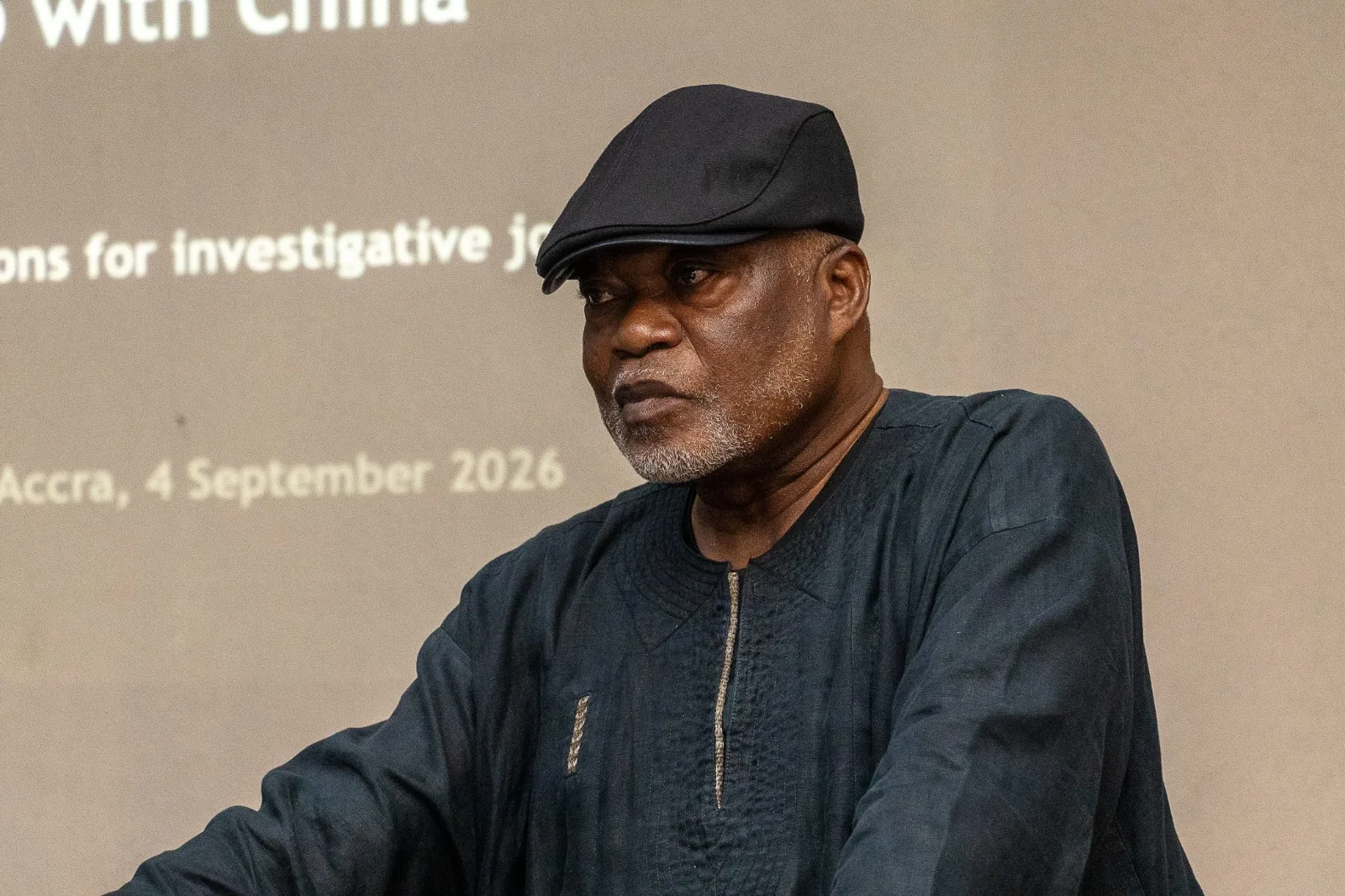
Journalists have been urged to apply the same critical scrutiny to China’s growing involvement in Africa as they do to Western powers and avoid simplistic or sensational narratives in their reporting.
Retired Colonel Festus B. Aboagye, a security analyst, said journalists should examine the interests of both China and African countries in their relations, rather than portraying China’s growing presence on the continent solely as exploitation.
“Understanding another country’s interests is not the same as agreeing with them,” Aboagye said during a three-day training workshop organised by the Media Foundation for West Africa (MFWA) in partnership with the Wits Centre for Journalism.

“The question is not why China is coming to exploit the country, but what it is that Ghana is seeking from the Chinese,” he said.
The workshop, held from 2 to 4 September in Accra, brought together journalists from Ghana, Nigeria, Sierra Leone, Liberia and The Gambia for training on reporting Africa-China relations, including trade, infrastructure financing, mining, technology and security.

Aboagye said China’s security engagement in Africa, which began gaining significant momentum around 2015, should be assessed in the context of existing partnerships between African countries and Western powers.
“Before China came, all of us in the country were already engaging with other partners. China is only coming to join other parties,” he said.

He urged journalists to investigate defence agreements, military cooperation and technology transfers and establish what African countries gain from such arrangements.
“You cannot argue either side unless you have evidence. So don’t just write the story — do the analysis. Go deep and find out the things that may be hidden,” he said.
Beyond the binary
Political scientist Prof Lloyd Amoah, Director of the Centre for Asian Studies at the University of Ghana, said journalists and civil society organisations must ask difficult questions about China-Africa relations rather than simply accepting the narratives presented by governments or foreign partners.

“It’s always going to give them the volume. But we have to begin to insist, civil society and journalists, that we ask the hard questions,” he said.
Prof Abena Yeboah-Banin, Dean of the School of Information and Communication Studies at the University of Ghana, challenged journalists to move beyond binary portrayals of China as either a benevolent development partner or a predatory power.

She encouraged evidence-led reporting that examines the interests, consequences and beneficiaries of Chinese aid and investment rather than allowing coverage to be shaped by predetermined pro-China or anti-China positions.

Financial analyst Nana Kwaku Amankwah Appiah also equipped participants with tools for investigating Chinese infrastructure financing in Anglophone West Africa, including loan agreements, debt sustainability assessments and government-to-government contracts.
Following the money
Dr. Nii Moi Thompson, economist and Chairman of Ghana’s National Development Planning Commission, examined Africa-China trade relations, including the continent’s dependence on commodity exports, manufactured imports, trade imbalances and the effect of cheap imports on local businesses.

Eliud Akwei, Senior Investigative Data Analyst and Certified Fraud Examiner at Code for Africa, introduced participants to open-source intelligence and digital tools for investigating Chinese-linked investments and financial activities.

The training included techniques for tracing company registrations, procurement records and investment financing structures.
On mining, Daryl Bosu, Deputy National Director of A Rocha Ghana, urged journalists to examine the governance systems that allow environmental degradation to occur instead of making nationality the sole focus of their reporting.

He cited a conversation with the Chinese ambassador in which the diplomat argued that responsibility for environmental damage rested partly with African governments for failing to enforce their own laws.
Bosu also discussed Chinese participation in Ghana’s mining sector, including resource-backed financing arrangements and the acquisition by Chinese companies of concessions previously held by Canadian and American firms.

Focus on accountability
Francis Kokutse, Senior Journalist and New York Times stringer, urged journalists to ensure that the public interest, rather than the nationality of a company, determines the focus of their stories.
“When you are doing your reporting, you need to decide whether you are focusing on the issue or the nationality of the company involved,” he said.

He said journalists should be careful that references to Chinese companies do not overshadow substantive issues such as environmental damage, toxic spills and labour violations.
Closing the workshop, MFWA Board Member Kwame Karikari said journalists should examine the benefits African countries derive from their relationships with foreign powers while applying the same standards to all external partners.

“China is a new empire of note,” he said, but stressed that China “has never been alone” in its engagement with Africa.
“We must ask: what is the benefit for us? How does this relationship benefit us?” Karikari said.

Chris Kabwato of the Wits Centre for Journalism said the training had exposed participants to different perspectives on Africa-China relations and challenged them to continue investigating the subject after the workshop.
Participants also pitched story ideas based on local dimensions of Africa-China relations, with organisers expressing hope that the training would contribute to more critical, nuanced and evidence-based coverage of China’s growing engagement with the continent.
Asaase 99.5 Accra, Asaase 98.5 Kumasi, Asaase 100.3 Cape Coast, AsaasePa 107.3 (Accra)
Affiliates: Bawku FM 101.5, Bead FM 99.9 (Bimbilla), Mining City Radio 89.5 (Tarkwa), Nandom FM 101.9, Nyatefe Radio 94.5 (Dzodze), Sissala Radio 96.3 (Tumu), Somuaa FM 89.9 (Gushegu), Stone City 90.7 (Ho) and Wale FM 106.9 (Walewale)
Listen online: asaaseradio.com, Sound Garden and TuneIn
Follow us:
X: @asaaseradio995, @Asaase985ksi, @asaase1003, asaasepa1073
Instagram: asaaseradio99.5, asaase985ksi, asaase100.3, asaasepa107.3
LinkedIn: company/asaaseradio995. TikTok: @asaaseradio99.5
Facebook: asaase99.5, asaase985ksi, Asaase100.3, AsaasePa107.3
YouTube: AsaaseRadioXtra
Join the conversation. Accra: call 020 000 9951/050 009 0121, WhatsApp 020 000 0995. Kumasi: call 059 415 7985 or call/WhatsApp 020 631 5260. Cape Coast: call/WhatsApp 059 388 2652.
#AsaaseRadio
#AsaasePa
#TheVoiceofOurLand
