


On an ordinary day, a mathematics question might barely register beyond the walls of a classroom.
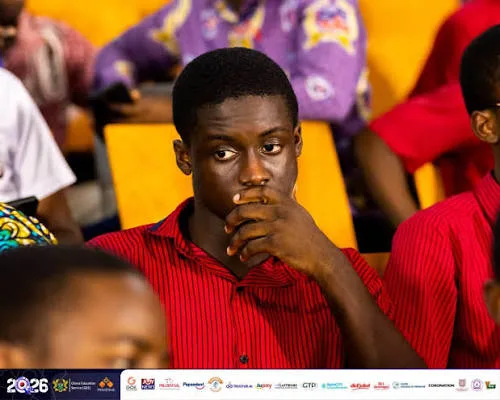
But on the day of the National Science and Maths Quiz, a question about mathematics, physics, chemistry or biology can become a matter of school pride, regional bragging rights and national conversation.
For more than three decades, Ghana’s National Science and Maths Quiz (NSMQ) has transformed academic competition into entertainment. Students become celebrities, teachers become strategists, old school rivalries are revived and alumni groups rally behind their schools with the intensity usually reserved for football.
What began in 1993 as a competition involving just 32 schools has grown into one of Ghana’s most recognisable academic institutions and a national television spectacle.
At the centre of it all is a deceptively simple proposition: put Ghana’s brightest senior high school students in a room, ask them difficult questions, and see who can think fastest.
The result has been anything but simple.
From a 32-school contest to a national spectacle
When NSMQ began in 1993, it was a much smaller affair.
Sponsored by Brilliant Soap, the inaugural competition involved 32 schools divided into Northern and Southern sectors. Prempeh College emerged as the first champion.
The sector system was eventually abandoned, allowing schools from across the country to compete directly. By 1998, the contest had formally become the National Science & Maths Quiz after the original sponsorship arrangement ended.
The competition continued to expand.
The field reached 40 schools in 2000. In 2013, it grew to 81 schools and introduced preliminary stages and three-school contests. A year later, the competition expanded further, with 135 schools eligible to participate.
That growth changed the character of NSMQ.
It was no longer simply a contest between a handful of schools. It was becoming a national tournament in which success at the regional level could eventually lead to a televised battle watched far beyond the participating schools.
Today, the journey to the trophy is itself a marathon.
Schools navigate regional and zonal contests before the national stages. Seeded teams receive an advantage based on their previous performances, while regional champions and high-performing runners-up fight for places in the national competition.
In 2026, the competition structure includes seeded schools, regional qualifiers, private schools and 36 top-performing runners-up — effectively wildcards for teams that may have lost their regional contests but performed strongly enough to earn another chance.
The message is clear: in NSMQ, losing one battle does not necessarily mean the end of the war.
The wildcards that keep the giants alive
The introduction of high-performing runners-up has added another layer of intrigue to the competition.
The so-called wildcards are schools that failed to win their regional contests but posted sufficiently strong scores to remain in contention.
In 2022, nine schools that scored at least 40 points in regional contests were invited to the national preliminaries.
By 2026, the system had expanded to 36 top-performing runners-up.
It means that a school can lose its regional contest, leave disappointed, and still find itself back in the national arena.
For the competition, the system serves another purpose: it reduces the likelihood of a strong team disappearing simply because it happened to encounter an equally formidable opponent at the regional stage.
Where school pride becomes competitive sport
But NSMQ is not sustained by questions and scores alone.
Its emotional power comes from the schools.
Across Ghana, certain names have become synonymous with the competition: Presbyterian Boys’ Secondary School, Prempeh College, Mfantsipim School, St Peter’s Senior High School, Achimota School, Adisadel College, Opoku Ware School, St Augustine’s College and others.
These schools have accumulated histories, rivalries and expectations that extend well beyond the students sitting behind the buzzers.
For alumni, a competition involving their former school can become intensely personal.
A school anthem, a familiar uniform or the appearance of a former contestant on television can trigger memories of one’s own time in school. Social media amplifies the feeling, turning every correct answer into celebration and every missed opportunity into collective anguish.
Supporters do not merely watch.
They cheer.
They chant.
They debate answers.
They analyse scores.
And sometimes, they relive the competition long after the cameras have stopped rolling.
The result is an unusual phenomenon in which academic excellence becomes spectator sport.
The women who gave the quiz its voice
Through its history, NSMQ has had only three quizmistresses.
Prof. Marian Ewurama Addy, the founding quizmistress, presided over the competition during its formative years. A biochemist and Ghana’s first female full professor of natural science, she became closely associated with the early identity of the programme.
Dr Eureka Emefa Adomako succeeded her in 2001 and served until 2005.
Then came Prof. Elsie Effah Kaufmann.
Since taking over in 2006, Prof. Kaufmann has become perhaps the most recognisable face of NSMQ.
A biomedical engineer and lecturer, she has overseen the competition through a period of significant expansion and transformation.
Under her tenure, the quiz has evolved into a modern television production, while her interactions with contestants have also helped give the programme a personality beyond the questions themselves.
For a generation of Ghanaian students, the words of the quizmistress announcing a question, requesting an answer or confirming a score have become part of the soundtrack of academic competition.
Five rounds, two students and almost no room for error
The structure of NSMQ helps explain its drama.
Each contest pits three schools against one another, with two contestants representing each school.
The teams move through five rounds, testing different forms of knowledge and speed.
There are foundational questions across biology, chemistry, physics and mathematics. Then comes the Speed Race, where contestants must respond quickly to buzzer questions.
The Problem of the Day requires deeper calculation and reasoning.
True or False questions test both knowledge and precision.
And then comes the Riddle Bonanza.
For spectators, the final round can be particularly agonising because a contest that appears settled can suddenly become a contest of nerves.
A single answer can change the scoreboard.
A single mistake can erase a lead.
And sometimes, after months of preparation, the championship can come down to a handful of points.
That is what makes NSMQ compelling television: knowledge is important, but so are speed, composure, teamwork and the ability to recover under pressure.
The dynasties
If NSMQ were football, some schools would be described as giants.
Presbyterian Boys’ Secondary School — better known as Presec Legon — sits at the summit of the championship hierarchy, with eight titles recorded through 2025.
Mfantsipim and Prempeh College are also among the most successful schools in the competition’s history.
Only 11 schools have won the national title.
That list includes Prempeh College, Presec Legon, Achimota, St Peter’s, St Augustine’s, Adisadel College, Mfantsipim, Pope John Senior High School, Ghana Secondary Technical School, St Thomas Aquinas and Wesley Girls’ High School.
The concentration of titles among a small group has helped create the idea of NSMQ powerhouses.
Presec’s dominance has been particularly striking.
The school has produced multiple championship runs, including back-to-back victories in 2022 and 2023.
But the competition has never belonged exclusively to one school.
Mfantsipim claimed consecutive titles in 2024 and 2025, defeating formidable opposition in both years.
In the 2025 final, Mfantsipim scored 56 points to finish ahead of St Augustine’s College on 42 and Opoku Ware School on 29.
The result gave Mfantsipim another chapter in its own history while ensuring that the NSMQ crown remained contested rather than permanently attached to one institution.
The moments that become school folklore
NSMQ has produced its share of heartbreaks and improbable recoveries.
In 2022, Presec came from behind before ultimately winning the final.
In 2018, St Peter’s overturned the momentum of a contest after Adisadel had established a significant lead.
The Riddle Bonanza has also become synonymous with late drama. The 2024 final, for instance, was decided by a single point.
These moments do something important to the competition.
They turn results into stories.
Years later, students and alumni may not remember every question asked in a particular final, but they remember the comeback, the missed answer, the decisive riddle and the moment the winning score appeared on the board.
In that sense, NSMQ is building its own sporting mythology — except the weapons are calculators, buzzers, memory and reasoning.
The preparation begins long before television
The apparent spontaneity of NSMQ masks months of preparation.
Behind every pair of contestants is a wider team of teachers, coaches, former contestants and supporters.
Schools drill past questions, revise advanced topics and organise internal competitions to identify the students best suited to represent them.
Some teams train through intensive camps.
Others rely on former contestants and alumni to mentor current teams.
The preparation is not simply about memorising facts.
Contestants must learn how to work as a unit, identify who is best positioned to answer a particular question and make decisions under intense time pressure.
A student may know the answer and still lose the point if another team reaches the buzzer first.
Another may make a calculation correctly but fail to communicate the answer within the allotted time.
NSMQ therefore rewards a combination of academic knowledge and competitive discipline.
For schools, that preparation can become part of the institution’s culture.
When academic achievement becomes entertainment
Perhaps NSMQ’s greatest achievement is that it has made academic excellence entertaining.
Ghana has no shortage of academic competitions, but NSMQ has managed to create a rare crossover between education and popular culture.
Its finals generate extensive television, radio and online coverage.
Social media has expanded the audience further.
School hashtags, live reactions, memes, commentary and supporter campaigns allow people who are nowhere near the venue to participate in the experience.
Alumni groups become digital fan clubs.
Students who have never met contestants develop favourites.
Celebrities join the conversation.
And school rivalries that may have existed quietly for decades are suddenly visible to a national audience.
The competition’s appeal is therefore not confined to science and mathematics.
It is about belonging.
A student is not simply answering for themselves. They are answering for their school, their teachers, their classmates, their parents and generations of alumni.
That is why a wrong answer can feel bigger than a wrong answer.
And why a championship can feel like a national holiday within a school community.
A national stage for Ghana’s STEM ambitions
NSMQ’s importance also lies in what it represents.
The competition places science, mathematics, intellectual discipline and academic achievement at the centre of public attention.
At a time when governments and educators continue to promote STEM education, NSMQ provides a highly visible platform for demonstrating what young Ghanaian students can accomplish.
Its significance goes beyond producing winners.
It identifies academically gifted students, gives them a national platform and creates role models for younger pupils who watch them compete.
A junior high school student watching the final may see more than six students answering questions.
They may see a possible future version of themselves.
That is part of the competition’s educational power.
The business behind the buzz
The spectacle also requires an extensive organisational machine.
Primetime Limited has produced NSMQ since its inception, working with the Ghana Education Service and corporate partners.
Over the years, sponsors and partners have included GOIL, Prudential, Joy News, MTN MoMo, Pepsodent, Jupay and others.
The partnership between education authorities, producers and private companies has allowed the competition to survive and expand while providing winners with cash prizes and other rewards.
But the model also exposes the competition to the realities of funding.
Recent reports cited in the research material indicate that sponsorship difficulties have affected some preliminary regional stages.
That is an important reminder that even a competition with enormous public affection still depends on the resources required to organise it.
The geography of a national competition
NSMQ is national in name and increasingly national in reach, but its championship history reveals an interesting geographical pattern.
Only five of Ghana’s 16 regions have produced champions: Greater Accra, Ashanti, Central, Eastern and Western.
Greater Accra and Ashanti, in particular, have produced several of the competition’s dominant schools.
The pattern has helped fuel another dimension of the competition: regional pride.
When a school from one part of the country advances, communities often claim the achievement as their own.
The national contest consequently becomes a collection of smaller rivalries — school against school, city against city and, sometimes, region against region.
More than the trophy
The NSMQ trophy is ultimately the visible prize.
But the competition’s real currency is prestige.
A school that wins earns bragging rights.
Its contestants become part of school history.
Its teachers are celebrated.
Its alumni have another reason to tell stories about their alma mater.
And younger students are given an example of what academic excellence can look like when it is placed before a national audience.
That may explain why the competition has survived for more than three decades and why each new edition generates the same familiar anticipation.
Every year brings new contestants.
New schools dream of an upset.
Old champions attempt to defend their reputations.
Teachers begin another cycle of preparation.
Alumni dust off their school colours.
And Ghana waits for the next question.
From 32 schools in 1993 to a competition involving a far broader national field, NSMQ has evolved dramatically. Yet its essential appeal remains unchanged: six students, difficult questions, limited time and the possibility that everything can change with one answer.
That is why the National Science and Maths Quiz is no longer merely a quiz.
It is a piece of Ghanaian popular culture — a celebration of intellect wrapped in competition, school identity and national pride.
And every year, when the buzzer sounds, Ghana listens.
Asaase 99.5 Accra, Asaase 98.5 Kumasi, Asaase 100.3 Cape Coast, AsaasePa 107.3 (Accra)
Affiliates: Bawku FM 101.5, Bead FM 99.9 (Bimbilla), Mining City Radio 89.5 (Tarkwa), Nandom FM 101.9, Nyatefe Radio 94.5 (Dzodze), Sissala Radio 96.3 (Tumu), Somuaa FM 89.9 (Gushegu), Stone City 90.7 (Ho) and Wale FM 106.9 (Walewale)
Listen online: asaaseradio.com, Sound Garden and TuneIn
Follow us:
X: @asaaseradio995, @Asaase985ksi, @asaase1003, asaasepa1073
Instagram: asaaseradio99.5, asaase985ksi, asaase100.3, asaasepa107.3
LinkedIn: company/asaaseradio995. TikTok: @asaaseradio99.5
Facebook: asaase99.5, asaase985ksi, Asaase100.3, AsaasePa107.3
YouTube: AsaaseRadioXtra
Join the conversation. Accra: call 020 000 9951/050 009 0121, WhatsApp 020 000 0995. Kumasi: call 059 415 7985 or call/WhatsApp 020 631 5260. Cape Coast: call/WhatsApp 059 388 2652.
#AsaaseRadio
#AsaasePa
#TheVoiceofOurLand
