


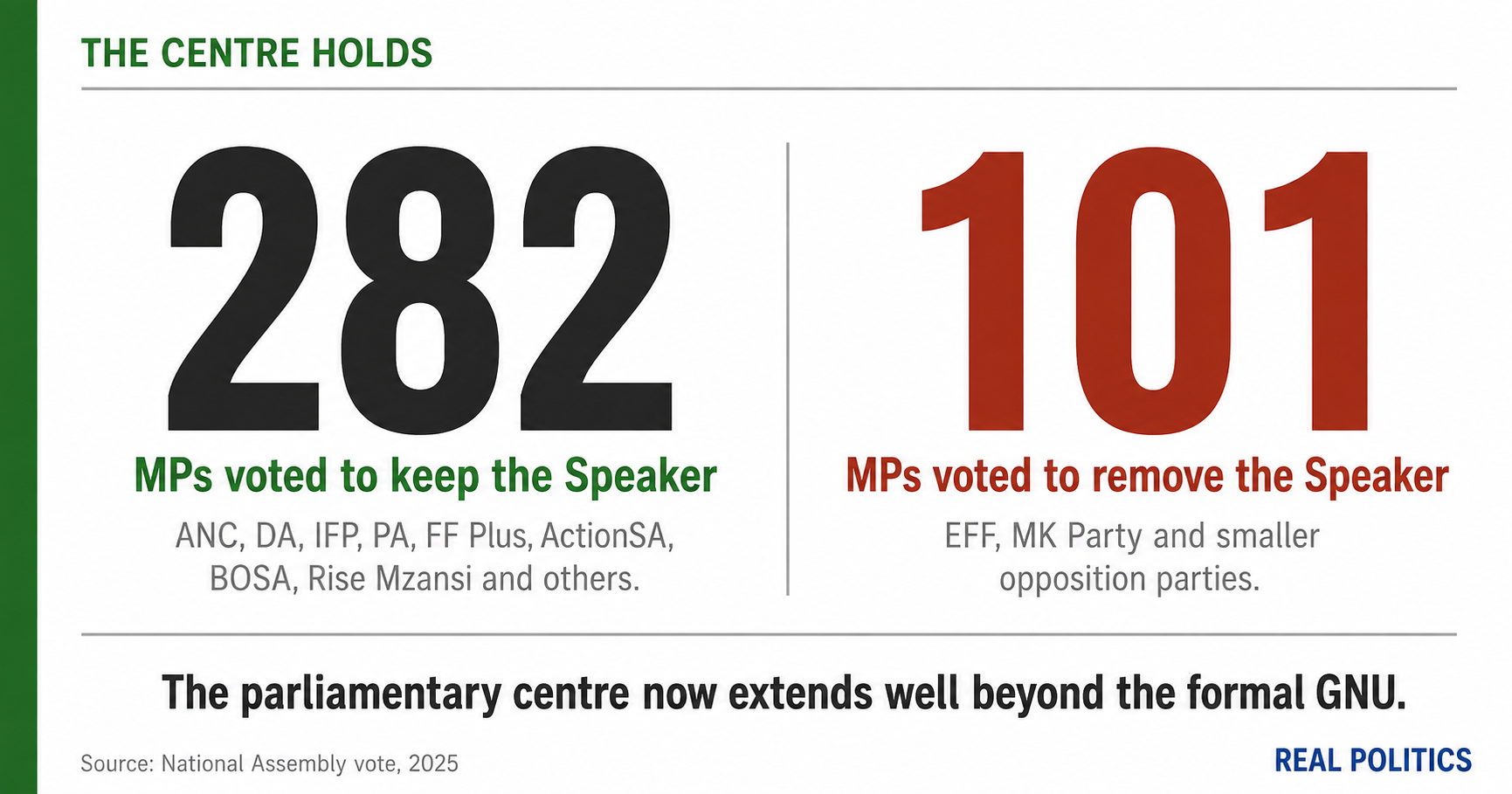
The 282 to 101 defeat of the EFF’s motion against Didiza shows the GNU is growing stronger, and South Africa now needs that stability to deliver real reform, writes Zukile Majova in Real Politics.
The decisive defeat of the Economic Freedom Fighters’ motion of no confidence in National Assembly Speaker Thoko Didiza was more than routine parliamentary theatre.
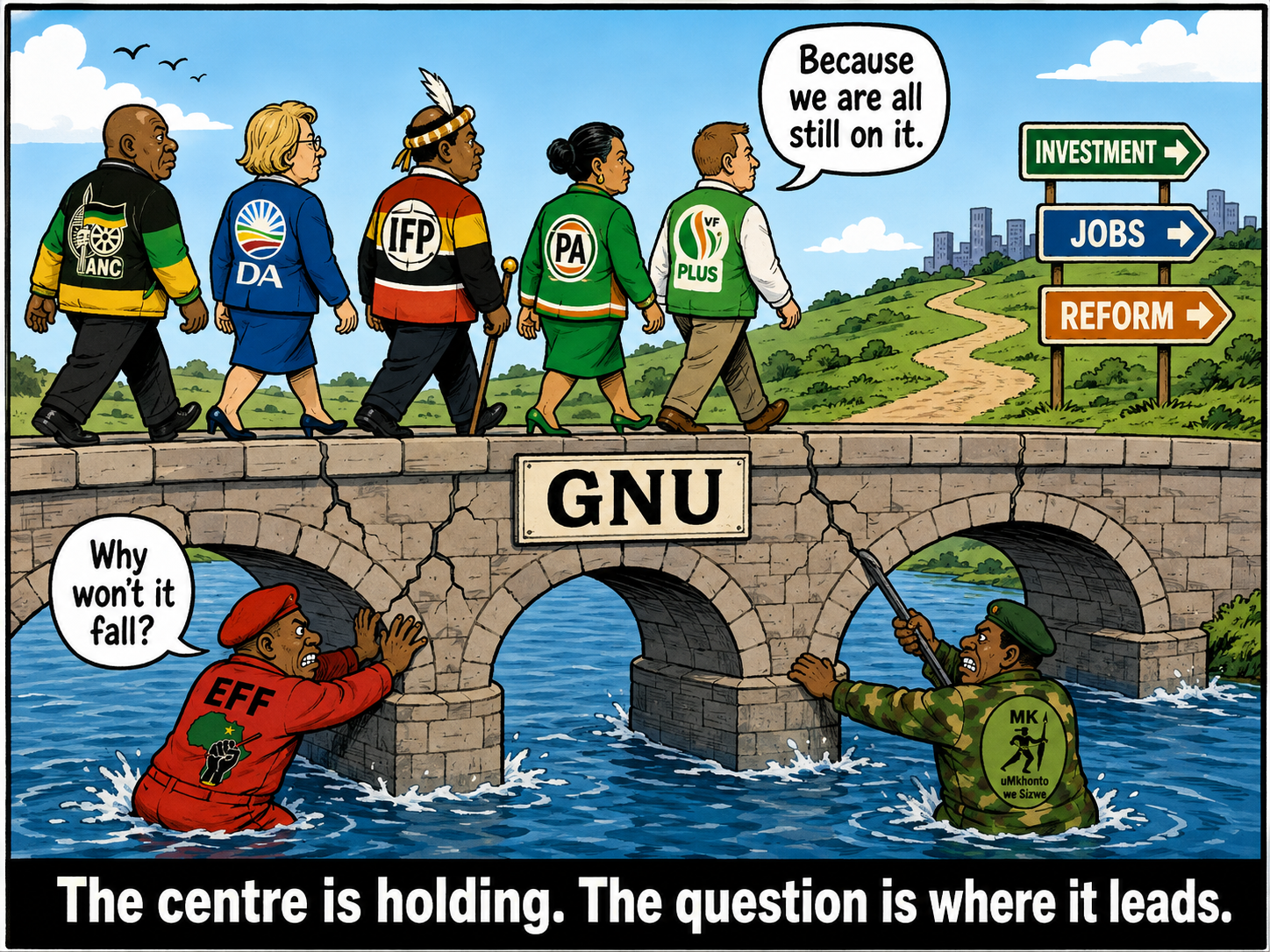
The 282 to 101 vote showed that, despite its internal tensions, the Government of National Unity can still close ranks when political stability and the integrity of key institutions are at stake. In a political landscape defined by fragmentation, that resilience has become one of the most important stabilising forces in South African public life.
The GNU’s parties continue to disagree over policy, personalities and the exercise of executive power. But they are showing an increasing ability to contain those differences without allowing every dispute to become a threat to the government itself.
Not all 282 MPs who opposed the motion belong to GNU parties. But that makes the result more significant. Alongside the ANC, DA, IFP, Patriotic Alliance and Freedom Front Plus were ActionSA, Build One South Africa, Rise Mzansi, the PAC and Al Jama-ah. The parliamentary centre extended well beyond the formal government. The EFF was supported by MK, the African Transformation Movement and a handful of smaller parties — a substantial bloc, but one confined to roughly a quarter of the National Assembly.
The EFF accused Didiza of protecting President Ramaphosa after she decided not to oppose his court application to halt the Phala Phala impeachment committee’s proceedings. The DA also disagreed with elements of her approach. But DA chief whip Glynnis Breytenbach drew an important distinction between criticising a decision and finding sufficient grounds to remove the Speaker.
That distinction is a sign of institutional maturity. GNU membership did not require the DA to pretend Didiza had acted perfectly. It required the party to judge whether the threshold for removing the head of the National Assembly had been met. It concluded that it had not. The vote showed that disagreement inside the GNU does not have to result in governmental collapse. That would have been considered optimistic two years ago.
When the GNU was formed after the ANC lost its majority in 2024, many expected it to be short-lived. The ANC and DA differed on national health insurance, expropriation, education, empowerment, foreign policy and the role of the state. The budget and proposed VAT increase later brought the arrangement close to breaking point. Yet the GNU survived. The VAT proposal was withdrawn, the parties absorbed the political damage and the government continued. The partners have gradually discovered that compromise is not surrender and that disagreement need not become divorce.
This matters greatly to South African business and investors. They supported the GNU not because they expected the ANC and DA to become ideological allies, but because the alternative was far more dangerous. An ANC arrangement with MK and the EFF could have threatened fiscal discipline, property rights, central bank independence and the opening of network industries to private participation. By contrast, the GNU offered continuity at the Treasury and a chance to accelerate reforms in electricity, freight rail, ports, water, digital communications and public administration.
Businesses can price policy risk. They struggle to price political chaos.
That does not mean corporate South Africa is satisfied with Ramaphosa. Some business leaders have lost patience with the slow pace of implementation, weak consequence management and the president’s reluctance to confront entrenched interests. But business can be disappointed in Ramaphosa while remaining invested in the GNU. Increasingly, the coalition rather than the president alone is becoming the guarantor of reform. The institutional arrangement may prove more valuable than the individual who helped establish it.
The GNU’s stability also matters to the work of rebuilding the state. The Madlanga Commission is continuing to expose the extent to which criminal networks may have penetrated the police and other law-enforcement structures. A stable governing centre reduces the risk that every damaging revelation becomes a trigger for the collapse of government. It allows commissions to complete their work and gives the NPA, the Hawks, the SIU and the courts political space to act.
The next responsibility of the GNU must be to protect the institutions whose independence will determine whether state capture can recur — the NPA, police, Crime Intelligence, state-owned companies and the Auditor-General. It must also protect whistle-blowers, who continue to carry an intolerable personal risk for exposing the theft of public money.
Keeping MK and the EFF out of executive power must happen through democratic persuasion and credible performance, not through an anti-democratic cartel. The GNU will retain legitimacy only if it governs better, protects opposition rights and allows voters to judge it freely.
The next great test will come after the 4 November municipal elections. Johannesburg, Tshwane, Ekurhuleni, eThekwini and Nelson Mandela Bay may again produce hung councils. If GNU principles are extended to these cities, South Africa could replace unstable transactional coalitions with broad agreements centred on financial recovery and service delivery. For business, functioning metros are not a secondary governance issue. No national reform programme can succeed while companies face water outages, failing roads, collapsing sewage systems and unstable municipal administrations.
The country needs the GNU to endure beyond the 2029 national election — not necessarily in its current form or under its current leaders, but as a governing principle. South Africa’s post-majority future will require parties to cooperate across ideological lines, protect institutions and accept that no single organisation owns the state.
Stability is not an end in itself. It is the platform from which reform, investment and employment can grow.
The Didiza vote showed that the centre is holding. The challenge now is to use that stability to produce functioning cities, faster reforms, rising investment and jobs. If the GNU can do that, it will become more than a temporary response to an inconclusive election. It could become the foundation of South Africa’s democratic recovery.
Pictured above: Thoko Didiza.
Image source: ActionSA
