


By Celestine Avi and Seth Eyiah
The Chief Executive Officer of the Ghana Gold Board (GoldBod), Sammy Gyamfi, has rejected allegations by Minority Leader Alexander Afenyo-Markin that the state gold trading institution incurred losses of GHc22 billion ($1.7bn) from its operations in 2025.
Mr Gyamfi described the allegations as baseless and deliberately misleading, insisting that GoldBod’s audited financial statements for the year ended December 31, 2025, show that the institution recorded an operational surplus of GH¢907 million and an overall surplus of more than GH¢5.4 billion.
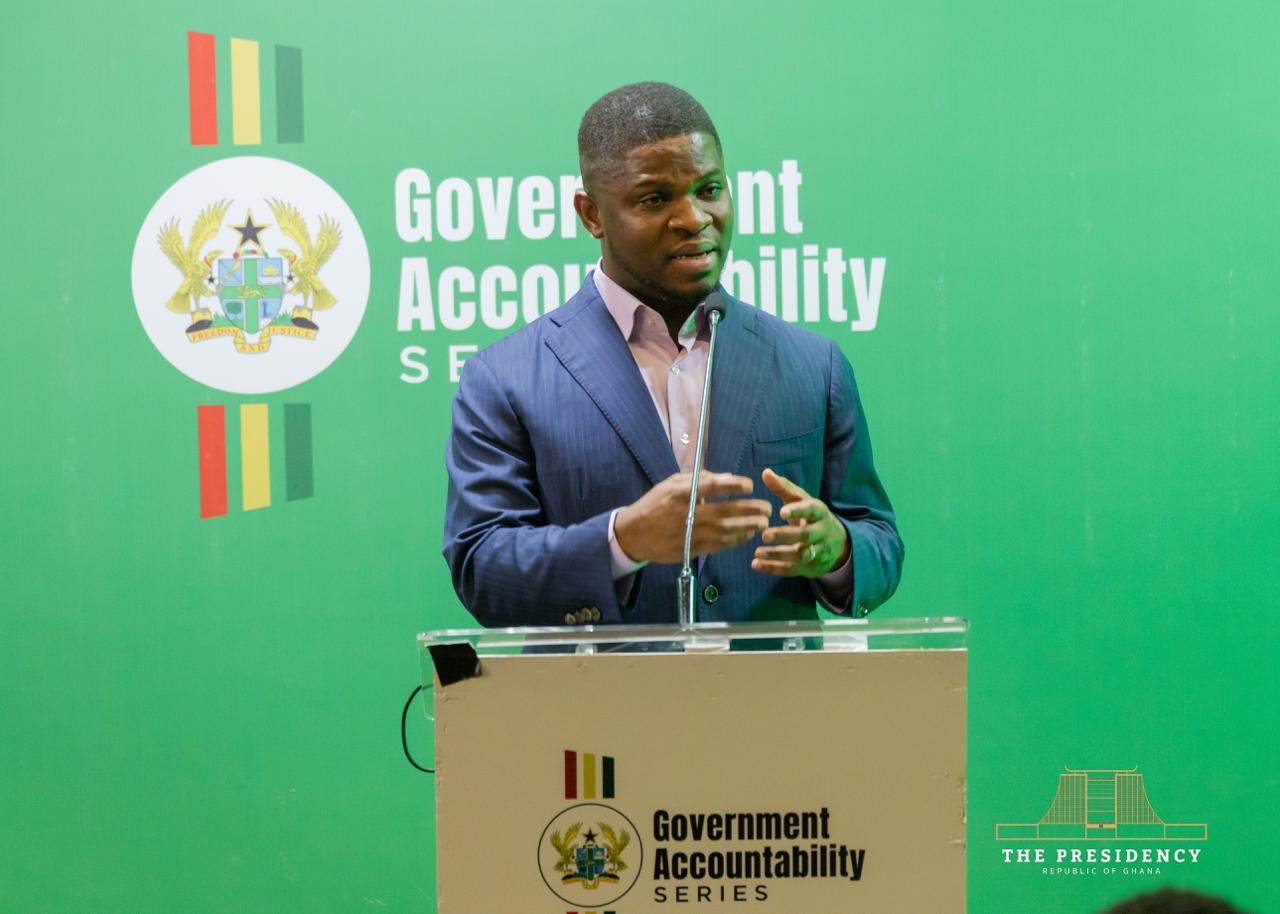
Speaking at the Government Accountability Series on Wednesday, August 19, 2026, Mr Gyamfi said the figures contained in GoldBod’s audited annual report, prepared and published by the Auditor-General, directly contradict claims that the institution made losses in its 2025 gold-trading operations.
He said the Auditor-General’s audit was conducted with full access to relevant information and documents provided by GoldBod, adding that all queries raised during the audit were satisfactorily addressed.
According to him, the audited report contained no adverse audit finding against GoldBod.
GoldBod not responsible for BoG’s GH¢1.7bn loss
Mr Gyamfi also rejected claims that GoldBod was responsible for the US$1.7 billion loss recorded by the Bank of Ghana (BoG) under its Domestic Gold Purchase Programme (DGPP) in 2025.
He said the IMF report cited by Mr Afenyo-Markin did not accuse GoldBod of causing the loss.
He explained that the DGPP was a Bank of Ghana programme under which GoldBod, which inherited the role of the defunct Precious Minerals Marketing Company (PMMC), acted only as a gold-buying agent.
“GoldBod’s role under the DGPP in 2025 was simply a continuation of the inherited role of the defunct PMMC,” Mr Gyamfi said.
He stressed that GoldBod’s responsibility was limited to purchasing and aggregating gold for the Bank of Ghana under agreed terms and that it had no role in the subsequent sale of the gold.
According to him, GoldBod was not a signatory to the off-take agreements under the programme and had no authority to determine the selling price or terms of sale.
He therefore argued that losses arising from the sale of the gold could not reasonably be attributed to an entity whose role ended with the purchase of the commodity.
Fees paid to GoldBod
Mr Gyamfi further disputed claims that fees paid to GoldBod contributed significantly to the Bank of Ghana’s reported losses.
He said GoldBod received an assay fee of 0.258 percent and a service fee of 0.5 percent, amounting to 0.758 percent.
He noted that the assay fee was a statutory charge approved under the Fees and Charges Act and was paid for assay services provided by GoldBod as the national assayer.
The service fee, he explained, covered expenses associated with the aggregation of gold, including transportation, logistics, security, insurance, trade margins and smelting losses.
Mr Gyamfi said similar fees had been paid to PMMC and other aggregators operating under the DGPP before GoldBod was established.
He questioned why GoldBod should be blamed for losses simply because it received legitimate fees for services rendered.
Exchange rate differences
The GoldBod CEO also addressed the IMF’s reference to exchange-rate differences as one of the factors contributing to the reported losses.
He said the terms under which GoldBod purchased gold for the Bank of Ghana were determined by an agreement signed between PMMC and the central bank in September 2023, before the establishment of GoldBod.
Mr Gyamfi argued that GoldBod, acting as a buying agent, could not unilaterally alter the agreed price and exchange-rate terms.
He also pointed out that the Bank of Ghana recorded a US$400 million loss under the DGPP in 2024, when GoldBod did not yet exist.
He therefore questioned how GoldBod could be blamed for losses incurred under the programme before its establishment.
GoldBod’s own trading model began in 2026
Mr Gyamfi further clarified that GoldBod did not begin implementing its own trading model in 2025.
Although GoldBod was established in April 2025, he said the institution only commenced implementation of the trading model envisaged under the Ghana Gold Board Act, 2025 (Act 1140), in March 2026.
He attributed the delay partly to the fact that GoldBod received its revolving seed trade capital on December 30, 2025, and needed to put the necessary institutional systems in place before launching the model.
He therefore argued that the 2025 DGPP losses could not be attributed to a GoldBod trading model that had not yet commenced.
Funding arrangements
Responding to claims that the Bank of Ghana had withdrawn financing from GoldBod because of losses, Mr Gyamfi said the central bank had not withdrawn any financing because GoldBod was not being financed by the BoG in the manner suggested.
He explained that from January 2025 to February 2026, GoldBod operated as the Bank of Ghana’s gold-buying agent, with funds advanced to it being used to purchase gold under the central bank’s programme.
He said that after GoldBod commenced its own trading model in March 2026, the institution received funding support for artisanal and small-scale mining gold purchases under the BoG’s FX Intermediation Programme and a Forex Sale Agreement between the two institutions.
Mr Gyamfi added that GoldBod had, from August 2026, indicated its intention to raise funds for its artisanal and small-scale mining purchases independently, with a pilot already successfully conducted.
GoldBod defends wider economic impact
While defending GoldBod’s financial performance, Mr Gyamfi said the institution should not be blamed for the Bank of Ghana’s reported DGPP losses.
He argued that the DGPP was originally designed as an economic stabilisation intervention aimed at generating foreign exchange rather than making profits.
According to him, the scaling-up of the programme contributed to an increase in Ghana’s international reserves from US$8.9 billion in 2024 to about US$13 billion in 2025.
He also linked the programme to the significant appreciation of the Ghana cedi and the decline in inflation recorded in 2025.
Mr Gyamfi maintained that the reported losses were largely accounting and valuation effects associated with the design and implementation of the programme and should not automatically be interpreted as evidence of criminality or misappropriation of state funds.
‘I am ready to appear before Parliament’
Mr Gyamfi challenged Mr Afenyo-Markin to substantiate his allegations before Parliament.
He said he was prepared to appear before any parliamentary committee to answer questions concerning GoldBod’s operational and financial performance.
“I am ready any day and time to appear before any committee of Parliament to discuss the operational and financial health of the GoldBod,” he said.
He maintained that GoldBod had nothing to hide and would continue to account for its stewardship while focusing on its mandate of creating value for Ghana from the country’s gold resources.
He urged the media and the public to subject allegations concerning GoldBod’s financial performance to the highest standard of evidence, insisting that public debate should be based on facts, evidence and independently verifiable information.
More stories here
