


Ghana’s growing problem of turning major roads, pavements and pedestrian crossings into commercial spaces is no longer simply a matter of street hawking. It has become a serious challenge involving road safety, urban planning, local governance and public behaviour.
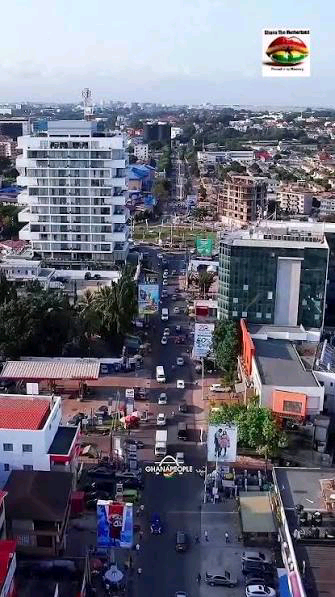
A video recorded at Lapaz in Accra on Friday, August 14, 2026, captured the scale of the problem. Along sections of the N1 highway, racks of clothes, shoes, mannequins, suitcases, bedding and other merchandise had taken over parts of the roadside. Pedestrians moved dangerously close to vehicles, while commercial buses stopped to pick up and drop off passengers in active traffic lanes. Even areas intended for pedestrians had effectively become extensions of the market.
The N1 was developed as a major urban highway to improve mobility through Accra. Yet at places such as Lapaz, commercial activity, uncontrolled parking and passenger loading have significantly undermined that purpose.
The footage, circulated by civic group Civic Sense GH, reportedly appealed to the Presidency to intervene and get the relevant local authority to act. The fact that citizens increasingly look to central government to resolve what should ordinarily be a local enforcement matter raises questions about the effectiveness of metropolitan and municipal authorities.
Ghana does not necessarily lack laws to address the situation. Road traffic legislation, regulations and local assembly bye-laws provide a framework for controlling activities that obstruct roads and endanger motorists and pedestrians. The bigger problem is enforcement.
The consequences of allowing commercial activity to spread onto busy roads can be deadly. Traders, customers, pedestrians, commercial drivers and motorists are forced to compete for the same limited space. A moment of distraction by a driver or pedestrian can result in tragedy.
Road safety statistics already provide enough reason for concern. With thousands of people dying or suffering injuries on Ghana’s roads each year, allowing highways to double as marketplaces only increases the danger.
The problem extends far beyond Accra. Across Ghana, commercial activity has gradually followed traffic onto major roads and bypasses. Roads constructed to reduce congestion are increasingly becoming new centres of roadside trading, creating the very congestion they were intended to eliminate.
In most towns in Ghana traders have access to a designated market, yet significant commercial activity reportedly shifts towards the trunk road on major market days. The result is congestion and increased danger to traders, customers and motorists, while parts of the formal market remain underused.
Kumasi presents another important lesson. The Kejetia Market was developed at enormous public cost as a modern commercial facility capable of accommodating thousands of traders. Yet surrounding streets remain heavily congested with commercial activity, while sections of the market, particularly some upper levels, have struggled to attract the same intensity of business.
This demonstrates an uncomfortable reality: building markets does not automatically move markets off the streets.
A market succeeds only when traders believe customers will come. Traders naturally follow buyers, while buyers often choose convenience. When customers prefer purchasing goods along roads, at junctions, around transport terminals or through vehicle windows, traders have a strong economic incentive to remain there.
This reality should inform the government’s planned 24-Hour Economy market projects. The concept has considerable potential to improve commerce, create jobs and provide safer and more organised trading environments. But constructing modern facilities alone will not guarantee their success.
Before substantial public resources are committed to new markets, policymakers must ask a fundamental question: what will make traders and customers actually use them?
Ghanaian shopping behaviour often favours convenience. People buy food, clothing and household goods near transport stations, along busy roads and at junctions because those locations fit naturally into their daily journeys.
The same behavioural challenge can be observed with pedestrian footbridges. Even where safer crossing facilities exist, some pedestrians continue to cross busy roads directly because it appears quicker and more convenient. If convenience consistently defeats safety, expensive new markets could face the same difficulty.
Another concern is the contradiction between revenue collection and enforcement. Where assemblies collect daily tolls or fees from traders occupying unauthorised spaces, enforcement becomes difficult. A trader who repeatedly receives an official receipt may understandably interpret it as permission to remain.
Assemblies cannot sustainably regulate an activity while simultaneously deriving revenue from allowing it to continue illegally.
There is also the problem of temporary enforcement. Ghana has experienced numerous decongestion exercises in which traders are removed from roads and pavements, sometimes amid significant media attention. Within days or weeks, many return. Enforcement that lasts only as long as the operation itself cannot change behaviour.
Market design is equally important. Traders cannot simply be ordered into buildings without considering visibility, accessibility, transportation, security, customer movement, loading facilities and affordability. Market planning must reflect how commerce actually works rather than how planners assume it should work.
Government and assemblies have obligations, but citizens also make choices. Customers who stop vehicles in traffic to purchase goods create demand for roadside trading. Drivers who load passengers at unauthorised locations contribute to congestion. Pedestrians who abandon designated crossings increase their own exposure to danger.
Removing traders without changing the behaviour that attracts them to the roadside will therefore produce only temporary results.
The solution requires enforcement, infrastructure and behavioural change to work together. Local authorities must consistently keep carriageways, pavements and pedestrian crossings clear. Revenue systems that indirectly legitimise unauthorised trading should be reviewed. Proper markets must be accessible, affordable and connected to transport networks so that traders do not lose their livelihoods simply by moving inside.
At the same time, sustained public education must encourage customers to patronise designated markets and transport operators to use approved loading points.
The 24-Hour Economy markets could become an important part of Ghana’s commercial infrastructure. But their success should not be measured by how many buildings are commissioned. It should be measured by whether traders occupy them, customers patronise them and surrounding roads remain free for their intended purpose.
Ghana does not need another cycle in which expensive markets are built while commerce continues outside their gates.
The law is necessary, but legislation alone cannot restore order to our roads. Enforcement must be consistent, markets must respond to economic realities, and citizens must accept that convenience cannot always come before safety.
Our roads were built to move people and goods. They should not become the places where those goods are sold.
