


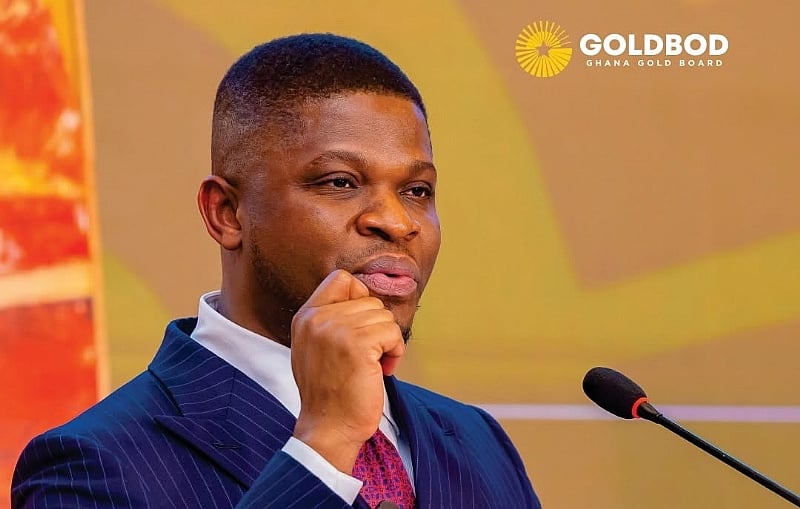
Chief Executive Officer of the Ghana Gold Board (GoldBod), Sammy Gyamfi, has called for a fundamental rethink of Ghana’s approach to mining, insisting that the country must own more, refine more, process more and retain greater value from its mineral resources.
According to him, Ghana’s century-long history of gold production should no longer leave Ghanaians as spectators in an industry built around their natural resources.
Mr. Gyamfi made the call on Tuesday, August 18, 2026, when he delivered the keynote address at the National Mining Dialogue in Accra, held on the theme, “Rethinking the Social Licence to Operate.”
He argued that the social licence to operate must go beyond legal permits and regulatory approvals to include the confidence of mining communities that mineral wealth is contributing meaningfully to their development.
“Natural resources are God’s gift to the communities that host them and a blessing to the State. If those resources do not transform the communities from which they are taken, then we have not fully converted blessing into development,” he said.
Mr. Gyamfi said it was unacceptable for mining communities to continue experiencing poverty, inadequate access to potable water, poor roads, youth unemployment and weak local economies while mineral wealth extracted from their lands generates enormous economic value.
He identified the youth question as one of the strongest reasons Ghana must rethink the social contract surrounding mining.
According to him, young people in mining communities often see mineral wealth leaving their lands without corresponding opportunities for decent employment, skills development, ownership and entrepreneurship.
“A social licence cannot survive where the youth believe mining has no place for them except as casual labourers and bystanders,” he said.
He therefore proposed greater integration of young people into the mining value chain through capacity building, sustainable jobs, mining-related services, local enterprise development and alternative livelihoods.
Mr. Gyamfi further called for mining communities to be treated as development partners and economic shareholders rather than merely land donors.
He questioned why, after more than a century of commercial gold mining, Ghanaians still have limited ownership of the mines and a relatively small share of the wider value chain.
He cited Obuasi as an example, arguing that the town’s long history of gold production had not translated into the level of industrial depth, urban development and economic opportunities associated with some major mining cities elsewhere.
“Mines do not build nations by accident. Nations build value through deliberate ownership, strategic partnerships, infrastructure, linkages, reinvestment and disciplined policy management,” he said.
The GoldBod CEO said Ghana must deliberately expand indigenous participation across exploration, production, logistics, fabrication, refining, jewellery manufacturing, environmental services and other mining-related businesses.
He said such an approach would transform mining communities from places where minerals are simply extracted into industrial and economic centres capable of creating jobs and supporting local businesses.
Mr. Gyamfi also stressed the need for mining revenues to translate into visible development for host communities.
He noted that gold remains Ghana’s dominant export commodity, contributing significantly to the country’s foreign exchange earnings, reserves and broader economic stability.
He said the economic importance of gold also creates a moral responsibility to ensure that the communities producing the resource benefit directly from it.
To achieve this, Mr. Gyamfi proposed an “IPE” model built around three principles: Involve, Protect and Expand.
Under “Involve,” he called for greater participation of mining communities in decisions affecting them, higher and more decentralised local royalty retention, clear commitments to local jobs and businesses, and stronger indigenous ownership.
Under “Protect,” he said water bodies, forests, farmlands and public health must be treated as non-negotiable national assets.
He also called for mandatory reclamation and reforestation, stronger formalisation of artisanal and small-scale mining, improved traceability and firm enforcement against irresponsible mining.
The “Expand” component, he explained, should focus on expanding Ghanaian ownership and capital participation across exploration, production and mining services, while accelerating local refining, jewellery manufacturing and other downstream industries.
Mr. Gyamfi said the success of Ghana’s mining sector should ultimately be measured not only by the volume of gold produced but also by the number of jobs, businesses, industries and prosperous communities created from the resource.
He called on government, mining companies, traditional authorities, communities, development partners, civil society, academia and the private sector to work together to renew the social licence for mining.
“If we get this right, Ghana will not only produce gold. Ghana will produce prosperous mining towns, strategic industries around its minerals and deeper community trust,” he said.
He urged stakeholders to make the National Mining Dialogue a turning point in Ghana’s mining history by choosing to involve, protect and expand for the benefit of current and future generations.
