


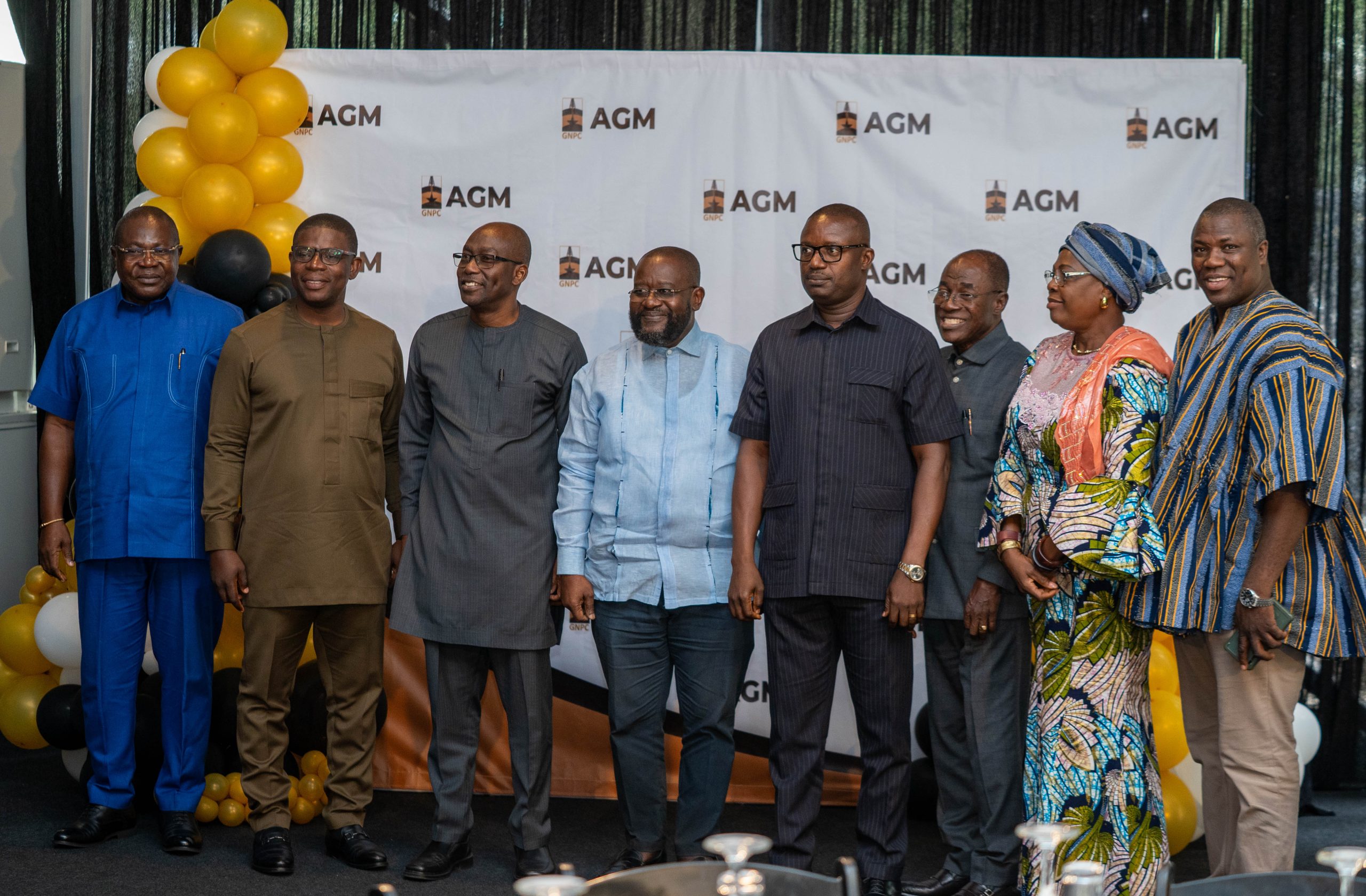
The Ghana National Petroleum Corporation (GNPC) has marked four decades of operations with a renewed focus on restoring petroleum production growth, expanding gas commercialisation, advancing exploration and strengthening its capacity to take on a greater operatorship role.
The Corporation outlined these priorities at its 3rd Annual General Meeting, held at the Labadi Beach Hotel in Accra under the theme, “40 Years of Resilience.”
The meeting brought together GNPC’s Board and Management, the Minister for Energy and Green Transition, representatives of Government, subsidiary leadership, operating partners and other stakeholders to review the Corporation’s 2025 performance and its direction for the year ahead.
Four Decades of Resilience and Transformation
Speaking at the event, GNPC Board Chairman, Prof. Joseph Oteng-Adjei, highlighted the Corporation’s four-decade journey, which evolved from laying the foundation of Ghana’s petroleum industry and promoting upstream investment to developing commercial discoveries, advancing operatorship and strengthening its role as a strategic national energy institution.
“Each phase of this journey has been characterised by resilience, adaptability and an unwavering commitment to creating lasting value for Ghana.”
He reiterated the Board’s focus on positioning GNPC for its next phase of growth, providing strategic oversight to Management in advancing priorities including arresting oil production decline, accelerating gas commercialisation, attracting new upstream investment and progressing exploration activities in the Voltaian Basin.
Responding to Production Decline
The Corporation’s 2025 performance reflected both the challenges confronting Ghana’s upstream petroleum sector and GNPC’s efforts to respond to them.
Ghana recorded its fifth consecutive year of declining crude oil production in 2025. Against that backdrop, GNPC worked with its operating partners on targeted interventions across the Jubilee, TEN and Sankofa Gye Nyame fields to stabilise production and improve performance.
Average daily crude oil production from the three producing fields stood at 102,199 barrels per day, while gas exports for domestic use reached approximately 336 MMscf/d, above the annual target of 325 MMscf/d.
Gas Commercialisation Drives Financial Performance
Financial performance also improved, with Group revenue increasing by 3.66 per cent to US$1.64 billion. Gas revenue reached US$952.38 million and accounted for 65.6 per cent of standalone revenue, confirming the growing importance of gas commercialisation to GNPC’s financial performance.
Chief Executive, Mr Kwame Ntow Amoah, said GNPC had responded to the difficult operating environment with targeted interventions aimed at the immediate challenges facing the sector.
“GNPC responded with disciplined execution, stronger focus, and targeted interventions to stabilise production, deepen gas commercialisation, advance exploration, and strengthen operatorship capability.”
He said the results of those interventions began to show in the second half of 2025, with the steep decline in production being slowed.
Investment Worth US$3.5 Billion Unlocked
A major development during the period was the extension of three Petroleum Agreements covering Deepwater Tano, West Cape Three Points and Offshore Cape Three Points.
According to the Chief Executive, the extensions have unlocked US$3.5 billion of investment over the next three years. This has reinforced efforts to sustain upstream activities and support future production.
Exploration and New Resources
GNPC also recorded progress in efforts to expand Ghana’s future resource base. The Eban-Akoma discoveries achieved declaration of commerciality, while preparations continued towards drilling an exploration well in the Voltaian Basin in the fourth quarter of 2026. The Corporation is also advancing a cluster-based development programme aimed at unlocking smaller and infrastructure-constrained petroleum resources.
Sector Minister Urges Increased Investment and Production Growth
Addressing the AGM, the Minister for Energy and Green Transition, Hon. Dr John Abdulai Jinapor, commended the Corporation’s performance but said the petroleum sector must now move beyond resilience towards renewed investment and production growth.
“Government welcomes these achievements, but our focus must now shift from resilience to renewal, growth and long-term sustainability.”
The Minister said Ghana’s mature producing fields would require increasingly sophisticated reservoir management, enhanced recovery, infill drilling and timely capital investment, alongside efforts to bring discovered resources into production and make new discoveries.
“Every barrel produced must increasingly be matched by new reserves.”
He identified opportunities including Pecan, Eban-Akoma, Afina, Pecan North, Almond and Beech, as well as marginal and stranded resources, while calling for technically disciplined exploration of frontier areas such as the Voltaian Basin.
Building Ghana’s Capability in Operatorship
Dr Jinapor also reaffirmed Government’s support for strengthening GNPC’s operatorship capability, saying Ghana could not indefinitely depend on international operators for all aspects of upstream development while seeking to maximise national value from its petroleum resources.
Investing in People, Sustainability and Governance
Beyond its core petroleum operations, GNPC invested US$6.57 million in Corporate Social Investment programmes during 2025, covering education, healthcare, skills development, community infrastructure, economic empowerment and institutional capacity building.
The Corporation also continued work to strengthen its ESG framework and reporting practices, while using its AGM and publication of annual report as part of broader efforts to promote good governance, transparency, accountability responsible stewardship of Ghana’s petroleum resources.
Closing his presentation, Mr Ntow Amoah said GNPC’s direction beyond its 40-year milestone remained clear.
“Looking ahead, GNPC’s focus is clear: restore production growth, expand gas commercialisation, accelerate operatorship capability, unlock new resources and build a resilient institution capable of delivering sustainable value for Ghana.”
