


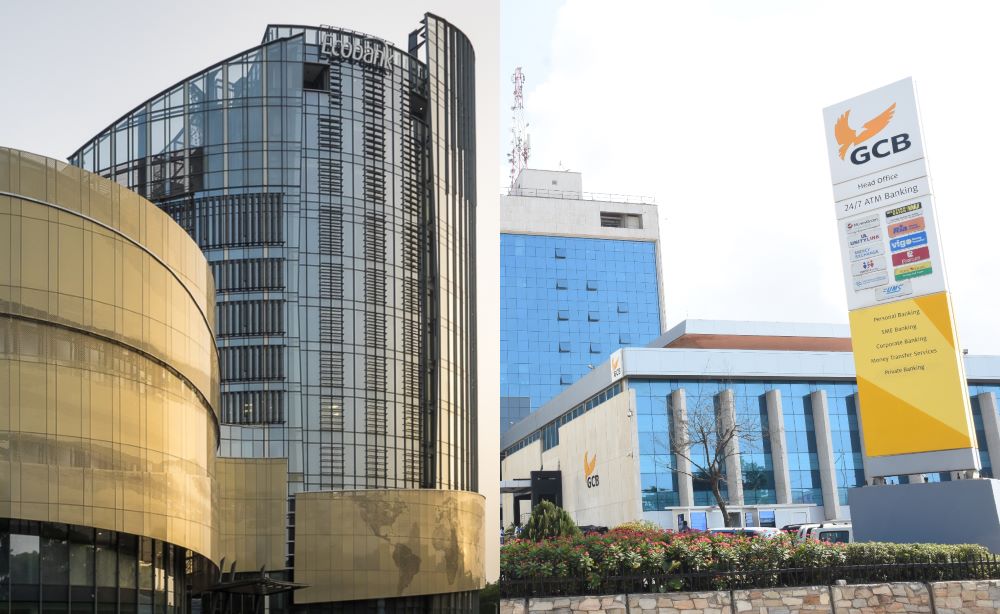
Ghana’s banking market is becoming increasingly competitive, with GCB strengthening its position as the industry’s leading player in deposits, loans and operating assets, even as some mid-tier banks make significant gains.
The latest PwC Ghana Banking Survey shows GCB took the lead in industry deposits with a share of 12.37% in 2025, down from the 12.99 % in 2024, taking the lead from Ecobank Ghana, whose share fell from 14.33% to 10.52% over the same period.
Stanbic Bank maintained third position with 7.80%, meaning the three largest banks collectively controlled about 30.7% of total industry deposits in 2025.
The concentration underscores the continued strength of the major banks, despite growing competition across the sector.
The shift is even more pronounced in lending, where GCB expanded its market share from 15.4% in 2024 to 17.8% in 2025.
Ecobank remained second with 14.2%, giving the two institutions a combined 32% share of industry loans, up from 29.7% a year earlier.
The growth came against a broader expansion in credit. Industry loans and advances rose by 23.4%, from GH¢85.1 billion in 2024 to GH¢105.1 billion in 2025, as lower lending rates, improving economic conditions and rising demand for business and consumer credit supported loan growth.
But while the biggest banks consolidated their positions, several mid-tier institutions recorded notable gains.
OmniBSIC Bank emerged as one of the strongest movers in deposits, jumping from 13th position in 2024 to fifth in 2025, with a 6.0% market share.
PwC attributes the improvement to focused customer acquisition and growth in retail and SME deposits.
Zenith Bank also increased its deposit share from 5.9% to 6.3%, while First Atlantic Bank improved to 4.9%, reflecting stronger customer retention and business banking activity.
The competitive reshuffling is also visible in banks’ operating assets.
Total industry operating assets jumped from GH¢308.4 billion in 2024 to GH¢404.3 billion in 2025, with GCB retaining the largest share at 12.3%.
Ecobank followed with 10.8%, while Stanbic held 8.6%. Absa accounted for 7.2%, Fidelity Bank 6.1%, and Zenith Bank 6.1%.
Notably, OmniBSIC’s operating-asset share surged from 2.8% to 5.1%, while Zenith’s increased from 5.7% to 6.1%, pointing to aggressive balance-sheet expansion as banks reposition for a lower-interest-rate environment.
The market-share shifts come as the industry’s balance sheet expands and banks rethink where to deploy funds.
Liquid assets grew by 57.7% to GH¢169.7 billion, Treasury bills approximately doubled to GH¢102.1 billion, while net loans and advances increased by 24.9% to GH¢92.1 billion.
Overall, the survey points to a banking market where scale remains a major competitive advantage, but market leadership is no longer static. GCB has strengthened its position across key balance-sheet indicators, while institutions such as OmniBSIC and Zenith are gaining ground through targeted deposit mobilisation, lending expansion and asset growth.
With interest rates falling and traditional investment returns coming under pressure, the next phase of competition is likely to depend increasingly on customer acquisition, digital banking, SME lending and the ability to grow market share without compromising asset quality.
