


By Hannah Dadzie
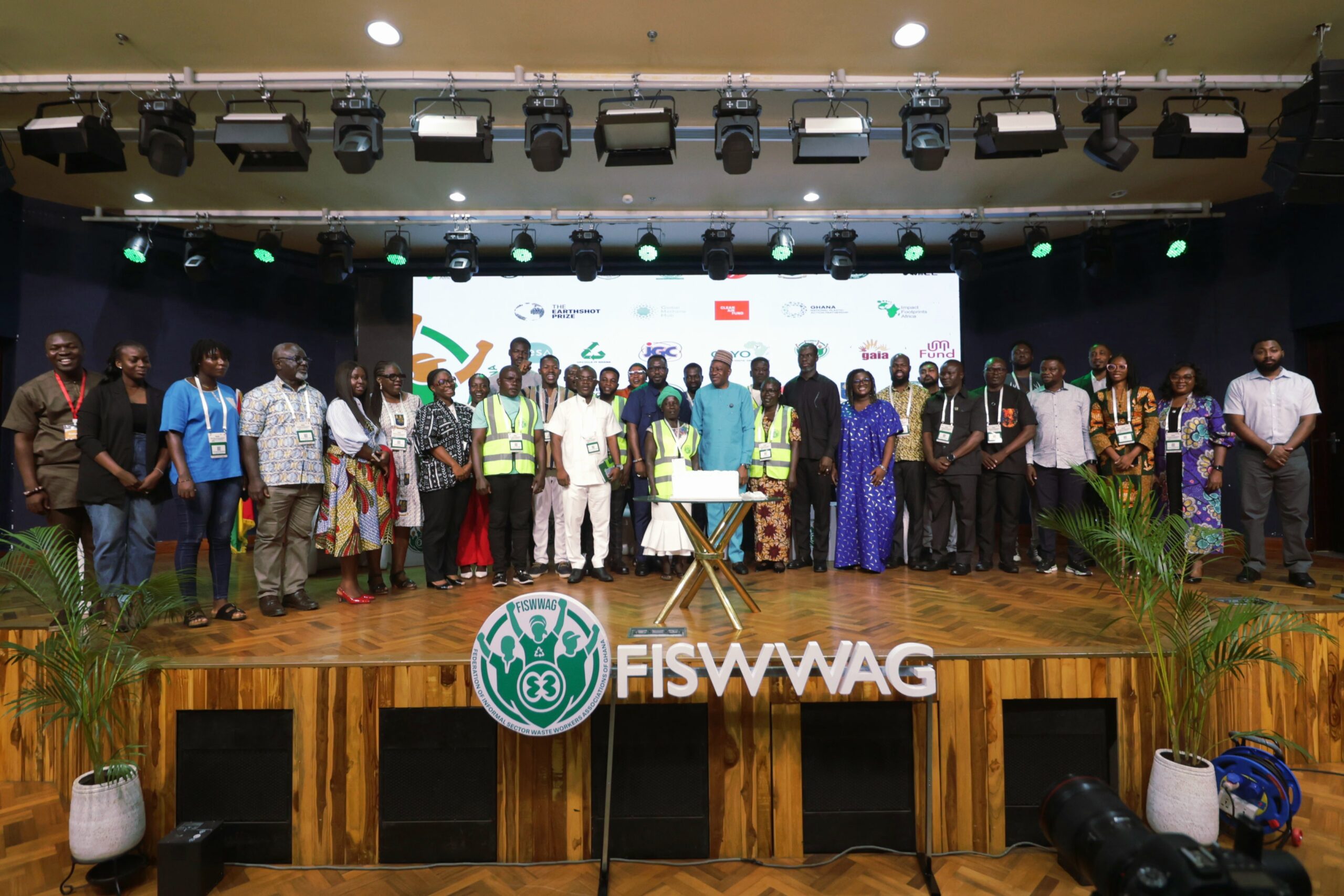
The Green Africa Youth Organization (GAYO), with support from the Ministry of Local Government and development partners, has officially launched the Federation of Informal Sector Waste Workers Associations of Ghana (FISWWAG), Ghana’s national union for informal waste workers, at the Wesley Towers Conference Room in Accra.
The event, themed “From Informality to Inclusion: Recognizing Informal Waste Workers as Essential Actors in Ghana’s Circular Economy,” brought together waste worker leaders from all 16 regions of Ghana, along with government officials, development partners, and private-sector actors.
The launch marks the culmination of a five-year journey by GAYO to organize and mobilize waste pickers across the country, a process that began with a single waste picker cooperative and has grown into a nationwide movement that recognizes the environmental and economic contributions of informal waste workers.
The new union gives informal waste workers, many of whom recover recyclable materials, divert waste from landfill, and supply industries with secondary raw materials, a unified voice to engage government, municipalities, industry, and development partners for the first time.
Its mandate includes advocating for safer working conditions, stronger worker organizations, better access to markets, social protection, occupational health and safety, and meaningful participation in policy decisions affecting the sector.
Minister for Labour, Jobs and Employment, Dr. Abdul-Rashid Pelpuo, confirmed the union’s formation as a lawful exercise under the Labor Act 2003 (Act 651) and Ghana’s ratified International Labor Organization conventions on freedom of association.
“The formation of the National Informal Waste Worker Union is therefore a lawful exercise of constitutional and statutory underpinnings, and Government fully recognizes this important development,” he said,
Dr. Pelpuo pledged government commitment to safe workplaces, social dialogue, and inclusive employment for the sector.
Speaking on behalf of GAYO, the Executive Director, Richard Matey said the launch reflects years of organizing and relationship-building.
“Recognition requires organization. Organization requires representation. Representation requires partnerships. That understanding shaped the journey that has brought us here today,” he said,
Mr Matey added that inclusion for the sector is an ongoing process that will continue with legal recognition, municipal integration, and expanded market access.
Government and GAYO both described the launch as a starting point rather than an endpoint. Priorities going forward include strengthening the union’s institutional capacity, expanding partnerships with Metropolitan, Municipal and District Assemblies (MMDAs), improving access to social protection and occupational health services, and integrating waste workers more fully into Ghana’s circular economy and Extended Producer Responsibility systems.
The initiative has been supported by funding partners including the UMI Fund, The Earthshot
Prize, Global Methane Hub, and the Clean Air Fund, alongside technical and institutional
partners such as Global Alliance for Incinerator Alternatives (GAIA), the Ghana National Plastic
Action Partnership (Ghana NPAP), the Accra Metropolitan Assembly, People’s Dialogue, Impact Footprint Africa, IESS Legon, Green Growth Africa, Work First Mile, CONIWAS, and a wide network of government institutions, recycling companies, and civil society organizations.
GAYO has extended an open invitation to government institutions, private companies, producer responsibility organizations, research institutions, foundations, and development partners not yet involved to join the effort.
About GAYO
The Green Africa Youth Organization (GAYO) is a pan-African, youth-led organization that cocreates and implements climate solutions across Africa. Working across themes such as zero-waste cities, just transition, adaptation and resilience, and green jobs, GAYO bridges communities, institutions, and policy to deliver locally owned and durable change.
More Stories Here
