


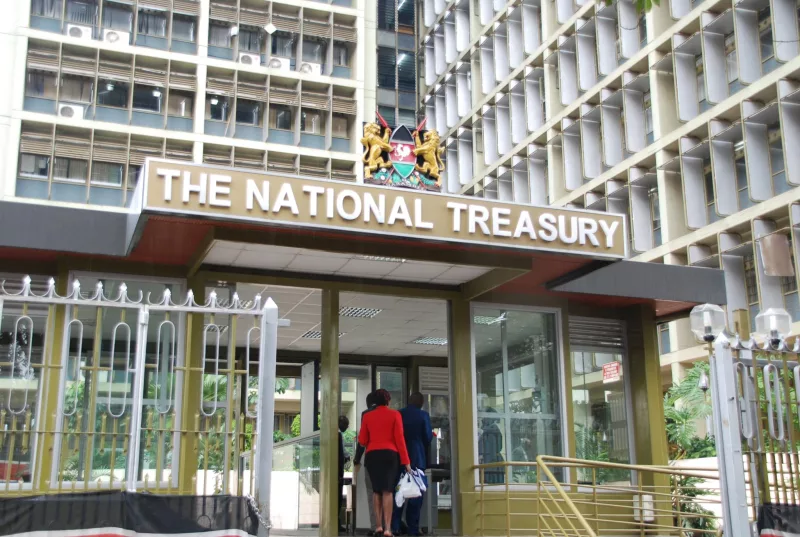
 National Treasury offices in Nairobi/FILE
Four years into President William Ruto’s administration, Kenya’s public debt has crossed the Sh13 trillion mark, while the cost of servicing the loans has become one of the biggest claims on government revenue.
The latest National Treasury figures show that public and publicly guaranteed debt stood at Sh13.013 trillion at the end of June 2026, up from about Sh8.76 trillion in September 2022, when Ruto assumed office.
That represents an increase of roughly Sh4.25 trillion in the four years, although the change in the debt stock cannot be attributed entirely to new borrowing.
Exchange-rate movements, valuation adjustments, disbursements, repayments and other debt-management transactions also affect the stock.
The bigger question is therefore not simply how much Kenya borrowed, but what the money was used to finance and how much of it went into projects capable of generating economic returns.
How much was borrowed?
Treasury records show that in the 2022/23 financial year, the government raised about Sh759.7 billion in net financing to cover the fiscal deficit.
This comprised about Sh502.4 billion in net domestic financing and Sh257.3 billion in net external financing.
In 2023/24, net domestic financing rose to Sh595.6 billion, while net external financing was Sh222.8 billion, bringing net borrowing for deficit financing to about Sh818.3 billion.
The borrowing increased further in 2024/25.
Treasury data shows net domestic financing of Sh854.5 billion and net external financing of Sh179.7 billion, or about Sh1.03 trillion combined.
In 2025/26, the government borrowed Sh983.7 billion, according to the draft 2026 Budget Review and Outlook Paper.
Of this, Sh776 billion was ultimately spent on development, while Sh207.7 billion financed recurrent expenditure.
Taken together, the four financial years point to almost Sh3.6 trillion in net borrowing for deficit financing.
But there is an important qualification: not every shilling borrowed can be matched to a particular road, hospital or housing project.
A significant portion of government borrowing is raised through Treasury bonds and other instruments for general budget financing.
Once deposited into the Exchequer, the money becomes part of the overall government financing pool.
Where did the money go?
A substantial part went into development programmes.
Development expenditure increased from Sh493.7 billion in 2022/23 to Sh546.4 billion in 2023/24, Sh582.9 billion in 2024/25 and a provisional Sh731.5 billion in 2025/26.
These expenditures have supported government priorities, including roads, water and irrigation, energy, housing, education, health, agriculture and digital infrastructure.
The Ruto administration has also continued major infrastructure programmes inherited from previous governments while starting or expanding projects under its Bottom-Up Economic Transformation Agenda.
The road programme has been one of the largest areas of government investment, alongside the expansion of water and irrigation projects.
The government has also allocated substantial resources to the Affordable Housing Programme, markets, industrial parks and digital connectivity.
Some external loans are easier to trace because they are project-specific.
Treasury records, for example, list loans supporting the Affordable Housing Finance Project, while other external financing has been tied to infrastructure, water, energy, transport and social programmes.
The government has also relied on borrowing to support programmes aimed at agriculture and food security, including irrigation and input support, as well as youth and enterprise programmes.
However, the latest figures expose a more complicated reality.
Borrowing for recurrent spending
President Ruto came to power promising to end the practice of borrowing to finance the government’s day-to-day operations.
In his first State of the Nation address to Parliament in September 2022, he said: “The government should never borrow to finance recurrent expenditure.
It is not right, it is not prudent, and it is not sustainable. It is simply wrong.”
The latest Treasury figures show that promise has not been fully achieved.
In 2023/24, more than half of the Sh766.4 billion borrowing cited in the Treasury’s latest review went towards recurrent expenditure, while in 2024/25 Sh250.4 billion of the Sh854.5 billion borrowing went to recurrent spending.
In 2025/26, the figure was Sh207.7 billion.
Treasury has acknowledged the breach of the Public Finance Management Act principle requiring borrowing, over the medium term, to finance development rather than recurrent expenditure.
The argument from government is that fiscal consolidation is underway and the share of borrowing going to development has been rising.
The price of the debt
The most immediate cost is debt service.
In the 2024/25 financial year, Kenya paid Sh1.72 trillion in principal and interest on domestic and external debt.
Domestic debt service accounted for Sh1.091 trillion, while external debt service consumed Sh580.2 billion.
Interest alone has become particularly expensive.
For 2025/26, Parliament’s Public Debt and Privatisation Committee projected debt servicing at Sh1.9 trillion, including Sh1.3 trillion for domestic debt and Sh586.4 billion for external debt.
Interest payments were projected at Sh1.097 trillion.
This means that money raised through taxes is increasingly being committed to obligations created by previous borrowing.
Kenya’s credit rating
The rising debt burden has also kept Kenya under close watch by international credit-rating agencies, which assess the country’s ability to repay its obligations and access international capital markets.
Kenya remains below investment grade, meaning international lenders continue to regard the country as a relatively high-risk borrower.
This has implications for the cost of external financing, with higher perceived risk generally translating into higher borrowing costs.
Moody’s upgraded Kenya’s sovereign rating to B3 from Caa1 in January 2026, citing a reduction in near-term default risks and improvements in external liquidity and foreign-exchange buffers.
”The upgrade to B3 reflects our view that Kenya’s near-term default risk has declined,” Moody’s said in its January 2026 assessment.
The upgrade provides some relief for the Treasury as it seeks to return more frequently to international capital markets, but it does not remove the pressure created by Kenya’s large debt stock and high annual repayment obligations.
The rating agencies’ assessments therefore provide another measure of the debt challenge: it is not only the amount Kenya owes that matters, but also how investors perceive the country’s ability to repay and the price they demand to lend to it.
In May, Treasury CS John Mbadi warned that a weaker shilling would make the situation worse because foreign debt becomes more expensive in local currency.
He said debt-servicing costs could rise “from 1.5 trillion to a higher figure” if the shilling depreciated unnecessarily.
For the 2026/27 financial year, Mbadi has said about Sh1.5 trillion is required for debt repayment obligations, before other major government commitments are funded.
That explains why the debt question is no longer an abstract Treasury statistic. It affects how much money remains for salaries, counties, health, education, security and development.
Government’s defence
Treasury argues that borrowing remains necessary because government revenue has not been sufficient to finance the country’s expenditure needs.
Mbadi has also been seeking new ways of reducing the cost of existing debt rather than simply contracting more expensive loans.
In June, he proposed debt-for-food and debt-for-development swaps, under which some debt obligations could be converted into investment in food security and development projects.
“The government is considering thematic and liability management instruments such as debt-for-food swaps and debt-for-development swaps,” Mbadi said.
Treasury is also exploring Panda and Samurai bonds, Sukuk instruments and other liability-management options as it seeks cheaper and more diversified financing.
But PS Chris Kiptoo has himself acknowledged the limits of the borrowing model.
Appearing before Parliament’s Public Debt and Privatisation Committee in April, Kiptoo said: “Borrowing is not sustainable. We are working hard, but without achieving fiscal consolidation, it is going to be very difficult going forward.”
That admission captures the central challenge facing the Ruto administration.
Kenya has not borrowed only to build new projects. It has borrowed to bridge budget deficits, refinance maturing obligations, support development and, increasingly, cover gaps in recurrent spending.
So, where did the money go?
The answer is therefore mixed.
Some borrowing financed identifiable development projects, roads, water systems, housing, energy, agriculture, digital infrastructure and other capital programmes.
Some financed general government expenditure, making it impossible to attribute every shilling to an individual project.
Some borrowing refinanced old debt, meaning new loans were used to repay maturing obligations rather than create new assets.
And, increasingly, some borrowing has supported recurrent expenditure, including obligations that President Ruto pledged in 2022 would no longer be funded through debt.
The result is a country with a much larger debt stock and a much heavier annual debt-service bill.
The Treasury’s own debt-management strategy describes Kenya’s debt as sustainable but at high risk of debt distress, with the present value of public debt above the benchmark.
The test for the remaining years of the Ruto presidency will therefore be less about whether Kenya can continue borrowing and more about whether every new shilling of debt can generate enough economic activity, jobs, exports and revenue to repay the loans without crowding out the services Kenyans depend on.
That is ultimately the real debt question: not simply what Kenya borrowed, but whether the assets and economic opportunities created by the borrowing will be worth the bill future taxpayers will have to pay.
