


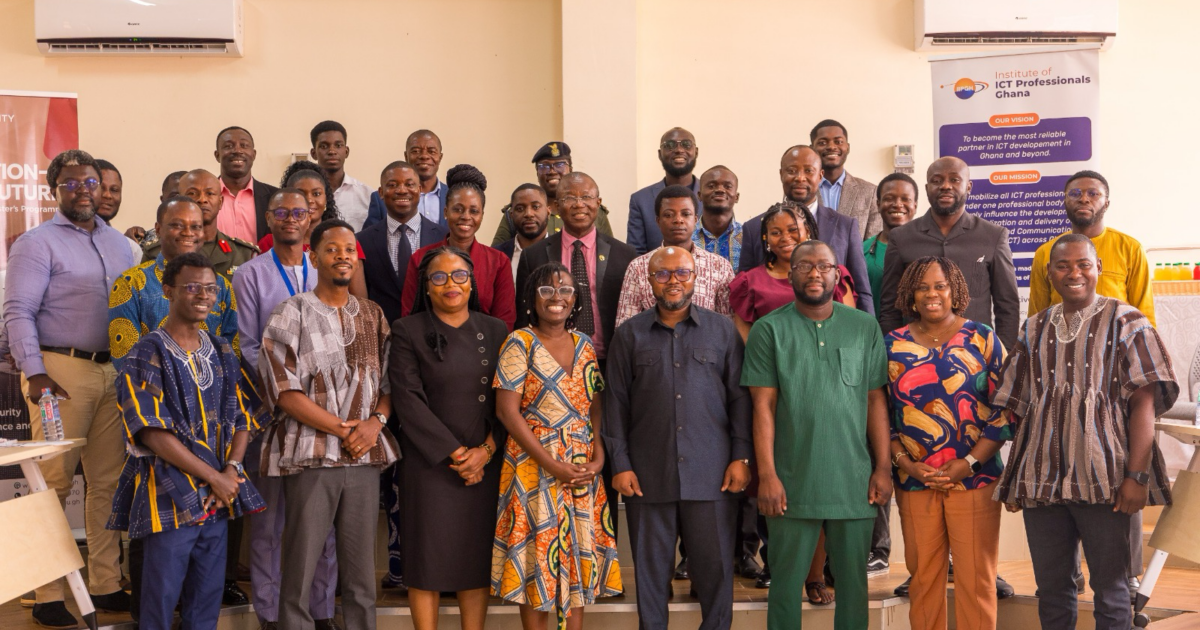
Academic City University, the Institute of ICT Professionals Ghana, and the Cyber Security Authority, Ghana, have released a white paper calling for stronger accountability, public awareness and coordinated action to safeguard Ghana’s rapidly expanding digital ecosystem.
This follows cybersecurity-related financial losses of more than GHS19.3 million recorded in 2025.
The white paper, titled Securing Trust in Ghana’s Digital Future: Accountability, Awareness and Action, draws attention to the growing threats facing individuals, businesses and public institutions as the country increasingly relies on digital systems for financial transactions, governance, education and social interaction.
According to the report, Ghana recorded 14,425 cybersecurity-related reports and enquiries between January and September 2025, of which 3,286 were confirmed as actual cyber incidents.
Online fraud accounted for 37% of the reported incidents, followed by cyberbullying at 22%, online blackmail at 15%, unauthorised access at 12%, and information disclosure at 9%.
Dr. Muhammed Siraj, the Director for Graduate and Continuous Education for the Faculty of Computational Science and Informatics at Academic City and the lead for the white paper’s synthesis team, said the findings should serve as a wake-up call for stakeholders to move beyond discussions about cybersecurity and focus on practical measures that strengthen public confidence in Ghana’s digital systems.
“Digital transformation can only deliver its full benefits when people trust the systems they use. That trust must be built through awareness, accountability and effective action.
“At Academic City, we believe higher education institutions have a responsibility not only to develop the skills needed for the digital economy but also to contribute research and practical solutions to national challenges,” he added.
The white paper was developed from discussions at the 2025 National Cyber Security Awareness Month Roundtable, held on October 2, 2025, and co-organised by Academic City, the Institute of ICT Professionals Ghana and the Cyber Security Authority.
It brought together stakeholders from government, academia, the private sector, security agencies and civil society to examine how Ghana could strengthen trust in its digital environment.
The report identified limited digital literacy, weak reporting of cyber incidents, the high cost of secure digital services, data misuse, weak institutional accountability, vulnerabilities in imported ICT systems and a shortage of skilled cybersecurity professionals as major challenges.
It noted that the education sector was particularly vulnerable, with more than 550 compromised university staff credentials reportedly found on the dark web, while a number of institutional websites were operating outdated or insecure systems.
Among the key recommendations is the introduction of continuous, multilingual national cybersecurity awareness campaigns using radio, television, social media, community durbars and faith-based platforms.
It further recommended stronger enforcement of existing cybersecurity and data protection laws, greater transparency in ICT procurement, improved verification of imported hardware and software, and the development of a National Digital Trust Framework to establish common cybersecurity, privacy and digital governance standards.
It also stressed the need to expand cybersecurity education and professional training, strengthen collaboration between government, academia and industry, and direct greater resources towards underserved communities.
According to the report, Ghana’s digital future cannot be secured through policy frameworks alone, stressing that the effectiveness of the country’s cybersecurity agenda will ultimately depend on implementation, enforcement, institutional accountability and
DISCLAIMER: The Views, Comments, Opinions, Contributions and Statements made by Readers and Contributors on this platform do not necessarily represent the views or policy of Multimedia Group Limited.
DISCLAIMER: The Views, Comments, Opinions, Contributions and Statements made by Readers and Contributors on this platform do not necessarily represent the views or policy of Multimedia Group Limited.
