


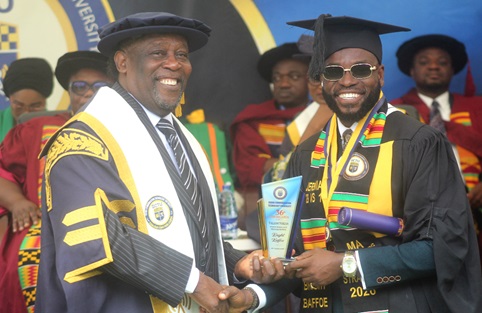
The Executive Director of the Data Protection Commission (DPC), Dr Arnold Kavaarpuo, has challenged graduates of the Ghana Communication Technology University (GCTU) to create innovations that will enable the country to own and shape its digital future, rather than remain consumers of technologies developed elsewhere.
He said the country’s growing use of digital payments, online platforms and artificial intelligence (AI) did not necessarily amount to digital transformation, and stressed that the country must develop local infrastructure, technical capability, intellectual property and governance systems to capture greater value from its digital economy.
“If Ghana supplies the users and the data while others own the infrastructure, models, intellectual property and capital, we may become digitally active without becoming digitally powerful.
We risk becoming exporters of raw data and importers of processed intelligence. That would reproduce an old economic structure in a new technology form,” he stated.
Event
He gave the challenge while speaking at a GCTU Special Congregation held in Accra last Friday. It was on the theme: “Shaping the Future: Innovation and Technology Education to support Ghana’s Digital Economy.”
The special congregation saw 300 graduates receive qualifications, comprising 60 Coventry University graduates, 132 GCTU Master’s graduates and 108 undergraduates from ICT, business and engineering programmes.
Leveraging AI
Dr Kavaarpuo, a GCTU alumnus, urged the graduates to use AI to extend their capabilities without surrendering human judgement and accountability to machines.
He emphasised that AI was increasingly capable of writing software, analysing financial information, generating legal arguments and performing complex tasks, with implications for jobs, particularly entry-level positions.
The DPC boss, however, urged graduates to develop originality, judgement, responsibility and trust because technological progress did not automatically translate into human progress.
He also called on GCTU to become part of the execution of the country’s National AI Strategy by producing people capable of building new systems and creating technologies grounded in Ghanaian realities.
Meeting changing demands
The Acting Vice-Chancellor of GCTU, Professor Ebenezer Malcalm, said the university had introduced programmes at the PhD, Master’s, bachelor and diploma levels to meet changing demands of the digital economy.
He said GCTU was deepening collaboration with industry and international partners to bridge the gap between academia and professional practice.
He added that the university was investing in modern laboratories, digital learning platforms and lecture and office facilities, while pursuing hostel projects to address accommodation challenges.
Prof. Malcalm stated that the institution was equipping graduates in artificial intelligence, cybersecurity, cloud computing, robotics, data science, fintech, digital infrastructure and smart manufacturing.
Affirmation
The Chairman of the Governing Council of GCTU, Divine D. K. Kpetigo, said the graduation was an affirmation of the university’s commitment to producing competent, ethical and innovative graduates capable of contributing to national development and the global knowledge economy.
He congratulated the graduates and acknowledged the support of parents, guardians, lecturers and mentors.
