


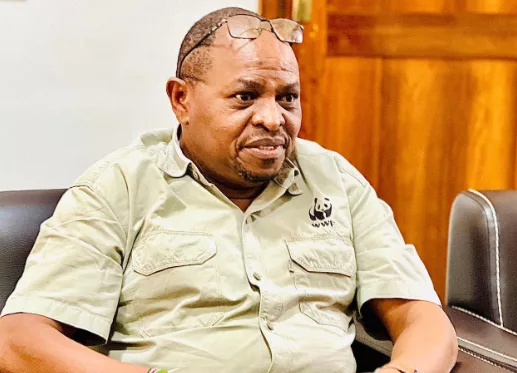
 Noah Sitati/ COURTESY
Every political generation produces leaders who redefine the national conversation. Some inherit power through established political networks.
Others emerge by challenging the status quo. Whether one agrees with him or not, Nairobi Senator Edwin Sifuna has become one of the most talked-about politicians in Kenya today.
The lawyer-turned-politician has steadily transformed himself from a party spokesperson into one of the country’s most recognisable constitutional voices.
Even after the Orange Democratic Movement (ODM) entered a broad-based working arrangement with President William Ruto’s United Democratic Alliance (UDA), Sifuna has continued to chart an independent political course, frequently questioning government decisions that he believes conflict with the spirit and letter of Kenya’s 2010 Constitution.
His willingness to publicly differ from both government and, at times, his own political allies has earned him admiration from supporters and criticism from opponents. In today’s Kenya, where political loyalties often shift quickly, Sifuna has cultivated an image of consistency—something that many citizens say is increasingly rare.
A Constitutional voice
For more than a decade, the Constitution of Kenya 2010 has been regarded as one of Africa’s most progressive constitutional documents.
It emerged after decades of political struggle and introduced far-reaching reforms on devolution, human rights, judicial independence and checks on executive authority. Sifuna has consistently argued that no government, regardless of its popularity or parliamentary strength, should operate outside those constitutional boundaries.
As a practising advocate before entering elective politics, his legal training is evident in his public speeches. Parliamentary debates, television and radio interviews and political rallies often see him referencing constitutional provisions rather than relying solely on political rhetoric.
Supporters describe him as one of the strongest defenders of constitutionalism in contemporary Kenyan politics.
His critics argue that his confrontational style sometimes overshadows opportunities for constructive engagement. Yet even those who disagree with him acknowledge his command of legal and constitutional issues.
Building a grassroots movement
One of the most striking developments in recent months has been the growing visibility of the Linda Mwananchi movement associated with Sifuna and his close allies.
Across different parts of Kenya, public gatherings linked to the movement have attracted significant crowds, particularly among younger people. Supporters see the movement as a platform for defending ordinary citizens, promoting accountability and encouraging active public participation in governance.
The grand reception accorded to Sifuna during his recent visit to Bungoma County, his home county, became one of the most discussed political events on Kenyan social media.
Images and videos of enthusiastic crowds generated widespread commentary, with supporters interpreting the turnout as evidence of expanding national appeal. Political analysts, however, cautioned that public rallies, while politically significant, do not necessarily predict electoral outcomes.
Nevertheless, few observers dispute that Sifuna has become one of the country’s fastest-rising political figures.
Politics without wealth
Perhaps the most unusual aspect of Sifuna’s political journey is the conversation it has sparked about money and leadership.
Unlike many senior politicians who possess substantial personal wealth or extensive business empires, Sifuna is widely perceived as living a relatively modest lifestyle. His supporters argue that this makes him relatable to ordinary Kenyans struggling with the rising cost of living.
His critics have used the same narrative to question whether someone without significant financial resources can successfully lead a nation.
The debate intensified after photographs of his modest home circulated widely online. Rather than diminishing support, however, many Kenyans responded by expressing solidarity.
Supporters pressed for the launch of a public fundraising initiative through a Safaricom PayBill, encouraging voluntary contributions of any amount.
Thousands reportedly participated, with many making very small donations to symbolise that political movements can be sustained by ordinary citizens rather than wealthy benefactors.
Whether this model becomes a lasting feature of Kenyan politics remains to be seen, but it has undoubtedly challenged traditional assumptions about political financing.
Fundraising by politicians is not new but it the approach that has changed from dinner fundraising galla of wealth people now down the common people
The experience question
Age and experience have become recurring themes in discussions surrounding Sifuna.
Some veteran politicians argue that national leadership requires decades of executive experience. Others contend that effective leadership depends more on integrity, competence, vision and the ability to assemble capable teams than on age alone.
History offers examples supporting both perspectives.
Thomas Sankara became President of Burkina Faso at 33 and remains one of Africa’s most influential reformers. Jacinda Ardern became Prime Minister of New Zealand at 37 and earned global respect for her leadership during multiple national crises.
Sanna Marin led Finland at 34, while Emmanuel Macron became President of France at 39 despite limited elected political experience. These examples do not suggest that youth alone guarantees success.
Rather, they illustrate that leadership is ultimately judged by performance, character and the ability to inspire confidence. Kenya’s own democratic history has repeatedly shown that citizens are willing to support leaders who articulate a compelling vision regardless of age.
The Raila Odinga legacy
No discussion of Edwin Sifuna’s political journey is complete without acknowledging the influence of Raila Odinga. For decades, Raila occupied a unique place in Kenya’s political history as one of the country’s leading advocates for multiparty democracy, constitutional reform and civil liberties.
His ability to mobilise large public gatherings and inspire political participation became one of his defining characteristics.
Sifuna entered national politics under ODM and worked closely with Raila during his tenure as Secretary General.
Many observers believe that period helped shape his communication style, political confidence, courage and constitutional outlook. Supporters often describe him as one of the younger leaders carrying forward aspects of Raila’s democratic legacy.
Members of the Odinga family have also publicly defended him on several occasions, reinforcing perceptions of a close political relationship. Whether he ultimately emerges as one of the principal heirs to that political tradition will depend on how his own leadership evolves in the years ahead.
Beyond the rallies
Crowds alone do not win elections. Political momentum must eventually translate into organisational structures, policy credibility and national electoral appeal.
Should Sifuna aspire to higher office in future, he will need to persuade Kenyans not only that he can criticise government effectively but also that he possesses practical solutions to challenges such as unemployment, public debt, healthcare, education, corruption, food security and economic growth.
He will also face the realities of Kenya’s complex coalition politics, where regional interests, party alliances and electoral strategy often determine political outcomes as much as personal popularity.
A political figure to watch
Whether viewed as a constitutional defender, an emerging national leader or simply an outspoken opposition politician, Edwin Sifuna has become one of the defining political personalities of his generation.
His rise reflects broader shifts taking place within Kenyan politics: a growing youth population demanding accountability, increasing public interest in constitutional governance, and renewed debate over whether integrity should outweigh wealth and political patronage in determining leadership.
Only time will tell whether today’s political momentum develops into a successful national leadership bid. Yet one conclusion already seems evident.
Edwin Sifuna has moved beyond being merely Nairobi’s senator. He has become a central figure in Kenya’s ongoing conversation about democracy, constitutionalism and the future of political leadership.
For his supporters, he represents hope for a new political culture. For his critics, he remains an untested politician whose greatest challenge lies ahead. For Kenya, he is undoubtedly a leader whose next chapter will be watched closely.
