


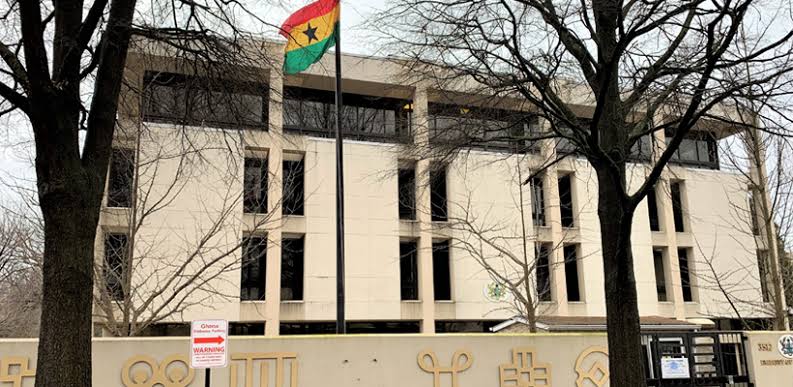
A forensic audit by the Auditor-General has uncovered what it describes as an elaborate scheme through which officials of Ghana’s Embassy in Washington, D.C., allegedly generated and shared about $19.4 million from visa and passport applicants between 2019 and 2025.
The audit, which examined the operations of the embassy from 2017 to 2025, identified several financial arrangements and private platforms allegedly used to collect charges above officially approved fees.
According to the report, websites and companies linked to the embassy’s IT Officer, Fred Kwarteng, were used to charge applicants $29.75 for the return delivery of visa and passport applications, although the actual postage cost was about $10.10.
One of the platforms identified was GhanaPV.org, a website the audit said was designed to resemble the embassy’s official website and could mislead applicants into believing they were dealing with an authorised government channel.
The Auditor-General’s report said the website, created in September 2020, used Ghana’s Coat of Arms, the name “Embassy of Ghana” and official contact details.
It redirected applicants to make payments for postage and application support services, charging $29.75 for return postage in addition to other service fees.

The report said the platform operated under several entities associated with Mr Kwarteng.
These included Ghana Travel Consultancy (GTC), Secure Data Center LLC, Travel Ghana, Travel Global, Secure Document Management Center (SDMC) and MFG Technology.
Another platform, TravelGhana.net, was also identified in the audit.
According to the report, the domain was originally developed between 2013 and 2014 before being relaunched in January 2021.
It offered mailing and application support services to visa and passport applicants, charging $29.75 for mailing, $67 for passport support and $76.78 for visa support services.
The audit said the website used Ghana’s Coat of Arms and branding resembling that of the embassy between 2021 and 2024, creating the impression that it had an official connection to the mission.
Senior officials linked to operations
The Auditor-General’s findings also raise questions about the involvement of senior embassy officials in the arrangements surrounding the private entities.
The report said email correspondence and internal records showed that Mr Kwarteng’s activities were facilitated through financial and consular channels involving senior officers at the mission.
It specifically cited the Chief Treasury Officer and the minister (Consular) in communications and transactions involving welfare payments, dispatch services and courier arrangements.
According to the report, the Chief Treasury Officer was involved in welfare account transactions, payment arrangements and operational coordination with entities linked to Mr Kwarteng.
It further said the minister (Consular) participated in, and was copied on, communications involving private entities linked to Mr Kwarteng that handled dispatch and courier services.
The communications, according to the audit, occurred between 2020 and 2024 and involved directing applicants to Mr Kwarteng’s private platforms.

The Auditor-General said the evidence demonstrated sustained engagement between the officials and the private entities within the embassy’s operations.
Citibank raised questions over embassy welfare account
The audit also uncovered a bank account allegedly used to channel proceeds from the arrangements and distribute payments to embassy staff under the description of welfare benefits.
The account was opened at Citibank as the “Embassy of Ghana Welfare Account”.
On March 16, 2020, Treasury Officer Janet Maku Koranteng wrote to Citibank requesting the opening of the account with effect from April 1, 2020.
The proposed signatories were First Secretary Mary Zori, Head of Chancery Genevieve Edna Apaloo and Ms Koranteng.
Citibank subsequently raised questions about the account and its sources of funding.
In one query, a Citibank official asked whether the $80,000 expected to be withdrawn every quarter for staff welfare would be paid in cash or by cheque.
Another query focused on payments being made into the account by Ghana Travel Consultancy LLC, an entity linked to Mr Kwarteng.
Citibank official Jay Varkey asked the embassy to explain the nature of Ghana Travel Consultancy’s relationship with the mission and why the company was making payments into the welfare account.
The bank specifically questioned whether the company was simply providing courier services or was processing consular applications on behalf of the embassy.
Embassy explained payments as courier reimbursements
Following discussions between Citibank and the embassy, Mr Varkey sent an email to Ms Koranteng summarising the explanation provided by the embassy.

According to the explanation, applicants were free to choose a courier or mailing service when applying for passports, visas and other consular services.
The embassy said applicants paid the courier directly and that the money did not pass through embassy accounts.
However, it explained that because embassy staff performed some administrative tasks that would ordinarily be handled by the courier companies, the companies reimbursed the embassy between $3 and $5 for each application processed.
The money was then credited to the welfare account and used for welfare payments to embassy staff.
Ghana Travel Consultancy was identified as one of the courier providers making such payments.
Citibank records cited in the audit showed three cheques from Ghana Travel Consultancy being paid into the account for reimbursements relating to December 2019, January 2020 and February 2020.
Welfare account closed but alleged scheme continued
The arrangement eventually came under scrutiny during a visit to the embassy by then foreign affairs minister Shirley Ayorkor Botchwey in June 2021.
The minister ordered the closure of the welfare account after the concerns surrounding its operations emerged.

The account was subsequently closed, but correspondence cited in the audit suggests that officials explored ways of maintaining a similar arrangement outside the formal management of the embassy.
In an email to Citibank on August 31, 2021, Ms Koranteng asked whether the Welfare Committee could open an account without the involvement of embassy management.
Citibank declined the request, explaining that it could not maintain a welfare account separately from the embassy as long as the account continued to be used to make welfare payments to embassy employees.
The account was officially closed on October 10, 2021.
The closure, however, did not bring an end to the wider arrangements surrounding the charging of applicants.
According to the forensic audit, the transactions through which applicants were allegedly charged amounts above approved fees continued until 2025.
The report puts the total amount generated through the illicit arrangements between 2019 and 2025 at approximately $19.4 million.

The findings have raised fresh questions about financial controls at Ghana’s diplomatic missions and the extent to which private entities and embassy officials were able to operate alongside official consular processes without adequate oversight.
Source: pledge against corruption
Asaase 99.5 Accra, Asaase 98.5 Kumasi, Asaase 100.3 Cape Coast, AsaasePa 107.3 (Accra)
Affiliates: Bawku FM 101.5, Bead FM 99.9 (Bimbilla), Mining City Radio 89.5 (Tarkwa), Nandom FM 101.9, Nyatefe Radio 94.5 (Dzodze), Sissala Radio 96.3 (Tumu), Somuaa FM 89.9 (Gushegu), Stone City 90.7 (Ho) and Wale FM 106.9 (Walewale)
Listen online: asaaseradio.com, Sound Garden and TuneIn
Follow us:
X: @asaaseradio995, @Asaase985ksi, @asaase1003, asaasepa1073
Instagram: asaaseradio99.5, asaase985ksi, asaase100.3, asaasepa107.3
LinkedIn: company/asaaseradio995. TikTok: @asaaseradio99.5
Facebook: asaase99.5, asaase985ksi, Asaase100.3, AsaasePa107.3
YouTube: AsaaseRadioXtra
Join the conversation. Accra: call 020 000 9951/050 009 0121, WhatsApp 020 000 0995. Kumasi: call 059 415 7985 or call/WhatsApp 020 631 5260. Cape Coast: call/WhatsApp 059 388 2652.
#AsaaseRadio
#AsaasePa
#TheVoiceofOurLand
