


There comes a moment in the life of every nation when a problem can no longer be explained away as someone else’s responsibility.
For Ghana, that moment may be here.
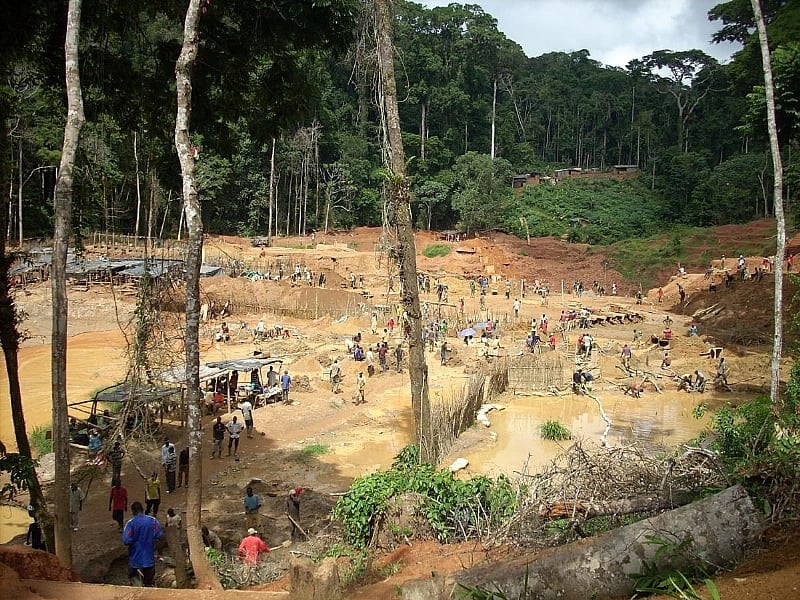
Illegal mining, popularly known as galamsey, is no longer simply a matter of people digging for gold without the necessary permits. It has become a question about the kind of country we are willing to leave behind for the next generation.
Our rivers are under pressure. Forests are being degraded. Farmlands are being destroyed. Communities that depend on natural resources for their livelihoods are increasingly confronted with the consequences of environmental degradation.
Yet the national response often follows a familiar pattern: public outrage, political promises, committees, enforcement exercises, media discussions — and then, eventually, silence.
Until the next river is destroyed.
How long are we going to talk while Ghana’s natural resources disappear before our eyes?
The price of gold cannot be the destruction of water
Ghana is blessed with mineral resources, and mining has an important place in the national economy. The answer, therefore, cannot be to pretend that mining itself is the enemy.
The real question is whether we can extract our mineral wealth without destroying the environmental systems that sustain human life.
Gold can generate revenue.
But gold cannot replace a river.
Gold cannot feed a community when agricultural land has been destroyed.
Gold cannot provide drinking water when a critical water source has become severely degraded.
And no government, regardless of its political colour, should consider the destruction of an essential water source an acceptable price for short-term economic gain.
This is why galamsey must be treated as more than an environmental issue.
It is a water-security issue. It is a public-health issue. It is an agricultural issue. It is an economic issue. And increasingly, it is a governance issue.
The health consequences cannot be ignored
The connection between safe water and public health is not controversial.
When communities lose reliable access to safe water, they may be forced to depend on alternative sources whose quality cannot always be guaranteed. Contaminated water and inadequate sanitation can increase exposure to waterborne diseases.
Mining activities can also introduce hazardous substances into the environment, depending on the methods and chemicals used.
This is where the galamsey debate becomes deeply troubling.
A community should not have to choose between earning a living today and protecting its health tomorrow.
Families involved in artisanal mining may depend on the income generated from it. Many young people enter the sector because it offers immediate economic opportunities in places where formal employment is limited.
We should acknowledge this reality without romanticising illegal mining.
Poverty may explain why some people enter galamsey. It does not justify destroying the resources upon which everyone depends.
That is why enforcement alone will not solve the problem.
Follow the money
Ghana’s fight against galamsey has sometimes focused heavily on the person physically operating the mining equipment.
But the person at the mining site is only one part of the chain.
Who finances the operation?
Who supplies the excavators?
Who purchases the gold?
Who provides logistics?
Who benefits financially from illegal operations?
If the country arrests miners while ignoring the financial networks that sustain illegal mining, then we are treating the visible symptom while leaving the machinery of the problem intact.
Follow the money.
Those who finance, facilitate and profit from unlawful mining should face appropriate consequences under the law.
Environmental enforcement should not become a punishment reserved for the poorest person at the bottom of the chain.
We cannot police our way out of unemployment
There is another uncomfortable truth.
If Ghana wants to reduce illegal mining sustainably, it must confront the economic conditions that make it attractive.
A young person without a job may not respond to environmental arguments in the same way as someone with a stable income.
Therefore, the fight against galamsey must be accompanied by serious investment in alternative livelihoods.
Agriculture must become more productive and attractive.
Technical and vocational education must lead to real employment opportunities.
Young entrepreneurs need access to affordable financing, markets and business support.
Mining communities need development strategies that do not leave residents believing that the only viable economic opportunity lies beneath the soil.
We cannot tell young people to stop mining without showing them what they can do instead.
Protect our water bodies from political convenience
There must also be a national conversation about the protection of Ghana’s most environmentally sensitive areas.
Critical water bodies and forest ecosystems should not be treated as political bargaining chips.
Where the law provides mechanisms for mining or other activities in environmentally sensitive areas, those mechanisms must be subjected to strict environmental assessment, transparency and public accountability.
No individual, political party or government should have unrestricted discretion to sacrifice an irreplaceable national resource for short-term interests.
Ghana’s rivers belong neither to one government nor to one generation.
They are a national inheritance.
From committees to consequences
Ghana does not suffer from a shortage of speeches about galamsey.
We suffer from a shortage of sustained results.
The country needs measurable targets.
Which water bodies are being restored?
Which illegal operations have been stopped?
Which financiers have been prosecuted?
How much degraded land has been reclaimed?
Which communities have received alternative livelihood support?
What is the condition of our water sources today compared with previous years?
Citizens deserve answers.
Environmental monitoring should also become more transparent. Communities should have access to credible information about the quality of the water they depend upon. Government agencies should publish relevant data regularly, allowing the public, researchers and the media to scrutinise progress.
We cannot manage what we refuse to measure, and we cannot protect what we refuse to monitor.
The next generation is watching
Perhaps the greatest danger is that we are gradually becoming accustomed to environmental destruction.
A river changes colour, and we discuss it for a few days.
A forest is degraded, and we express outrage.
Another illegal mining site is discovered, and another promise is made.
Then attention moves elsewhere.
But the children of Ghana will inherit the consequences of today’s decisions.
They will not care which political party was in power when a river was polluted.
They will not ask which minister made the promise.
They will simply ask why those who knew what was happening did not act.
That is the question we must answer now.
Ghana does not need another cycle of outrage followed by inaction.
We need political courage, institutional accountability, economic alternatives, stronger environmental enforcement and a national commitment to protecting our water and forests.
The fight against galamsey cannot be won by government alone. Traditional leaders, communities, businesses, religious organisations, schools, civil society and citizens all have responsibilities.
But leadership must begin at the top.
We must stop asking how much gold Ghana can extract and start asking how much of Ghana we are willing to sacrifice to extract it.
Because when the last excavator leaves, the gold may have been sold.
But the river may still be dead.
And unlike gold, a destroyed river cannot simply be dug up and replaced.
Galamsey is therefore not merely a fight over gold.
It is a test of whether Ghana values tomorrow as much as it values today.
And the time to decide is not when the rivers are gone.
It is now.
Author Profile
Osei Kwaku is a Ghanaian writer and climate communicator based in Kumasi. His work focuses on climate change, development, governance and social equity.
