


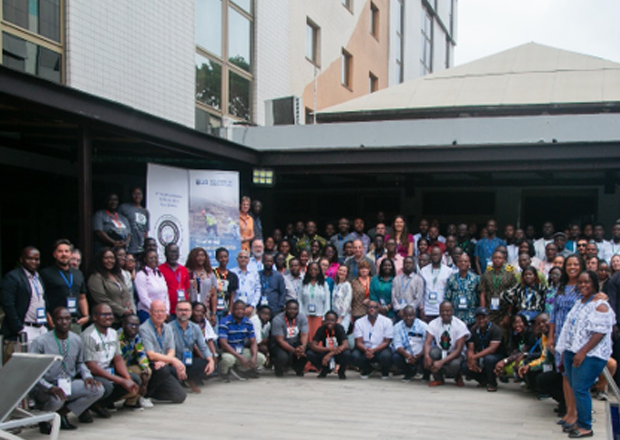
The global demand for gold, lithium, cobalt, and other critical minerals has intensified in recent years, accelerating a new industrial revolution centered on sustainable energy, technology, and infrastructure. While Africa holds some of the world’s most untapped mineral wealth, its ability to harness this potential hinges on geological expertise, advanced research, and strategic investment—factors that were prominently discussed at the International Association for Structural Geology and Tectonics (IASGT) Conference held in Accra, Ghana.
Hosted by the University of Ghana’s Department of Earth Science, in collaboration with the Centre for Exploration Targeting (CET) at the University of Western Australia and Agate Project, the conference brought together leading geoscientists, mining executives, and policymakers from across the globe. The event underscored a critical truth: Africa’s mineral wealth is not just about what lies beneath its soil—it’s about the scientific knowledge required to unlock it sustainably and profitably.
A Strategic Shift: From Resource Extraction to Geological Innovation
For decades, Africa’s mining industry has relied on traditional exploration methods, often leading to high-risk, low-reward outcomes due to limited geological understanding. However, the 2024 IASGT Conference highlighted a paradigm shift—one where structural geology, AI-driven analysis, and interdisciplinary collaboration are becoming the cornerstones of future mineral discoveries.
Prof. Manish Mamtani, a distinguished structural geologist from the Indian Institute of Technology (IIT) Kharagpur, emphasized that IASGT’s mission is to democratize geoscience research, particularly in developing nations where mineral deposits are abundant but often under-explored.
“Historically, major scientific conferences have been dominated by institutions in Europe and North America, limiting participation from Africa, South America, and Asia,” he stated. “By hosting this conference in Ghana, we are not just sharing knowledge—we are building capacity. The goal is to ensure that African researchers and industries have the tools and expertise to lead their own geological discoveries.”
This approach aligns with a global trend where emerging economies are investing in domestic scientific infrastructure to reduce reliance on foreign expertise. For Ghana—a nation whose economy remains heavily dependent on mining—this conference arrives at a pivotal moment, as it seeks to transition from being a raw material exporter to a value-added mineral processing hub.
The Role of Structural Geology in Unlocking Africa’s Hidden Treasures
At the heart of the conference was a deep dive into structural geology—the study of rock deformation, fault systems, and tectonic processes that dictate where minerals accumulate. Prof. Prince Ofori Amponsah, Head of the University of Ghana’s Department of Earth Science, stressed that without a robust understanding of geological structures, exploration efforts risk inefficiency and failure.
“Structural geology is the backbone of mineral exploration,” he explained. “It helps us predict where gold, lithium, and other critical minerals are likely to be found. In Ghana, we have some of the most promising geological formations in West Africa, but we need the right expertise to unlock them.”
His remarks resonated with industry leaders, who acknowledged that traditional mining methods are no longer sufficient in an era where easily accessible deposits are dwindling. Instead, advanced geological modeling, AI-assisted data analysis, and high-resolution subsurface mapping are now essential for discovering concealed ore bodies.
AI and Machine Learning: The Future of Mineral Exploration
While artificial intelligence (AI) and machine learning (ML) are revolutionizing mineral exploration, Prof. Mamtani warned that technology alone cannot replace fundamental geological knowledge.
“AI can process vast amounts of data, but it still relies on accurate field observations and geological interpretation,” he noted. “A geologist’s ability to read the Earth’s history is irreplaceable. What we need is a synergy between human expertise and cutting-edge technology.”
This sentiment was echoed by Prof. Mark Jessell, a renowned structural geologist from the University of Western Australia, who spoke about how fault systems in West Africa—particularly in Ghana—control the migration of mineral-rich fluids from deep within the Earth’s crust.
“In Ghana, faults and fractures act as natural conduits for gold, lithium, and other critical minerals,” Jessell explained. “By studying these structures, we can predict where new deposits are likely to form, reducing exploration risks and improving success rates.”
His insights reinforced the idea that Ghana’s geological potential is vast, but only if backed by rigorous scientific research and modern exploration techniques.
Industry Collaboration: Bridging the Gap Between Academia and Mining
One of the most notable outcomes of the conference was the strong engagement from Ghana’s mining sector, with companies like Asante Gold Corporation, AngloGold Ashanti (Obuasi Mine), and Turaco Gold actively participating. Daniel Apau, a senior executive at Asante Gold, highlighted how industry-academia partnerships are becoming critical for sustainable mining growth.
“This conference is not just about academic discussions—it’s about applying knowledge to real-world mining challenges,” Apau stated. “The more we collaborate with universities and research institutions, the better equipped we are to discover new deposits, improve efficiency, and ensure responsible mining practices.”
This industry-university synergy is particularly important for Ghana, which is expanding its critical minerals portfolio beyond gold. Lithium, cobalt, and rare earth elements—essential for electric vehicles, renewable energy storage, and advanced electronics—are increasingly in demand, and Ghana is positioning itself as a key player in this emerging market.
Beyond Mining: Geoscience for Disaster Resilience and Infrastructure Development
The conference also underscored the broader societal benefits of geoscience research. Prof. Tolulope Olugboji, a geophysicist from the University of Rochester, argued that Earth science is not just about mining—it’s about protecting lives and infrastructure.
“Geophysics helps us understand earthquake risks, groundwater availability, and land stability—all of which are crucial for urban planning and disaster preparedness,” he explained. “While Ghana is not as seismically active as some regions, fault systems still pose risks, and better monitoring can prevent catastrophic events.”
His call for increased investment in scientific instrumentation and research networks aligns with Ghana’s long-term economic strategy, which aims to reduce vulnerability to natural hazards while maximizing mineral wealth.
Ghana’s Ambition: Becoming Africa’s Geoscience Hub
Prof. Ofori Amponsah made it clear that Ghana’s long-term vision is to position itself as a regional leader in geoscience research. Through partnerships with international institutions like the University of Western Australia’s Centre for Exploration Targeting, Ghana is strengthening its research capacity and attracting global expertise.
“We want Ghana to be recognized as a destination for geoscience innovation,” he stated. “By hosting conferences like this, we are building a pipeline of skilled geologists, fostering industry-university collaborations, and ensuring that our mineral discoveries are made with precision and sustainability in mind.”
This ambition is not just about academic prestige—it’s about economic empowerment. By reducing exploration risks, improving resource management, and attracting foreign investment, Ghana can capture a larger share of the global mineral market, rather than merely exporting raw materials.
The Path Forward: Knowledge, Technology, and Collaboration
The 2024 IASGT Conference in Accra served as a watershed moment for Africa’s mining sector. It reinforced the idea that the continent’s mineral wealth is not just a resource—it’s a strategic asset that can drive economic growth, technological advancement, and sustainable development—if backed by the right scientific expertise.**
As global demand for critical minerals continues to rise, Africa’s ability to compete in the mining industry will depend on:
1. Investment in geological research to improve exploration success rates.
2. Strengthening partnerships between universities, mining companies, and international research institutions.
3. Adopting AI and machine learning to enhance data-driven mineral discovery.
4. Prioritizing environmental and social responsibility in mining operations.
For Ghana, hosting this conference was more than an academic exercise—it was a strategic move to position the country as a leader in African geoscience. If sustained, this initiative could transform Ghana from a mining nation into a geoscience powerhouse, ensuring that its mineral wealth is unlocked with intelligence, innovation, and long-term sustainability.
The message from Accra is clear: Africa’s mining future will not be defined by luck or chance—it will be shaped by the scientific knowledge and technological prowess developed today.
