


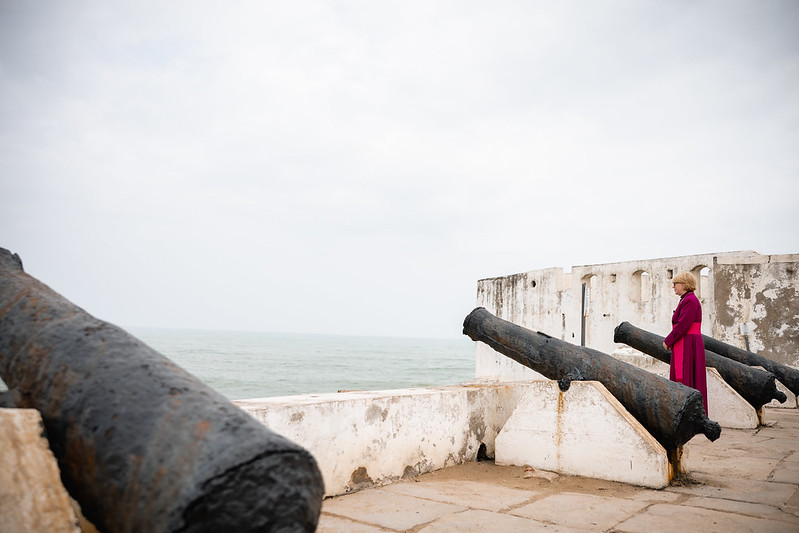
The Archbishop of Canterbury, Sarah Mullally, has undertaken a deeply reflective journey across Ghana, visiting historic sites tied to the transatlantic slave trade while addressing the Church of England’s complex legacy. Her visit, which included a solemn prayer at Cape Coast Castle—a grim symbol of the horrors endured by enslaved Africans before their forced voyage to the Americas—has reignited global conversations about reparations, historical accountability, and the Church’s moral responsibility.
A Pilgrimage of Lament and Reflection
During her tour, Archbishop Mullally led prayers in a former Anglican chapel situated above the castle’s dungeons, where enslaved men were once confined in squalid conditions. Today, the chapel serves as an educational space, but its original purpose remains a haunting reminder of the Church’s entanglement in one of history’s darkest chapters.
In a public statement, Mullally expressed profound sorrow, declaring:
“Being at Cape Coast Castle today and seeing the horrific conditions that thousands endured—it is impossible not to feel the weight of the immense evil that fueled the transatlantic slave trade. We have a God who loves each individual, yet this love was denied here. I pray not only in lament for the Church’s past role but for hope—that God’s healing may bring justice and reconciliation to those still bearing its legacy.”
Her words echoed the Church’s growing acknowledgment of its historical complicity, though critics argue the narrative is incomplete.
Project Spire: A £100 Million Reparations Fund Under Scrutiny
The Archbishop’s visit coincides with the Church of England’s controversial £100 million reparations fund, officially named the Fund for Healing, Repair and Justice. Launched in 2023, the initiative stems from research revealing that the Queen Anne’s Bounty—a predecessor to the Church Commissioners—had financial ties to transatlantic slavery through investments and benefactions.
However, the fund’s progress has faced legal and financial hurdles. Last month, the Church of England General Synod reported that its registration with the Charity Commission has been delayed due to opposition from critics who argue the initiative is misguided. Meanwhile, the Church has already allocated £1.15 million toward the project, raising questions about priorities as many parishes struggle with declining attendance and crumbling infrastructure.
Criticism from Historians and Politicians
The Archbishop’s stance has drawn sharp criticism from scholars and policymakers, who challenge the framing of reparations and the Church’s historical narrative.
Oxford professor Nigel Biggar, a leading voice on reparations debates, accused African nations of “cynical opportunism” and “astonishing hypocrisy” for demanding reparations while downplaying their own historical involvement in slavery. He argued that claims for financial restitution often distort historical realities, ignoring the complex roles played by African kingdoms—including the Ashanti Empire—in the slave trade.
Biggar’s critique aligns with that of Theologian Ian Paul, who wrote on his blog:
“The irony is that the wealth of the Ashanti Kingdom was built on slavery. The empire’s prosperity came from gold, trade, tribute—and slavery itself. The Church of England’s focus on repentance feels selective, ignoring the fact that abolition was a collective effort, not solely a Western endeavor.”
Paul further questioned why Church leaders emphasize “atonement for past sins” without acknowledging the massive efforts already made to abolish slavery, including the sacrifices of British missionaries, sailors, and abolitionists like William Wilberforce.
Bijan Omrani, author of God is an Englishman, took the debate further, questioning why Archbishop Mullally’s prayers focused solely on lament rather than gratitude for those who ended slavery. He asked:
“Why isn’t there prayer for the clergy, politicians, and ordinary people who worked tirelessly to abolish slavery? For the British missionaries and sailors who risked their lives in this cause? And why isn’t there acknowledgment of Ghanaian elites’ own deep complicity in the trade?”
Parish Crises and the Politics of Priorities
The reparations debate has also become a symbolic battleground for the Church’s financial priorities. Conservative MP Nick Timothy criticized the fund as “gesture politics” at a time when local parishes are on the brink of collapse. He argued:
“Churches in West Suffolk are struggling to keep their roofs from caving in. Many have historic architectural value—part of our national heritage. Yet Lambeth Palace diverts £100 million to reparations while our churches crumble. This is grotesque.”
Timothy’s remarks reflect broader concerns among conservatives who view reparations as a distraction from the Church’s immediate crises, including declining membership, rising costs, and the loss of cultural relevance.
Former Queen’s Chaplain Gavin Ashenden went further, calling the Archbishop’s approach “reckless” and “historically inaccurate.” He defended the abolitionist legacy, noting that:
“William Wilberforce and the Clapham Sect achieved what no one thought possible—they ended Britain’s slave trade. The British Navy enforced abolition on the high seas at enormous economic and human cost. The Archbishop’s focus on guilt ignores the fact that the Church was also instrumental in ending slavery.”
Military historian Robert Lyman echoed this sentiment, stating:
“At the parish level, we are ignored. The Church’s obsession with reparations ignores the very people who built it—the worshippers in the pews. The argument that our evangelical ancestors stopped slavery is dismissed as an ‘uncomfortable truth.’ But who is the Church for? The evidence is clear: it’s not for the local congregation.”
A Call for Reconciliation or a Distraction?
Archbishop Mullally’s visit to Ghana underscores the complexity of historical justice. While her prayers at Cape Coast Castle symbolize the Church’s acknowledgment of past wrongs, critics argue that reparations—without broader historical context—risk oversimplifying a multi-layered tragedy.
The debate extends beyond finance: Who bears responsibility for slavery’s legacy? Is it solely the institutions of Europe, or must African nations also confront their roles? And if reparations are to be paid, how should the funds be distributed—to descendants of enslaved people, to Ghanaian infrastructure, or to global anti-racism efforts?
As the Church of England navigates these questions, one thing remains certain: the conversation has only just begun.

Archbishop Sarah Mullally during her visit to Cape Coast Castle, where she prayed in a former Anglican chapel above the dungeons where enslaved Africans were once held.
[IMAGE_2]
The throne of the Ashanti King, a symbol of the empire’s wealth built partly on the backs of enslaved laborers, raising questions about historical complicity in the slave trade.
